. 2010 Feb 2;107(5):2253-8.
doi: 10.1073/pnas.0909144107. Epub 2010 Jan 19.

ISG15 conjugation system targets the viral NS1 protein in influenza A virus-infected cells

Affiliations

ISG15 conjugation system targets the viral NS1 protein in influenza A virus-infected cells

Chen Zhao et al. Proc Natl Acad Sci U S A. .

Abstract

ISG15 is an IFN-alpha/beta-induced, ubiquitin-like protein that is conjugated to a wide array of cellular proteins through the sequential action of three conjugation enzymes that are also induced by IFN-alpha/beta. Recent studies showed that ISG15 and/or its conjugates play an important role in protecting cells from infection by several viruses, including influenza A virus. However, the mechanism by which ISG15 modification exerts antiviral activity has not been established. Here we extend the repertoire of ISG15 targets to a viral protein by demonstrating that the NS1 protein of influenza A virus (NS1A protein), an essential, multifunctional protein, is ISG15 modified in virus-infected cells. We demonstrate that the major ISG15 acceptor site in the NS1A protein in infected cells is a critical lysine residue (K41) in the N-terminal RNA-binding domain (RBD). ISG15 modification of K41 disrupts the association of the NS1A RBD domain with importin-alpha, the protein that mediates nuclear import of the NS1A protein, whereas the RBD retains its double-stranded RNA-binding activity. Most significantly, we show that ISG15 modification of K41 inhibits influenza A virus replication and thus contributes to the antiviral action of IFN-beta. We also show that the NS1A protein directly and specifically binds to Herc5, the major E3 ligase for ISG15 conjugation in human cells. These results establish a "loss of function" mechanism for the antiviral activity of the IFN-induced ISG15 conjugation system, namely, that it inhibits viral replication by conjugating ISG15 to a specific viral protein, thereby inhibiting its function.


Conflict of interest statement

The authors declare no conflict of interest.

Figures
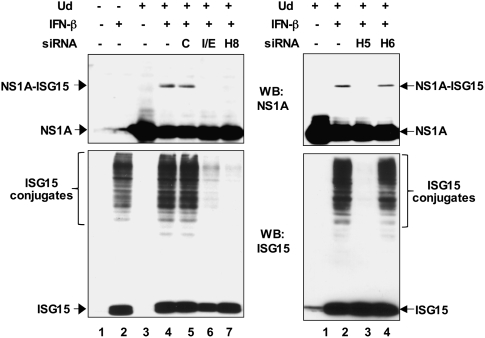
Fig. 1.
Fig. 1.
Influenza NS1A protein is conjugated to ISG15 in infected cells. Where indicated, A549 cells were transfected for 24 h with either control siRNA (C) or siRNA targeting ISG15 and/or its conjugation enzymes: ISG15+Ube1L (I/E), UbcH8 (H8), Herc5 (H5); or siRNA targeting Herc6 (H6). Cells were treated with IFN-β for 24 h and then infected with 5 pfu/cell of Ud virus. Cell extracts prepared from cells collected at 8 h after infection were immunoblotted with either anti-ISG15 or anti-NS1A antibody.
Fig. 2.
Fig. 2.
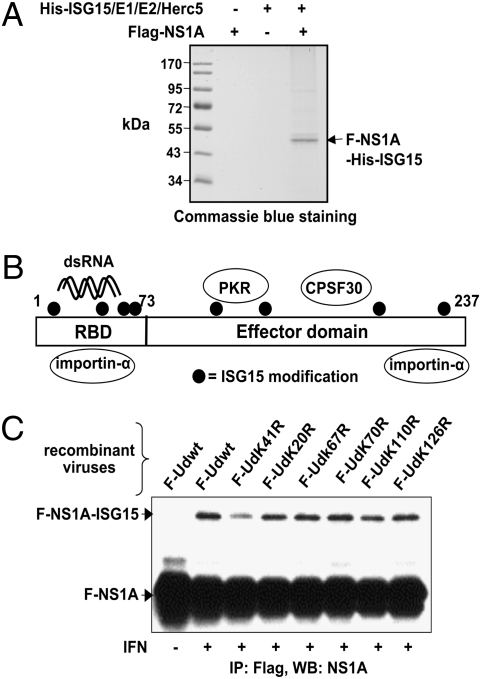
Identification of the ISG15 conjugation sites in the NS1A protein. (A) Flag-tagged Ud NS1A was expressed alone or together with His-ISG15 conjugation system in 293T cells by transient transfection. The Flag-NS1A-His-ISG15 conjugate was purified and resolved by gel electrophoresis, as described in Materials and Methods, and was analyzed by mass spectrometry. (B) Location of the ISG15-conjugated lysines identified by mass spectrometry (K20, K41, K67, K70, K110, K126, K196, and K219) in the NS1A protein (Table S1). The positions of the binding sites of several cellular proteins are denoted. (C) A549 cells, with or without IFN pretreatment, were infected with 5 pfu/cell of a recombinant Ud virus expressing the indicated Flag-NS1A (F-NS1A) protein. Infected cell extracts were selected and purified by anti-Flag M2 agarose, followed by immunoblotting using anti-NS1A antibody.
Fig. 3.
Fig. 3.
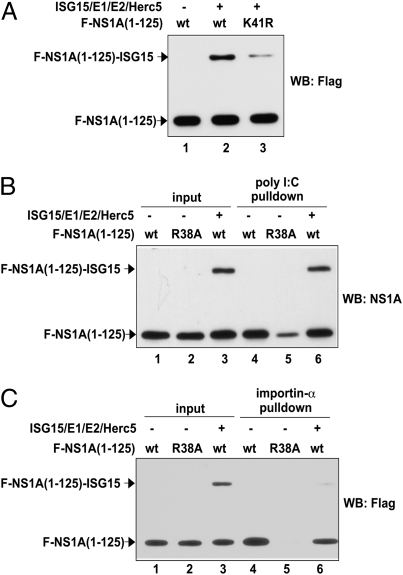
ISG15 conjugation of K41 of the NS1A protein selectively disrupts the interaction of its RBD with importin-α. (A) Flag-NS1A(1-125), its K41R mutant, or its R38A mutant were expressed in 293T cells by transfection in the presence or absence of the ISG15 conjugation system, and cell extracts were analyzed using an immunoblot probed by anti-Flag antibody. (B) Extracts of 293T cells transfected with the indicated plasmids were bound to agarose beads coupled to poly(I:C), and the eluant was immunoblotted using anti-NS1A antibody. (C) The same extracts were bound to glutathione beads containing GST-importin-α, and the eluant was immunoblotted using anti-Flag antibody.
Fig. 4.
Fig. 4.
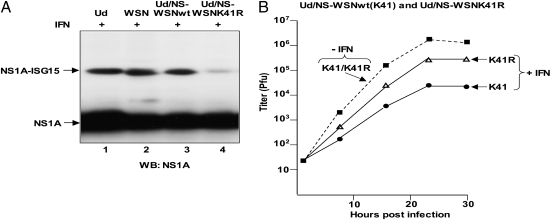
ISG15 modification of K41 of the NS1A protein inhibits influenza A virus replication. (A) IFN-β–pretreated A549 cells were infected with the indicated viruses: Ud, WSN, and recombinant Ud viruses expressing either the WSN NS1A protein (Ud/NS-WSN) or the WSN NS1A K41R mutant protein (Ud/NS-WSNK41R). Cell extracts were immunoblotted using anti-NS1A antibody. (B) HeLa Tet-on cells, with (+IFN) or without (-IFN) pretreatment with IFN-β, were infected with 0.1 pfu/cell of either Ud/NS-WSNwt or Ud/NS-WSNK41R virus, and virus production was determined by plaque assay in MDCK cells.
Fig. 5.
Fig. 5.
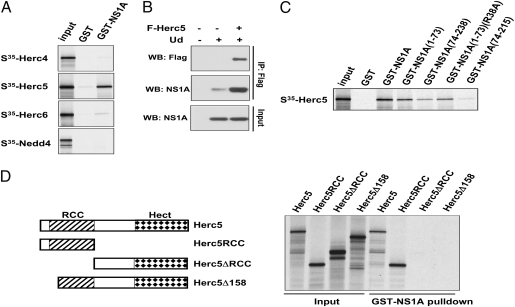
The NS1A protein interacts directly with Herc5 ISG15 E3 ligase. (A) 35S-labeled Herc5 protein and three other E3 ligases (Herc4, Herc6, and Nedd4) were subjected to a pulldown assay with glutathione beads containing either GST or GST-NS1A protein purified from bacteria. (B) 293T cells were transfected with a plasmid expressing Flag-tagged Herc5 (F-Herc5) and then infected with Ud virus. Cell extracts were immunoprecipitated with anti-Flag M2 agarose, followed by immunoblots probed with anti-Flag or anti-NS1A antibody. (C) 35S-labeled Herc5 pulldown assay performed with GST-NS1A protein and GST fused to the indicated NS1A mutant proteins. (D) Pulldown assays performed between purified GST-NS1A and 35S-labeled Herc5 deletion mutants. For A–D, the input represents 10% of the total.

References

    1. Haas AL, Ahrens P, Bright PM, Ankel H. Interferon induces a 15-kilodalton protein exhibiting marked homology to ubiquitin. J Biol Chem. 1987;262:11315–11323. - PubMed
    1. Yuan W, Krug RM. Influenza B virus NS1 protein inhibits conjugation of the interferon (IFN)-induced ubiquitin-like ISG15 protein. EMBO J. 2001;20:362–371. - PMC - PubMed
    1. Zhao C, et al. The UbcH8 ubiquitin E2 enzyme is also the E2 enzyme for ISG15, an IFN-alpha/beta-induced ubiquitin-like protein. Proc Natl Acad Sci USA. 2004;101:7578–7582. - PMC - PubMed
    1. Kim KI, Giannakopoulos NV, Virgin HW, Zhang DE. Interferon-inducible ubiquitin E2, Ubc8, is a conjugating enzyme for protein ISGylation. Mol Cell Biol. 2004;24:9592–9600. - PMC - PubMed
    1. Dastur A, Beaudenon S, Kelley M, Krug RM, Huibregtse JM. Herc5, an interferon-induced HECT E3 enzyme, is required for conjugation of ISG15 in human cells. J Biol Chem. 2006;281:4334–4338. - PubMed

Publication types

MeSH terms