. 2010 Apr;11(4):305-11.
doi: 10.1038/embor.2010.6. Epub 2010 Feb 5.

A domesticated transposon mediates the effects of a single-nucleotide polymorphism responsible for enhanced muscle growth

Affiliations

A domesticated transposon mediates the effects of a single-nucleotide polymorphism responsible for enhanced muscle growth

Falk Butter et al. EMBO Rep. 2010 Apr.

Abstract

Single-nucleotide polymorphisms (SNPs) in the regulatory regions of the genome can have a profound impact on phenotype. The G3072A polymorphism in intron 3 of insulin-like growth factor 2 (IGF2) is implicated in higher muscle content and reduced fat in European pigs and is bound by a putative repressor. Here, we identify this repressor--which we call muscle growth regulator (MGR)--by using a DNA protein interaction screen based on quantitative mass spectrometry. MGR has a bipartite nuclear localization signal, two BED-type zinc fingers and is highly conserved between placental mammals. Surprisingly, the gene is located in an intron and belongs to the hobo-Ac-Tam3 transposase superfamily, suggesting regulatory use of a formerly parasitic element. In transactivation assays, MGR differentially represses the expression of the two SNP variants. Knockdown of MGR in C2C12 myoblast cells upregulates Igf2 expression and mild overexpression retards growth. Thus, MGR is the repressor responsible for enhanced muscle growth in the IGF2 G3072A polymorphism in commercially bred pigs.


Conflict of interest statement

The authors declare that they have no conflict of interest.

Figures
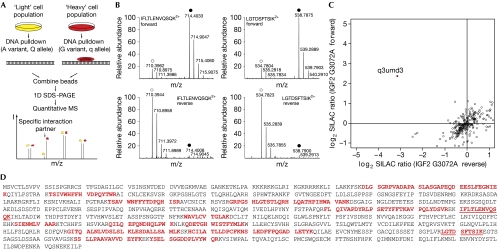
Figure 1
Figure 1
Identification of muscle growth regulator. (A) A schematic of the quantitative-SILAC-based DNA interaction screen with DNA oligonucleotides containing either the q variant or Q variant of the SNP. Specific interaction partners are differentiated from background binders by having a SILAC ratio other than 1:1. (B) The mass spectrum of two representative peptides of MGR detected in the quantitative MS screen for differential interaction partners. In the forward pulldown, the heavy form of the peptides IFLTLENVQSQK2+ and LGTDSFTSIK2+ are enriched over the light form (q variant of the SNP incubated with heavy extract, filled circle), whereas in the reverse pulldown the light form of the peptide is enriched (q variant of the SNP incubated with light extract, open circle). (C) Two-dimensional interaction plot for all detected proteins shows specific enrichment of a single protein (Uniprot entry q3umd3) with the q-probe against the Q-probe. (D) The complete open reading frame of the MGR gene, with identified peptides from the three pulldowns (bold red). MGR, muscle growth regulator; MS, mass spectrometry; SDS-PAGE, SDS-polyacrylamide gel electrophoresis; SILAC, stable isotope labelling with amino acids in cell culture; SNP, single-nucleotide polymorphism.
Figure 2
Figure 2
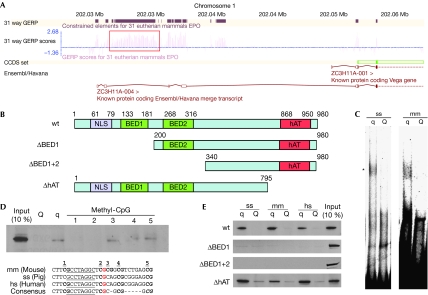
Characterization of muscle growth regulator. (A) A schematic of the genomic region containing the MGR from Ensembl. MGR is a single-exon gene (red box) contained in the intronic region of ZC3H11A. This region shows high conservation (GERP) scores in placental mammals. (B) A schematic of MGR (wt) and the constructed deletion variants. MGR contains four annotated domains: a classical nuclear localization signal (NLS), two BED-type zinc fingers and a hAT domain. (C) The recombinant murine MGR (asterisk indicates the protein–DNA complex) shifts with the q variant of the SNP, but not with the Q variant at the porcine and murine Igf2 sequence. (D) Methylation-dependent binding is observed for the two methyl-CpG islands directly adjacent to the palindromic sequence. (E) The murine full-length and ΔhAT MGR bind to the q variant, but not the Q variant of mouse, pig and human sequence in DNA pulldown experiments with recombinant GFP–MGR. Deletion variants of the first or both BED fingers are not able to bind to any Igf2 sequence. GERP, Genomic Evolutionary Rate Profiling; GFP, green fluorescent protein; hs, Homo sapiens; MGR, muscle growth regulator; mm, Mus musculus; SNP, single-nucleotide polymorphism; ss, Sus scrofa; wt, wild type.
Figure 3
Figure 3
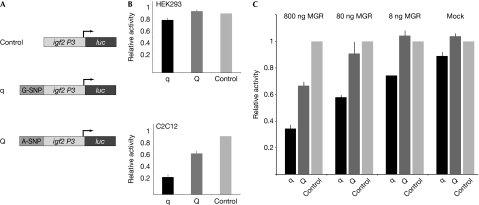
Muscle growth regulator functions as a repressor for Igf2. (A) The schema of the transactivation constructs. (B) Transfections of reporter gene constructs in HEK293 cells show only slight repression for the q allele, whereas in C2C12 myoblast cells the reporter construct shows stronger repression at the q allele together with partial repression of the Q allele. (C) Co-transfection of MGR results in dosage-dependent repression of the q allele (for 80 ng GFP–MGR repression at the q variant is 30±3% compared with that at the Q variant, which is 9±4%), which can mimic the repression pattern observed in C2C12 cells at 800 ng co-transfected MGR. GFP, green fluorescent protein; HEK, human embryonic kidney; MGR, muscle growth regulator.
Figure 4
Figure 4
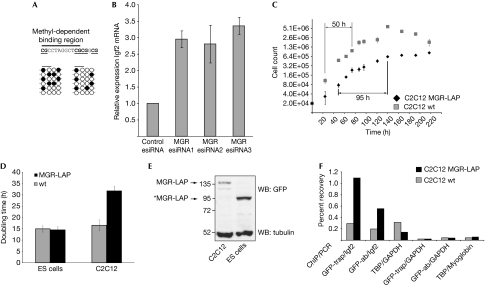
Functional validation of muscle growth regulator in vivo. (A) Bisulphite sequencing of the binding region of MGR in C2C12 cells. (B) RNA interference with three independent esiRNAs shows threefold Igf2 upregulation in proliferating, subconfluent C2C12 cells. (C,D) Growth curves of C2C12-LAP and wild-type cell lines show an at least twofold increase in doubling times for the MGR-LAP cell line. An embryonic stem cell line containing the identical BAC construct has no significant growth differences compared with the wild type. (E) Immunoblot of C2C12-LAP and mES-LAP shows expression of an amino-terminal truncated version of MGR-LAP (indicated by the asterisk) missing the nuclear localization signal and the DNA-binding domain. (F) ChIP shows tenfold (GFP-nanotrap) and sixfold (antibody) higher recovery in C2C12-LAP in comparison with that in wild-type cells (after normalization on TBP/GAPDH). BAC, bacterial artificial chromosome; ChIP, chromatin immunoprecipitation; ES cells, embryonic stem cells; esiRNA, endoribonuclease-prepared small interfering RNA; GAPDH, glyceraldehyde 3-phosphate dehydrogenase; GFP, green fluorescent protein; MGR, muscle growth regulator; TBP, TATA box binding protein; WB, western blot; wt, wild type.

Comment in

References

    1. Aravind L (2000) The BED finger, a novel DNA-binding domain in chromatin-boundary-element-binding proteins and transposases. Trends Biochem Sci 25: 421–423 - PubMed
    1. Brinkman AB, Pennings SW, Braliou GG, Rietveld LE, Stunnenberg HG (2007) DNA methylation immediately adjacent to active histone marking does not silence transcription. Nucleic Acids Res 35: 801–811 - PMC - PubMed
    1. Cheeseman IM, Desai A (2005) A combined approach for the localization and tandem affinity purification of protein complexes from metazoans. Sci STKE 2005: pl1. - PubMed
    1. Cooper GM, Stone EA, Asimenos G, Green ED, Batzoglou S, Sidow A (2005) Distribution and intensity of constraint in mammalian genomic sequence. Genome Res 15: 901–913 - PMC - PubMed
    1. Estelle J, Mercade A, Noguera JL, Perez-Enciso M, Ovilo C, Sanchez A, Folch JM (2005) Effect of the porcine IGF2-intron3-G3072A substitution in an outbred Large White population and in an Iberian x Landrace cross. J Anim Sci 83: 2723–2728 - PubMed

Publication types

MeSH terms

Substances