. 2010 Feb;159(4):787-96.
doi: 10.1111/j.1476-5381.2009.00608.x. Epub 2010 Feb 5.

Fluorescent ligand binding reveals heterogeneous distribution of adrenoceptors and 'cannabinoid-like' receptors in small arteries

Affiliations

Fluorescent ligand binding reveals heterogeneous distribution of adrenoceptors and 'cannabinoid-like' receptors in small arteries

C J Daly et al. Br J Pharmacol. 2010 Feb.

Abstract

Background and purpose: Pharmacological analysis of synergism or functional antagonism between different receptors commonly assumes that interacting receptors are located in the same cells. We have now investigated the distribution of alpha-adrenoceptors, beta-adrenoceptors and cannabinoid-like (GPR55) receptors in the mouse arteries.

Experimental approach: Fluorescence intensity from vascular tissue incubated with fluorescent ligands (alpha(1)-adrenoceptor ligand, BODIPY-FL-prazosin, QAPB; beta-adrenoceptor ligand, TMR-CGP12177; fluorescent angiotensin II; a novel diarylpyrazole cannabinoid ligand (Tocrifluor 1117, T1117) was measured with confocal microscopy. Small mesenteric and tail arteries of wild-type and alpha(1B/D)-adrenoceptor-KO mice were used.

Key results: T1117, a fluorescent form of the cannabinoid CB(1) receptor antagonist AM251, was a ligand for GPR55, with low affinity for CB(1) receptors. In mesenteric arterial smooth muscle cells, alpha(1A)-adrenoceptors were predominantly located in different cells from those with beta-adrenoceptors, angiotensin receptors or cannabinoid-like (GPR55) receptors. Cells with beta-adrenoceptors predominated at arterial branches. Endothelial cells expressed beta-adrenoceptors, alpha-adrenoceptors and cannabinoid-like receptors. Only endothelial alpha-adrenoceptors appeared in clusters. Adventitia was a rich source of G protein-coupled receptors (GPCRs), particularly fibroblasts and nerve tracts, where Schwann cells bound alpha-adrenoceptor, beta-adrenoceptor and CB-receptor ligands, with a mix of separate receptor locations and co-localization.

Conclusions and implications: Within each cell type, each GPCR had a distinctive heterogeneous distribution with limited co-localization, providing a guide to the possibilities for functional synergism, and suggesting a new paradigm for synergism in which interactions may be either between cells or involve converging intracellular signalling processes.


Figures
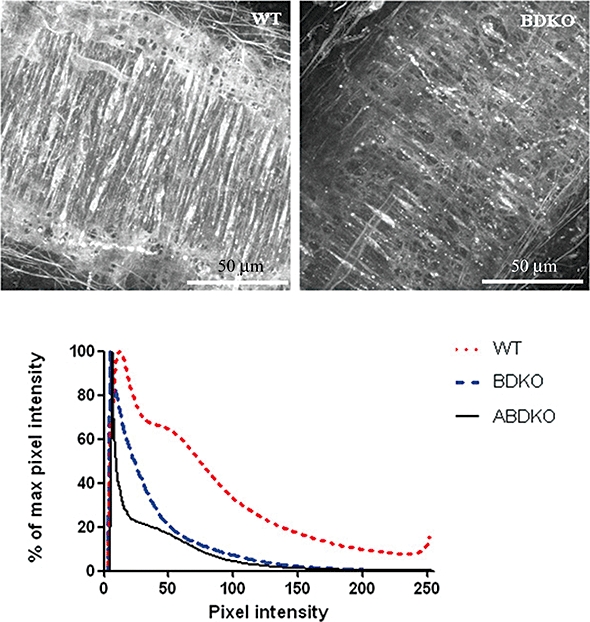
Figure 1
Figure 1
QAPB binding (1 µM) in MMA taken from WT, α1BD- and α1ABD-adrenoceptor knockout (KO) mice. Reduced binding was observed in arteries from both KO mice. Histogram analysis of image stacks from six samples from WT, five from BDKO and one from ABD KO shows an overall reduction in total fluorescence/binding in KO arteries throughout the vascular wall.
Figure 2
Figure 2
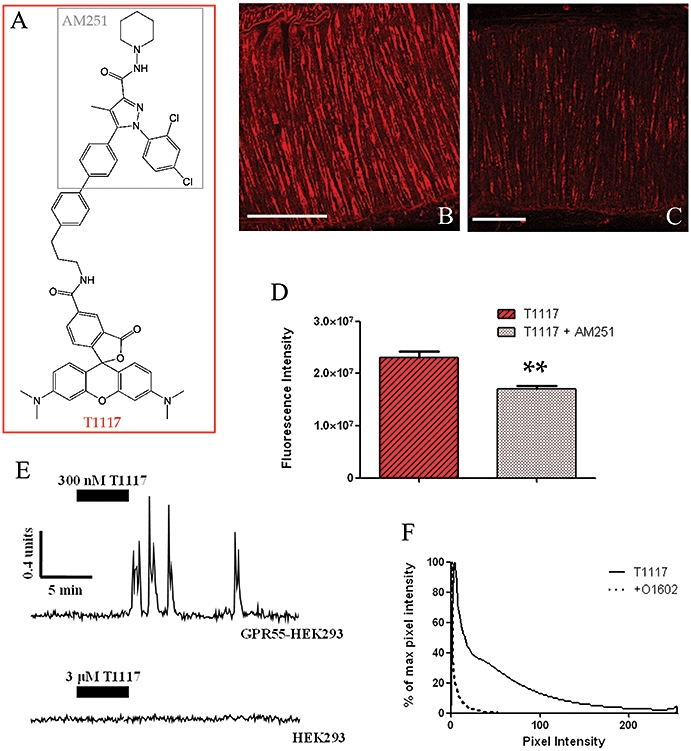
Characterization of the novel fluorescent cannabinoid ligand T1117. (A) The structure of T1117 is derived from the combination of tetramethylrhodamine and AM251. (B) Confocal scan of the media of a WT MMA segment after incubation with 0.3 µM T1117 (size bar 50 µm). (C) Following pre-incubation with non-fluorescent AM251 (3 µM), the T1117 binding-induced fluorescence is reduced (size bar 50 µm). (D) Quantitative fluorescence measurement of the T1117 binding in the presence and absence of AM251. Images shown in (B) and (C) are representative of those used for calculations in (D) (n= 3). (E) Representative tracing of the Ca2+ response induced by T1117 in GPR55-HEK293 and in control (HEK293) cells (tracing representative of n= 3). (F) Histogram analysis of z-series fluorescence (seven z-series from n= 3 each) shows a marked reduction in fluorescence induced by T1117 (0.3 µM), after exposure to the GPR55 agonist O1602 (10 µM).
Figure 3
Figure 3
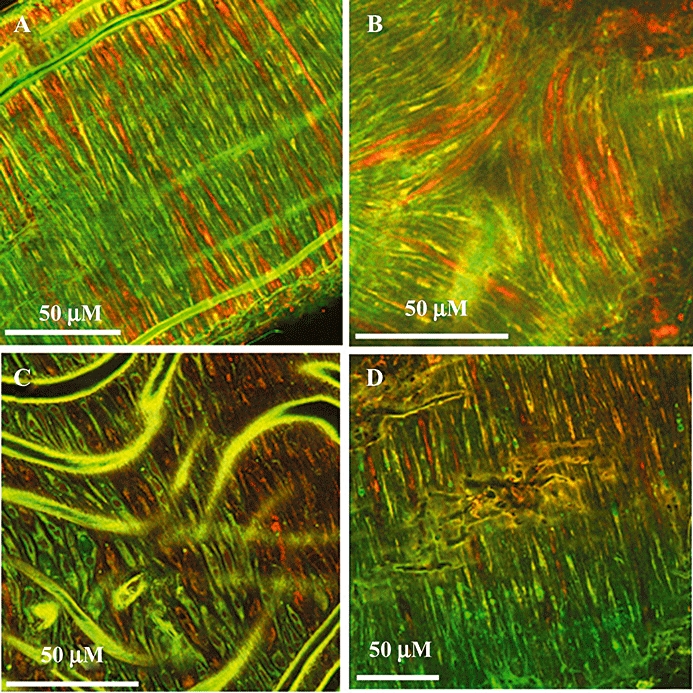
Fluorescent ligand co-localization in mouse vascular smooth muscle. (A and B) Binding of both QAPB and BODIPY-TMR-CGP12177 [both (1 µM) in MMA from BDKO mice] shows a combination of cells expressing mainly α1-adrenoceptors (green), mainly β-adrenoceptors (red) or both in relatively equal amounts (yellow). WT mesenteric arteries showed a similar pattern (see Supporting Information Video Clip S1) (B) A predominance of β-adrenoceptors was observed around the mesenteric branch points (see also Supporting Information Video Clip S2). (C) A similar heterogeneity was observed when combining QAPB (1 µM) with TMR-angiotensin II (0.3 µM) in WT carotid artery, or (D) combining QAPB (1 µM) with the fluorescent cannabinoid ligand T1117 (0.3 µM) in WT MMA. In all cases, images are representative of at least n= 3.
Figure 4
Figure 4
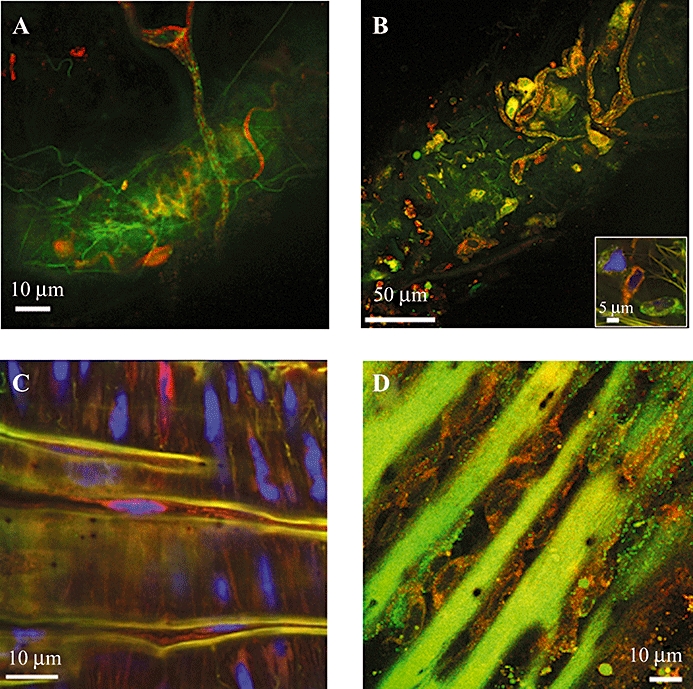
Fluorescent ligand binding in vascular adventitial and endothelial cells. In all images, QAPB (1 µM) is present and shown in green. (A) α1A- and β-adrenoceptors (TMR-CGP12177, 1 µM) are present, but not co-localized, on nerve cells of MMA from a BDKO mouse (see Supporting Information Video Clip S3). (B) Nerve cells also appear to express binding sites for T1117 (0.3 µM) which do co-localize, in certain areas, with α1-adrenoceptors. Insert image shows a group of adventitial cells mainly expressing either α1-adrenoceptors (green) or cannabinoid-like receptors (red). (C) β-Adrenoceptors are present on MMA (ABD-KO) endothelial cells (see Supporting Information Video Clip S5). (D) α1-Adrenoceptors (QAPB, green) are expressed on endothelial cells of rat tail artery which also express binding sites for T1117. In all cases, images are representative of at least n= 3.

References

    1. Alexander SPH, Mathie A, Peters JA. Guide to Receptors and Channels (GRAC), 3rd edition. Br J Pharmacol. 2008;153(Suppl. 2):S1–S209. - PMC - PubMed
    1. de Andrade CR, Fukada SY, Olivon VC, de Godoy MA, Haddad R, Eberlin MN, et al. Alpha1D-adrenoceptor-induced relaxation on rat carotid artery is impaired during the endothelial dysfunction evoked in the early stages of hyperhomocysteinemia. Eur J Pharmacol. 2006;543:83–91. - PubMed
    1. Baker GJ, Hall IP, Hill SJ. Pharmacology and direct visualisation of BODIPY-TMR-CGP: a long-acting fluorescent β2-adrenoceptor agonist. Br J Pharmacol. 2003;139:232–242. - PMC - PubMed
    1. Briones AM, Daly CJ, Jimenez-Altayo F, Martinez-Revelles S, Gonzalez JM, McGrath JC, et al. Direct demonstration of β1- and evidence against β2- and β3-adrenoceptors, in smooth muscle cells of rat small mesenteric arteries. Br J Pharmacol. 2005;146:679–691. - PMC - PubMed
    1. Daly CJ, McGrath JC. Fluorescent ligands, antibodies & proteins for the study of receptors. Pharmacol Ther. 2003;100:101–118. - PubMed

Publication types

MeSH terms