


Efficacy of Lactic Acid Bacteria (LAB) supplement in management of constipation among nursing home residents
- PMID: 20137076
- PMCID: PMC2835640
- DOI: 10.1186/1475-2891-9-5
Efficacy of Lactic Acid Bacteria (LAB) supplement in management of constipation among nursing home residents
Abstract
Background: Constipation is a significant problem in the elderly, specifically nursing home and/or extended-care facility residents are reported to suffer from constipation. Lactic acid bacteria (LAB) are beneficial probiotic organisms that contribute to improved nutrition, microbial balance, and immuno-enhancement of the intestinal tract, as well as diarrhea and constipation effect. The objective of this study was to investigate the efficacy of this LAB supplement in the management of nursing home residents.
Methods: Nineteen subjects (8M, 11F; mean age 77.1 +/- 10.1) suffering with chronic constipation were assigned to receive LAB (3.0 x 10(11) CFU/g) twice (to be taken 30 minutes after breakfast and dinner) a day for 2 weeks in November 2008. Subjects draw up a questionnaire on defecation habits (frequency of defecation, amount and state of stool), and we collected fecal samples from the subjects both before entering and after ending the trial, to investigate LAB levels and inhibition of harmful enzyme activities. Results were tested with SAS and Student's t-test.
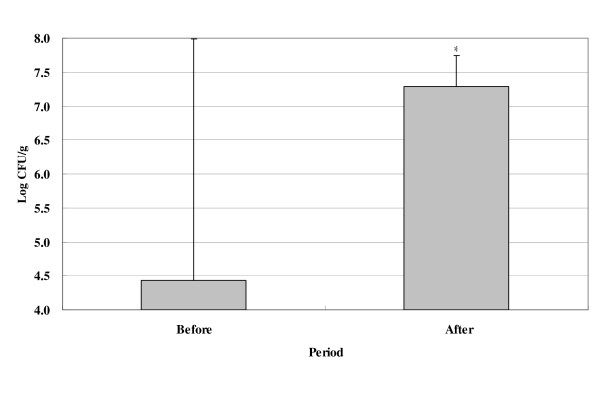
Results: Analysis of questionnaire showed that there was an increase in the frequency of defecation and amount of stool excreted in defecation habit after LAB treatment, but there were no significant changes. And it also affects the intestinal environment, through significantly increase (p < 0.05) fecal LAB levels. In addition, tryptophanase and urease among harmful enzyme activities of intestinal microflora were significantly decreased (p < 0.05) after LAB treatment.
Conclusion: LAB, when added to the standard treatment regimen for nursing home residents with chronic constipation, increased defecation habit such as frequency of defecation, amount and state of stool. So, it may be used as functional probiotics to improve human health by helping to prevent constipation.
Figures
References
-
- Bosaeus I. Fibre effects on intestinal functions (diarrhea, constipation and irritable bowel syndrome) Clin Nutr Suppliments. 2004;1:33–38. doi: 10.1016/j.clnu.2004.09.006. - DOI
-
- Volicer L, Lane P, Panke J, Lyman P. Management of constipation in residents with dementia: Sorbitol effectiveness and cost. J Am Med Dir Assoc. 2004;5:239–241. - PubMed
-
- Frank L, Schmier J, Kleinman L. Time and economic cost of constipation care in nursing homes. J Am Med Dir Assoc. 2002;3:215–223. - PubMed
-
- Kim JH, Kim HJ, Son JH, Chun HN, Yang JO, Choi SJ, Park NS, Choi GH, Kim SK. Effect of Lactobacillus fermentum MG590 on alchole Metabolism and liver function in rats. J Microbial Biotechno. 2003;13:919–925.
Publication types
MeSH terms
Substances
LinkOut - more resources
Full Text Sources
Medical
Miscellaneous
