


Review
doi: 10.1016/j.coi.2010.01.007.
Innate antiviral immunity in Drosophila
Affiliations
- PMID: 20137906
- PMCID: PMC2831143
- DOI: 10.1016/j.coi.2010.01.007
Item in Clipboard
Review
Innate antiviral immunity in Drosophila
Curr Opin Immunol.
2010 Feb.
Abstract
The study of Drosophila, and other genetically tractable insects, has expanded our understanding of innate immunity and more recently antiviral innate mechanisms. The Drosophila antiviral program includes inflammatory signaling cascades as well as antiviral RNA silencing and autophagy. This review will highlight the recent discoveries in antiviral immunity in insects and will reveal some of the lessons learned.
Copyright 2010 Elsevier Ltd. All rights reserved.
Figures
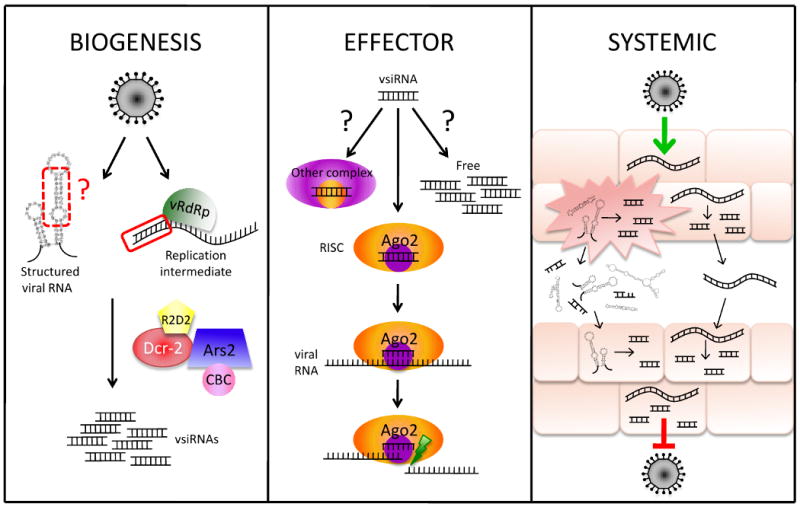
The biogenesis of virus-derived siRNAs (vsiRNAs) is mediated by Dcr-2, which recognizes dsRNA produced by the viral RNA-dependent RNA polymerase (vRdRp) or structured regions of single stranded viral RNA (left panel). Dcr-2 complexes with R2D2 and Ars2, which is required for efficient dsRNA processing and interacts with the nuclear cap binding complex (CBC) (left panel). Following vsiRNA biogenesis, Ago2 mediates the effector step of antiviral silencing through RISC-mediated cleavage of viral RNA (middle panel). The vsiRNAs not bound to Ago2 remain stabilized, either in another complex or free in the cytoplasm. A potential model for systemic antiviral RNAi is depicted at right. Viral RNA produced during infection is released extracellularly, either by controlled export or by lysis of the infected cell. The RNA is then internalized and processed by uninfected cells, protecting them from subsequent infection.

Four pathways including three classical immune signaling pathways (Toll, Imd, Jak-STAT) are responsive to infection by different viruses (blue text) based on studies in both Drosophila and mosquitoes (italics). The Toll pathway, responsive to fungi and gram-positive bacteria, has been found to be antiviral in response to infection by Drosophila X and Dengue viruses. The Imd pathway, responsive to gram-negative bacteria, is antiviral in response to infection with Sindbis and Cricket Paralysis viruses. The Jak-STAT pathway restricts infection by Drosophila C and Dengue viruses. Some downstream effectors were induced by infection (red text, italicized for studies in mosquitoes). In addition, Drosophila recognize VSV via the glycoprotein VSV-G (the PAMP), through an unidentified PRR which leads to attenuation of nutrient signaling, likely at the level of PI3K. Repression of this pathway results in the induction of antiviral autophagy which attenuates VSV replication.
References
-
- Lemaitre B, Nicolas E, Michaut L, Reichhart JM, Hoffmann JA. The dorsoventral regulatory gene cassette spatzle/Toll/cactus controls the potent antifungal response in Drosophila adults. Cell. 1996;86:973–983. - PubMed
-
- Pinheiro VB, Ellar DJ. How to kill a mocking bug? Cell Microbiol. 2006;8:545–557. - PubMed
-
- Schneider D. Using Drosophila as a model insect. Nat Rev Genet. 2000;1:218–226. - PubMed
-
- Veraksa A, Del Campo M, McGinnis W. Developmental patterning genes and their conserved functions: from model organisms to humans. Mol Genet Metab. 2000;69:85–100. - PubMed
Publication types
MeSH terms
Grants and funding
LinkOut - more resources
Full Text Sources
Molecular Biology Databases
