


Arabidopsis IWS1 interacts with transcription factor BES1 and is involved in plant steroid hormone brassinosteroid regulated gene expression
- PMID: 20139304
- PMCID: PMC2840484
- DOI: 10.1073/pnas.0909198107
Arabidopsis IWS1 interacts with transcription factor BES1 and is involved in plant steroid hormone brassinosteroid regulated gene expression
Abstract
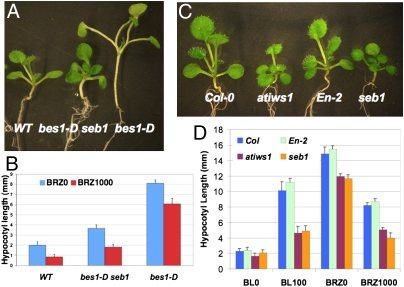
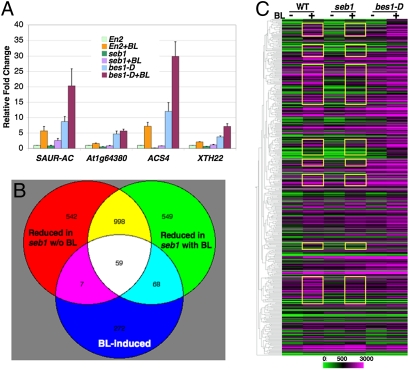
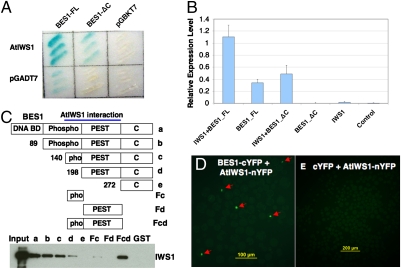
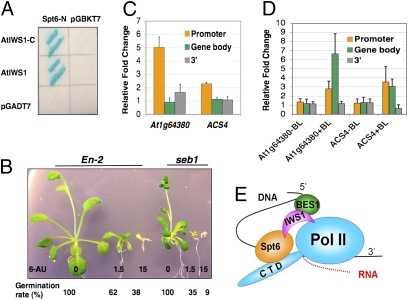
Plant steroid hormones, brassinosteroids (BRs), regulate essential growth and developmental processes. BRs signal through membrane-localized receptor BRI1 and several other signaling components to regulate the BES1 and BZR1 family transcription factors, which in turn control the expression of hundreds of target genes. However, knowledge about the transcriptional mechanisms by which BES1/BZR1 regulate gene expression is limited. By a forward genetic approach, we have discovered that Arabidopsis thaliana Interact-With-Spt6 (AtIWS1), an evolutionarily conserved protein implicated in RNA polymerase II (RNAPII) postrecruitment and transcriptional elongation processes, is required for BR-induced gene expression. Loss-of-function mutations in AtIWS1 lead to overall dwarfism in Arabidopsis, reduced BR response, genome-wide decrease in BR-induced gene expression, and hypersensitivity to a transcription elongation inhibitor. Moreover, AtIWS1 interacts with BES1 both in vitro and in vivo. Chromatin immunoprecipitation experiments demonstrated that the presence of AtIWS1 is enriched in transcribed as well as promoter regions of the target genes under BR-induced conditions. Our results suggest that AtIWS1 is recruited to target genes by BES1 to promote gene expression during transcription elongation process. Recent genomic studies have indicated that a large number of genes could be regulated at steps after RNAPII recruitment; however, the mechanisms for such regulation have not been well established. The study therefore not only establishes an important role for AtIWS1 in plant steroid-induced gene expression but also suggests an exciting possibility that IWS1 protein can function as a target for pathway-specific activators, thereby providing a unique mechanism for the control of gene expression.
Conflict of interest statement
The authors declare no conflict of interest.
Figures
References
-
- Li J, Chory J. Brassinosteroid actions in plants. J Exp Bot. 1999;50:332–340.
-
- Clouse SD. Molecular genetic studies confirm the role of brassinosteroids in plant growth and development. Plant J. 1996;10:1–8. - PubMed
-
- Wang X, et al. Sequential transphosphorylation of the BRI1/BAK1 receptor kinase complex impacts early events in brassinosteroid signaling. Dev Cell. 2008;15:220–235. - PubMed
-
- Li J, Jin H. Regulation of brassinosteroid signaling. Trends Plant Sci. 2007;12:37–41. - PubMed
Publication types
MeSH terms
Substances
LinkOut - more resources
Full Text Sources
Molecular Biology Databases
