


Negative effects of sample pooling on PCR-based estimates of soil microbial richness and community structure
- PMID: 20139317
- PMCID: PMC2849261
- DOI: 10.1128/AEM.03017-09
Negative effects of sample pooling on PCR-based estimates of soil microbial richness and community structure
Abstract
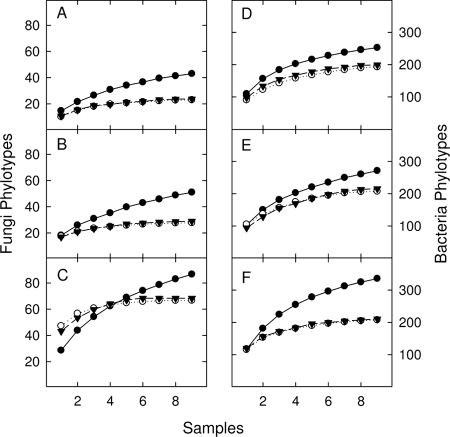
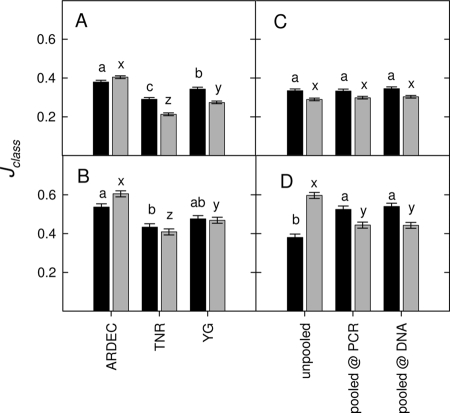
In this study, we examined the effect of various pooling strategies on the characterization of soil microbial community composition and phylotype richness estimates. Automated ribosomal intergenic spacer analysis (ARISA) profiles were determined from soil samples that were (i) unpooled (extracted and amplified individually), (ii) pooled prior to PCR amplification, or (iii) pooled prior to DNA extraction. Regression analyses suggest that the less even the soil microbial community (i.e., low Shannon equitability, E(H)), the greater was the impact of either pooling strategy on microbial detection (R(2) = 0.766). For example, at a tropical rainforest site, which had the most uneven fungal (E(H) of 0.597) and bacterial communities (E(H) of 0.822), the unpooled procedure detected an additional 67 fungal and 115 bacterial phylotypes relative to either of the pooled procedures. Phylotype rarity, resulting in missed detection upon pooling, differed between the fungal and bacterial communities. Fungi were typified by locally abundant but spatially rare phylotypes, and the bacteria were typified by locally rare but spatially ubiquitous phylotypes. As a result, pooling differentially influenced plot comparisons, leading to an increase in similarity for the bacterial community and a decrease in the fungal community. In conclusion, although pooling reduces sample numbers and variability, it could mask a significant portion of the detectable microbial community, particularly for fungi due to their higher spatial heterogeneity.
Figures
References
-
- Broz, A. K., D. K. Manter, and J. M. Vivanco. 2007. Soil fungal abundance and biodiversity: another victim of the invasive plant Centaurea maculosa. ISME J. 1:763-765. - PubMed
-
- Chandler, D. P., S. M. Li, C. M. Spadoni, G. R. Drake, D. L. Balkwill, J. K. Fredrickson, and F. J. Brockman. 1997. A molecular comparison of culturable aerobic heterotrophic bacteria and 16S rDNA clones derived from a deep subsurface sediment. FEMS Microbiol. Ecol. 23:131-144.
-
- Colwell, R. K. 2006. EstimateS: statistical estimation of species richness and shared species from samples, version 8. http://viceroy.eeb.uconn.edu/estimates.
-
- Ellingsoe, P., and K. Johnsen. 2002. Influence of soil sample sizes on the assessment of bacterial community structure. Soil Biol. Biochem. 34:1701-1707.
Publication types
MeSH terms
Substances
LinkOut - more resources
Full Text Sources
Medical
