


On the choice of adequate randomization ranges for limiting the use of unwanted cues in same-different, dual-pair, and oddity tasks
- PMID: 20139466
- PMCID: PMC3018147
- DOI: 10.3758/APP.72.2.538
On the choice of adequate randomization ranges for limiting the use of unwanted cues in same-different, dual-pair, and oddity tasks
Abstract
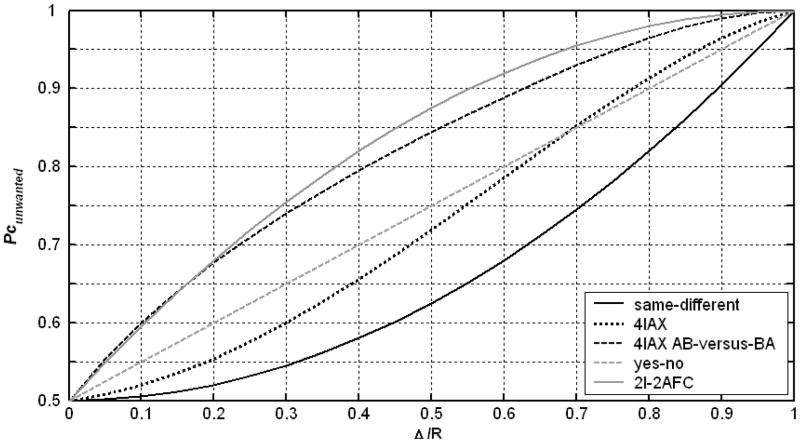
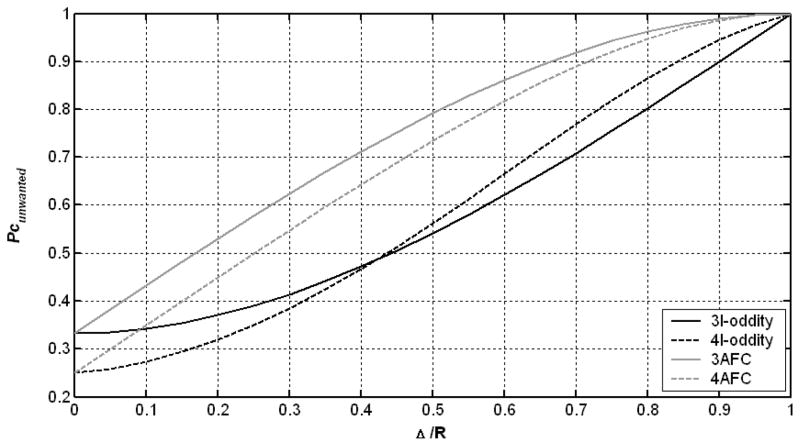
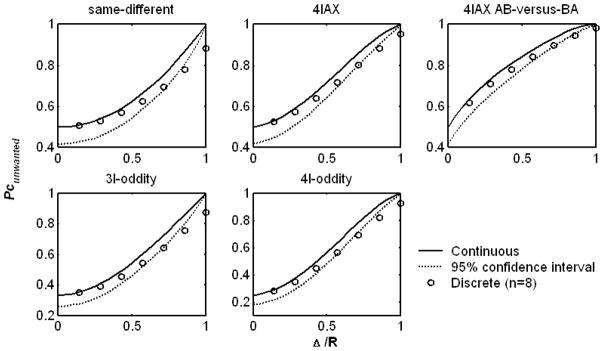
A major concern when designing a psychophysical experiment is that participants may use a stimulus feature (cue) other than that intended by the experimenter. One way to avoid this problem is to apply random variations to the corresponding feature across stimulus presentations to make the unwanted cue unreliable. An important question facing experimenters who use this randomization (roving) technique is how large the randomization range should be to ensure that the participants cannot achieve a certain proportion correct by using the unwanted cue, while at the same time avoiding unnecessary interference of the randomization with task performance. Previous researchers have provided formulas for the selection of adequate randomization ranges in yes-no and multiple-alternative forced choice tasks. In this article, we provide figures and tables that can be used to select randomization ranges that are better suited to experiments involving a same-different, dual-pair, or oddity task.
Figures
References
-
- Ashby FG, Townsend JT. Varieties of perceptual independence. Psychological Review. 1986;93:154–179. - PubMed
-
- Berliner JE, Durlach NI. Intensity perception. IV. Resolution in roving-level discrimination. Journal of the Acoustical Society of America. 1973;53:1270–1287. - PubMed
-
- Berliner JE, Durlach NI, Braida LD. Intensity perception. VII. Further data on roving-level discrimination and the resolution and bias edge effects. Journal of the Acoustical Society of America. 1977;61:1577–1585. - PubMed
-
- Bernstein LR, Trahiotis C. The effects of randomizing values of interaural disparities on binaural detection and on discrimination of interaural correlation. Journal of the Acoustical Society of America. 1997;102:1113–1120. - PubMed
-
- Bernstein LR, Trahiotis T. The effect of nonsimultaneous on-frequency and off-frequency cues on the detection of a tonal signal masked by narrow-band noise. Journal of the Acoustical Society of America. 1994;95:920–930. - PubMed
Publication types
MeSH terms
Grants and funding
LinkOut - more resources
Full Text Sources