


Per-contact probability of HIV transmission in homosexual men in Sydney in the era of HAART
- PMID: 20139750
- PMCID: PMC2852627
- DOI: 10.1097/QAD.0b013e3283372d90
Per-contact probability of HIV transmission in homosexual men in Sydney in the era of HAART
Abstract
Objective: The objective of this study is to estimate per-contact probability of HIV transmission in homosexual men due to unprotected anal intercourse (UAI) in the era of HAART.
Design: Data were collected from a longitudinal cohort study of community-based HIV-negative homosexual men in Sydney, Australia.
Methods: A total of 1427 participants were recruited from June 2001 to December 2004. They were followed up with 6-monthly detailed behavioral interviews and annual testing for HIV till June 2007. Data were used in a bootstrapping method, coupled with a statistical analysis that optimized a likelihood function for estimating the per-exposure risks of HIV transmission due to various forms of UAI.
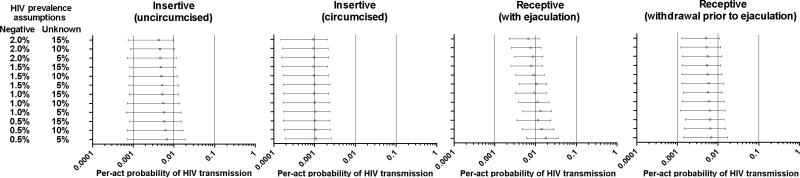
Results: During the study, 53 HIV seroconversion cases were identified. The estimated per-contact probability of HIV transmission for receptive UAI was 1.43% [95% confidence interval (CI) 0.48-2.85] if ejaculation occurred inside the rectum, and it was 0.65% (95% CI 0.15-1.53) if withdrawal prior to ejaculation was involved. The estimated transmission rate for insertive UAI in participants who were circumcised was 0.11% (95% CI 0.02-0.24), and it was 0.62% (95% CI 0.07-1.68) in uncircumcised men. Thus, receptive UAI with ejaculation was found to be approximately twice as risky as receptive UAI with withdrawal or insertive UAI for uncircumcised men and over 10 times as risky as insertive UAI for circumcised men.
Conclusion: Despite the fact that a high proportion of HIV-infected men are on antiretroviral treatment and have undetectable viral load, the per-contact probability of HIV transmission due to UAI is similar to estimates reported from developed country settings in the pre-HAART era.
Figures
Comment in
-
Infectiousness of HIV-infected homosexual men in the era of highly active antiretroviral therapy.AIDS. 2010 Sep 24;24(15):2418-20. doi: 10.1097/QAD.0b013e32833dbdfd. AIDS. 2010. PMID: 20827059 Free PMC article. No abstract available.
References
-
- Downs AM, De Vincenzi I. Probability of heterosexual transmission of HIV: relationship to the number of unprotected sexual contacts. European Study Group in Heterosexual Transmission of HIV. J Acquir Immune Defic Syndr Hum Retrovirol. 1996;11:388–95. - PubMed
-
- Mastro TD, Satten GA, Nopkesorn T, Sangkharomya S, Longini IM., Jr. Probability of female-to-male transmission of HIV-1 in Thailand. Lancet. 1994;343:204–7. - PubMed
-
- O'Farrell N. Enhanced efficiency of female-to-male HIV transmission in core groups in developing countries: the need to target men. Sex Transm Dis. 2001;28:84–91. - PubMed
-
- Padian NS, Shiboski SC, Glass SO, Vittinghoff E. Heterosexual transmission of human immunodeficiency virus (HIV) in northern California: results from a ten-year study. Am J Epidemiol. 1997;146:350–7. - PubMed
-
- DeGruttola V, Seage GR, 3rd, Mayer KH, Horsburgh CR., Jr. Infectiousness of HIV between male homosexual partners. J Clin Epidemiol. 1989;42:849–56. - PubMed
Publication types
MeSH terms
Grants and funding
LinkOut - more resources
Full Text Sources
Medical
