


"I know what you told me, but this is what I think:" perceived risk of Alzheimer disease among individuals who accurately recall their genetics-based risk estimate
- PMID: 20139767
- PMCID: PMC2921681
- DOI: 10.1097/GIM.0b013e3181cef9e1
"I know what you told me, but this is what I think:" perceived risk of Alzheimer disease among individuals who accurately recall their genetics-based risk estimate
Abstract
Purpose: This study evaluates the Alzheimer disease risk perceptions of individuals who accurately recall their genetics-based Alzheimer disease risk assessment.
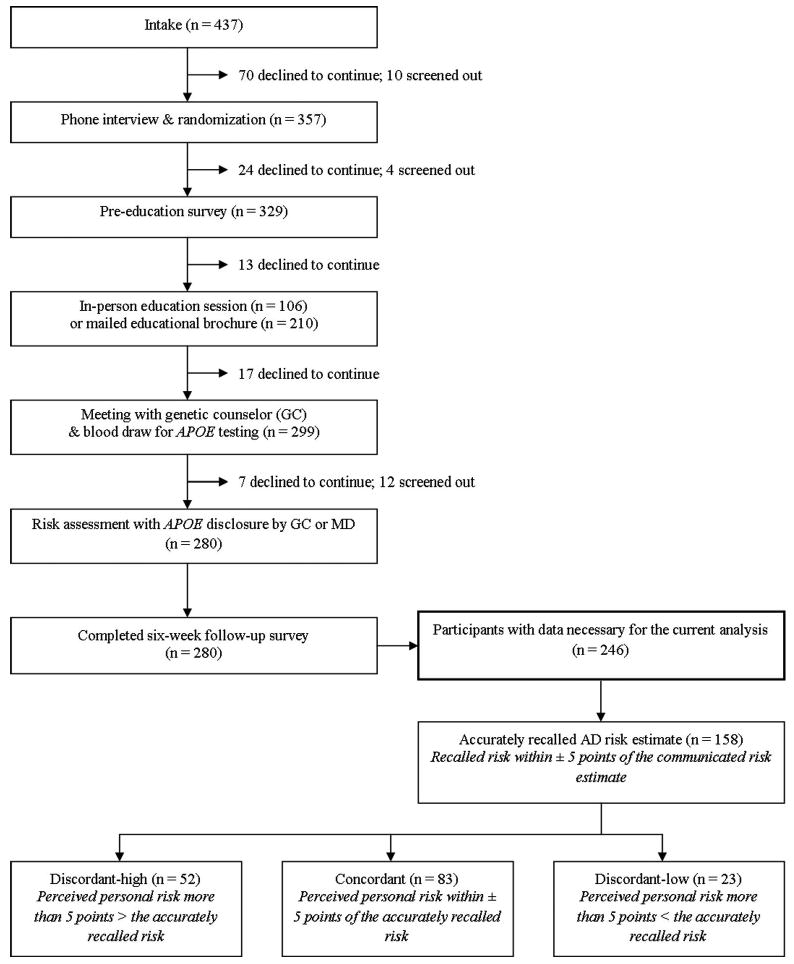
Methods: Two hundred forty-six unaffected first-degree relatives of patients with Alzheimer disease were enrolled in a multisite randomized controlled trial examining the effects of communicating APOE genotype and lifetime Alzheimer disease risk information.
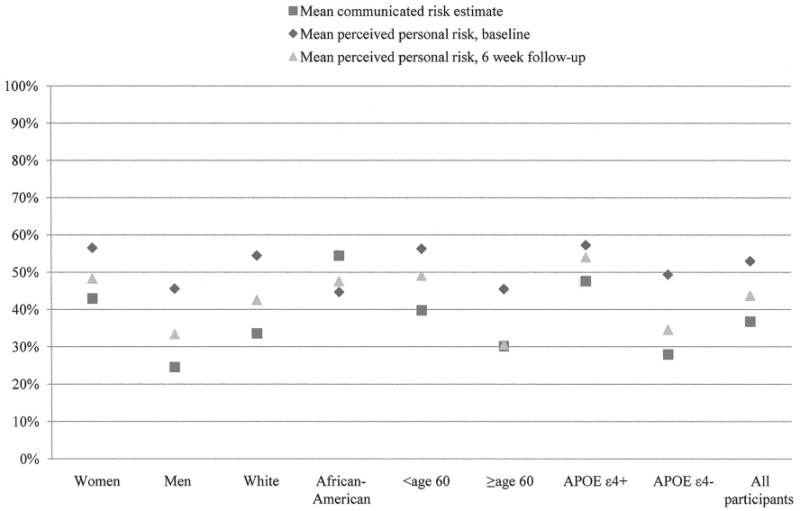
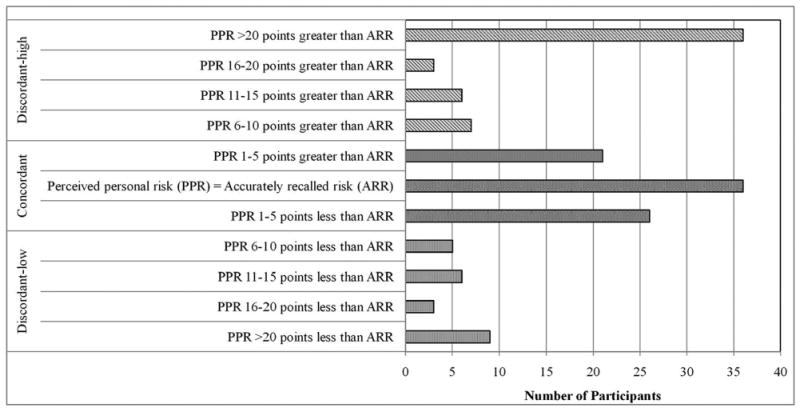
Results: Among the 158 participants who accurately recalled their Alzheimer disease risk assessment 6 weeks after risk disclosure, 75 (47.5%) believed their Alzheimer disease risk was more than 5% points different from the Alzheimer disease risk estimate they were given. Within this subgroup, 69.3% believed that their Alzheimer disease risk was higher than what they were told (discordant high), whereas 30.7% believed that their Alzheimer disease risk was lower (discordant low). Participants with a higher baseline risk perception were more likely to have a discordant-high risk perception (P < 0.05). Participants in the discordant-low group were more likely to be APOE epsilon4 positive (P < 0.05) and to score higher on an Alzheimer disease controllability scale (P < 0.05).
Conclusion: Our results indicate that even among individuals who accurately recall their Alzheimer disease risk assessment, many people do not take communicated risk estimates at face value. Further exploration of this clinically relevant response to risk information is warranted.
Conflict of interest statement
Disclosure: The authors declare no conflict of interest.
Figures
References
-
- Lipkus IM, Rimer BK, Strigo TS. Relationships among objective and subjective risk for breast cancer and mammography stages of change. Cancer Epidemiol Biomarkers Prev. 1996;5:1005–1011. - PubMed
-
- Schwartz LM, Woloshin S, Black WC, Welch HG. The role of numeracy in understanding the benefit of screening mammography. Ann Intern Med. 1997;127:966–972. - PubMed
-
- Woloshin S, Schwartz LM, Black WC, Welch HG. Women's perceptions of breast cancer risk: how you ask matters. Med Decis Making. 1999;19:221–229. - PubMed
Publication types
MeSH terms
Substances
Grants and funding
- K24-AG027841/AG/NIA NIH HHS/United States
- R01 AG009029/AG/NIA NIH HHS/United States
- P50-AG13846/AG/NIA NIH HHS/United States
- M01 RR000533/RR/NCRR NIH HHS/United States
- R24 HD041028/HD/NICHD NIH HHS/United States
- K24 AG027841/AG/NIA NIH HHS/United States
- M01-RR00533/RR/NCRR NIH HHS/United States
- R01 HG002213/HG/NHGRI NIH HHS/United States
- R01 HG005092/HG/NHGRI NIH HHS/United States
- R01-HG/AG02213/AG/NIA NIH HHS/United States
- R01-AG09029/AG/NIA NIH HHS/United States
- P30 AG013846/AG/NIA NIH HHS/United States
- P30 AG072978/AG/NIA NIH HHS/United States
LinkOut - more resources
Full Text Sources
Medical
Miscellaneous
