. 2010 Apr;40(4):1118-26.
doi: 10.1002/eji.200939275.

The antimicrobial peptide LL-37 modulates the inflammatory and host defense response of human neutrophils

Affiliations

The antimicrobial peptide LL-37 modulates the inflammatory and host defense response of human neutrophils

Sadek M Alalwani et al. Eur J Immunol. 2010 Apr.

Abstract

The human cathelicidin antimicrobial peptide acts as an effector molecule of the innate immune system with direct antimicrobial and immunomodulatory effects. The aim of this study was to test whether the cathelicidin LL-37 modulates the response of neutrophils to microbial stimulation. Human neutrophils were exposed to LPS, Staphylococcus aureus and Pseudomonas aeruginosa subsequent to incubation with LL-37 and cytokine release was measured by ELISA. The incubation with LL-37 significantly decreased the release of proinflammatory cytokines from stimulated human neutrophils. ROS production of neutrophils was determined by a luminometric and a flow cytometry method. The peptide induced the production of ROS and the engulfment of bacteria into neutrophils. Peritoneal mouse neutrophils isolated from CRAMP-deficient and WT animals were treated with LPS and TNF-alpha in the supernatant was measured by ELISA. Antimicrobial activity of neutrophils was detected by incubating neutrophils isolated from CRAMP-knockout and WT mice with bacteria. Neutrophils from CRAMP-deficient mice released significantly more TNF-alpha after bacterial stimulation and showed decreased antimicrobial activity as compared to cells from WT animals. In conclusion, LL-37 modulates the response of neutrophils to bacterial activation. Cathelicidin controls the release of inflammatory mediators while increasing antimicrobial activity of neutrophils.


Figures
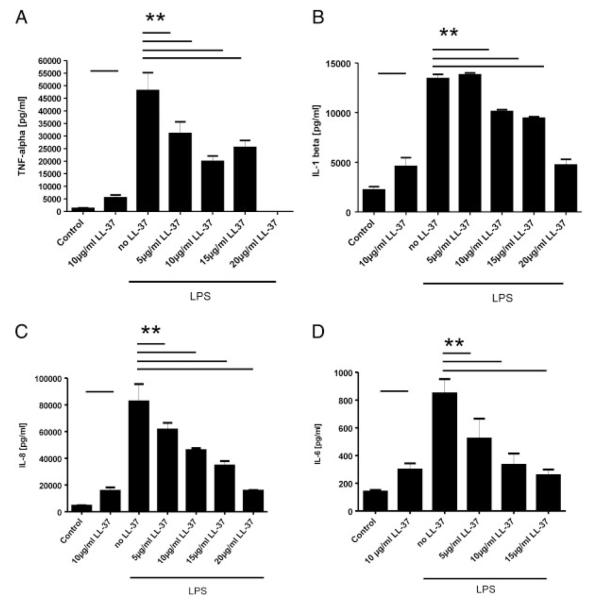
Figure 1
Figure 1
LL-37 modulates inflammatory reactions of neutrophils in response to LPS. Neutrophils were incubated with or without LPS (100 ng/mL) at various concentration of LL-37. (A-D) Cytokine concentrations were determined after 12 h stimulation: TNF-α (A), IL-1α(B), IL-8 (C) and IL-6 (D). Control = neutrophils without LPS or LL-37. n = 6 (“n”–experimental replicates). *p<0.05, **p<0.01, ***p<0.001, ANOVA with Tukey’s test.
Figure 2
Figure 2
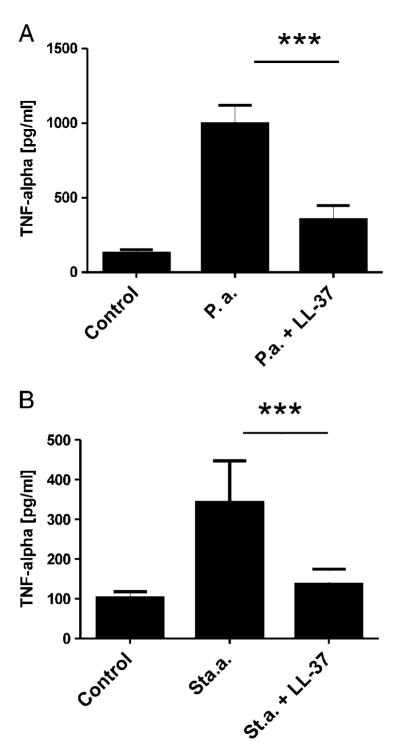
LL-37 decreases the release of proinflammatory mediators in response to whole bacteria. (A) Neutrophils were incubated with 104 CFU/ml of Pseudomonas aeruginosa (P.a.) or with (B) Staphylococcus aeurus (Sta. a.) with or without 20 μg/ml LL-37. TNF-α was measured after 12 h. Control = neutrophils without LPS or LL-37. n = 6. *p<0.05, **p<0.01, ***p<0.001, ANOVA with Tukey’s test.
Figure 3
Figure 3
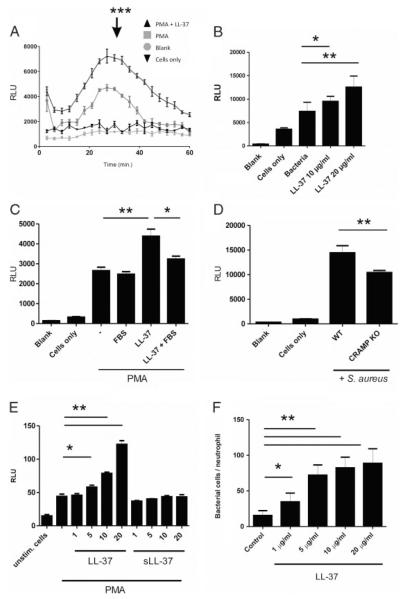
LL-37 increases ROS production and bacterial uptake of neutrophils. (A) Time course of ROS levels measured in human neutrophils (2×10⁶ cells/ml) by the luminol chemiluminescence method after PMA application at 37°C. The respiratory burst was triggered by application of 100 nM of PMA. Data show the mean±SD of three independent experiments. (B) LL-37 augments ROS production in human neutrophils induced by opsonized S. aureus as measured by the luminol chemiluminescence method. (C) The presence of 10% fetal bovine serum (FBS) inhibits the peptide’s effect on human neutrophils. The measurement was done 30 min after PMA-application. (D) 4×10⁵ neutrophils isolated from CRAMP-deficient animals were stimulated with S. aureus and ROS levels were measured by the luminol chemiluminescence method at 37°C. (E) ROS levels were measured in 2×10⁶ human neutrophils/ml by flow cytometry after loading with DCFDA. (F) Uptake of S. aureus by neutrophils in the presence of increasing concentrations of LL-37. Neutrophil : bacteria ratio is 1:25, n = 6 (“n”–experimental replicates). *p<0.05, **p<0.01, ***p<0.001, ANOVA with Tukey’s test. Data show the mean±SD (B-D).
Figure 4
Figure 4
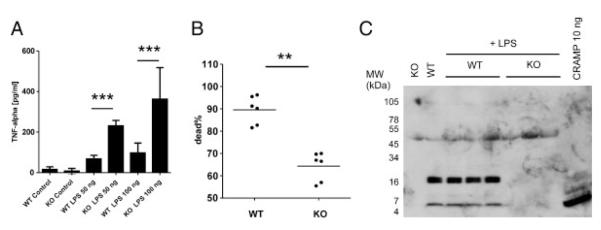
Endogenous cathelicidin modulates the neutrophil innate immune reaction. (A) Neutrophils were isolated from CRAMP-deficient animals, stimulated with LPS (50 or 100 ng/ml), and the release of TNF-α was measured. Neutrophils from CRAMP-knockout animals released significantly higher amounts of the cytokine as compared to the cells from WT animals. Control = neutrophils without LPS or LL-37. (B) Neutrophils from CRAMP-deficient animals showed a breach in their innate host defense. Neutrophils were incubated with P. aeruginosa (1 neutrophil : 1 bacterial cell) and the numbers of viable bacteria were analyzed by sampling 20 μl and plating on nutrient agar 90 min after bacterial inocculation. “Dead %” is the ratio of numbers of colonies at 90 min and at 0 min. (C) Western blotting of supernatants of murine neutrophils shows the presence of CRAMP peptide (pro- and active forms) in medium of unstimulated and LPS-stimulated (100 ng/ml, 1 h) neutrophils. The sizes of the pro- and the active form of CRAMP are 18 kDa and 5 kDa, respectively. n = 6 (“n”–experimental replicates) *p<0.05, **p<0.01, ***p<0.001, ANOVA with Tukey’s test.

References

    1. Malech HL. The role of neutrophils in the immune system: an overview. Methods Mol.Biol. 2007;412:3–11. - PubMed
    1. Zasloff M. Antimicrobial peptides of multicellular organisms. Nature. 2002;415:389–395. - PubMed
    1. Yang D, Biragyn A, Hoover DM, Lubkowski J, Oppenheim JJ. Multiple Roles of Antimicrobial Defensins, Cathelicidins, and Eosinophil-Derived Neurotoxin in Host Defense. Annu Rev Immunol. 2004;22:181–215. - PubMed
    1. Zanetti M. The role of cathelicidins in the innate host defenses of mammals. Curr. Issues Mol. Biol. 2005;7:179–196. - PubMed
    1. Chromek M, Slamova Z, Bergman P, Kovacs L, Podracka L, Ehren I, Hokfelt T, et al. The antimicrobial peptide cathelicidin protects the urinary tract against invasive bacterial infection. Nat. Med. 2006;12:636–641. - PubMed

Publication types

MeSH terms