


Climate variability and hemorrhagic fever with renal syndrome transmission in Northeastern China
- PMID: 20142167
- PMCID: PMC2920909
- DOI: 10.1289/ehp.0901504
Climate variability and hemorrhagic fever with renal syndrome transmission in Northeastern China
Abstract
Background: The transmission of hemorrhagic fever with renal syndrome (HFRS) is influenced by climatic variables. However, few studies have examined the quantitative relationship between climate variation and HFRS transmission.
Objective: We examined the potential impact of climate variability on HFRS transmission and developed climate-based forecasting models for HFRS in northeastern China.
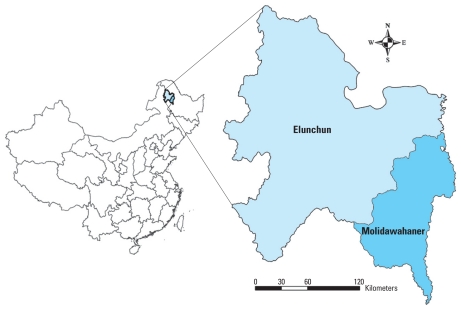
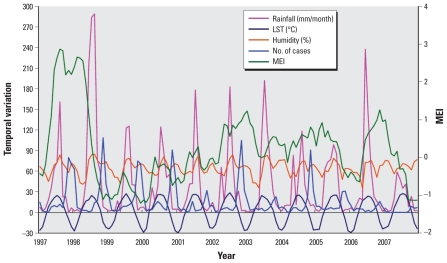
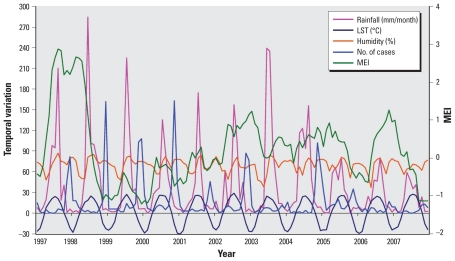
Methods: We obtained data on monthly counts of reported HFRS cases in Elunchun and Molidawahaner counties for 1997-2007 from the Inner Mongolia Center for Disease Control and Prevention and climate data from the Chinese Bureau of Meteorology. Cross-correlations assessed crude associations between climate variables, including rainfall, land surface temperature (LST), relative humidity (RH), and the multivariate El Niño Southern Oscillation (ENSO) index (MEI) and monthly HFRS cases over a range of lags. We used time-series Poisson regression models to examine the independent contribution of climatic variables to HFRS transmission.
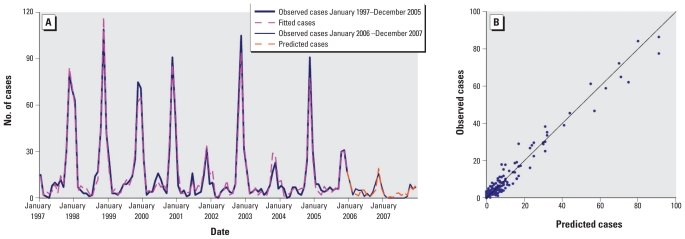
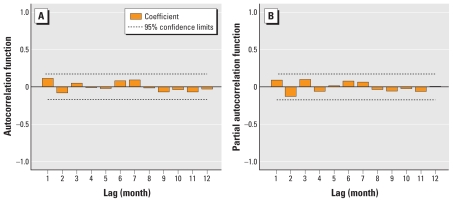
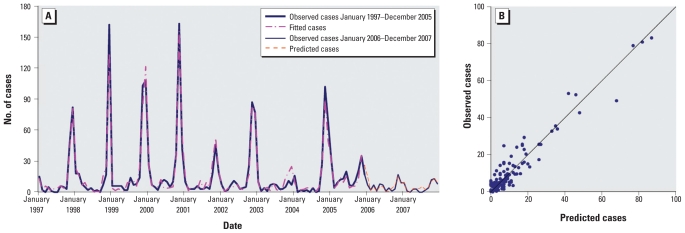
Results: Cross-correlation analyses showed that rainfall, LST, RH, and MEI were significantly associated with monthly HFRS cases with lags of 3-5 months in both study areas. The results of Poisson regression indicated that after controlling for the autocorrelation, seasonality, and long-term trend, rainfall, LST, RH, and MEI with lags of 3-5 months were associated with HFRS in both study areas. The final model had good accuracy in forecasting the occurrence of HFRS.
Conclusions: Climate variability plays a significant role in HFRS transmission in northeastern China. The model developed in this study has implications for HFRS control and prevention.
Figures
References
-
- Aars J, Ims RA. Intrinsic and climatic determinants of population demography: the winter dynamics of tundra voles. Ecology. 2002;83(12):3449–3456.
-
- Bi P, Cameron AS, Zhang Y, Parton KA. Weather and notified Campylobacter infections in temperate and sub-tropical regions of Australia: an ecological study. J Infect. 2008;57(4):317–323. - PubMed
-
- Bi P, Parton K. El Niño and incidence of hemorrhagic fever with renal syndrome in China. JAMA. 2003;289:176–177. - PubMed
-
- Bi P, Tong S, Donald K, Parton K, Ni J. Climatic, reservoir and occupational variables and the transmission of haemorrhagic fever with renal syndrome in China. Int J Epidemiol. 2002;31(1):189–193. - PubMed
-
- Bi P, Wu X, Zhang F, Parton K, Tong S. Seasonal rainfall variability, the incidence of hemorrhagic fever with renal syndrome, and prediction of the disease in low-lying areas of China. Am J Epidemiol. 1998;148(3):276–281. - PubMed
Publication types
MeSH terms
LinkOut - more resources
Full Text Sources