Postmenopausal hormone therapy and asthma onset in the E3N cohort
- PMID: 20142267
- PMCID: PMC2962872
- DOI: 10.1136/thx.2009.116079
Postmenopausal hormone therapy and asthma onset in the E3N cohort
Abstract
Background: Epidemiological studies have suggested that female hormones might play a role in asthma and that menopausal hormone therapy (MHT or hormone replacement therapy (HRT)) might increase the risk of asthma in postmenopausal women. The only prospective study addressing this issue reports an increase in the risk of developing asthma which was similar for oestrogen alone and oestrogen/progestagen treatment.
Methods: The association between the use of different types of MHT and the risk of asthma onset in postmenopausal women was investigated prospectively from 1990 to 2002 by biennial questionnaires as part of the French E3N cohort study. Asthma onset was considered to be the time of medical diagnosis of asthma cases occurring during the follow-up of women who were asthma free at baseline. Cox proportional hazards models were used, adjusting for potential confounding factors.
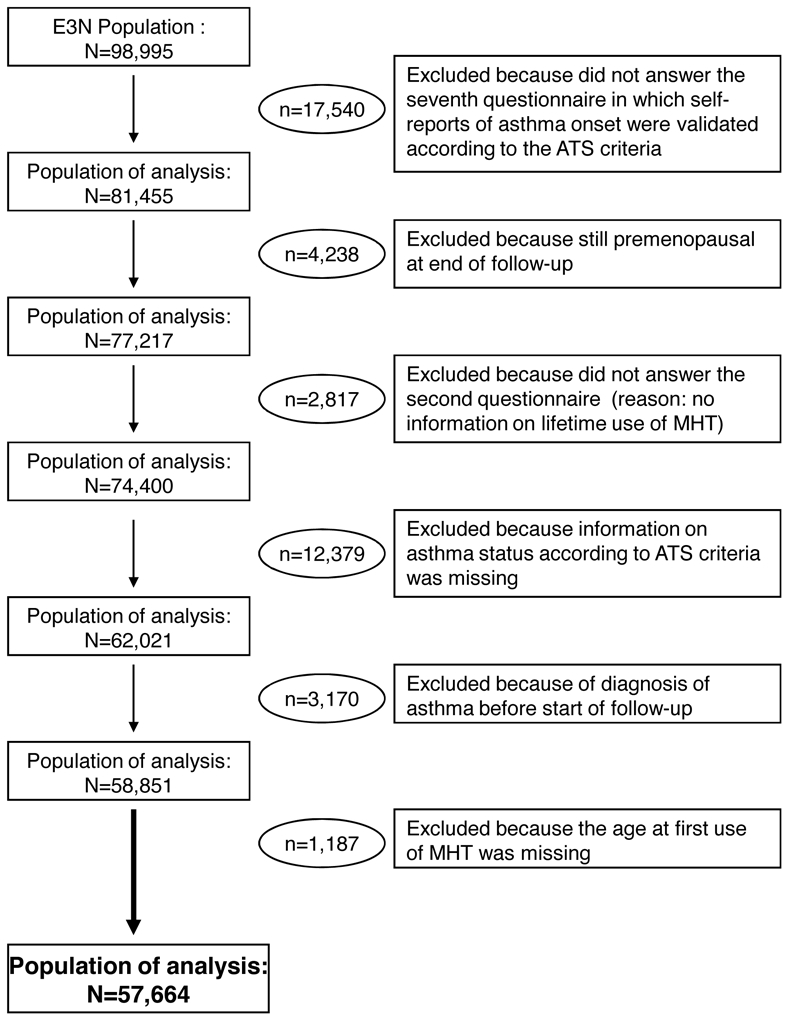
Results: Among 57 664 women free of asthma at menopause, 569 incident cases of asthma were identified during 495 448 years of follow-up. MHT was related to an increased risk of asthma onset (HR=1.20, 95% CI 0.98 to 1.46) among recent users. The increase in risk of asthma onset was only significant among women reporting the use of oestrogen alone (HR=1.54, 95% CI 1.13 to 2.09) particularly in never smokers (HR=1.80, 95% CI 1.15 to 2.80) and women reporting allergic disease prior to asthma onset (HR=1.86, 95% CI 1.18 to 2.93). A small increase in the risk of asthma onset associated with the use of oestrogen/progestagen was also observed in these subgroups.
Conclusion: Postmenopausal use of oestrogen alone was associated with an increased rate of newly diagnosed asthma in menopausal women.
Conflict of interest statement
Competing interesting: None
Figures
Comment in
-
Is postmenopausal HRT a risk factor for adult-onset asthma?Thorax. 2010 Apr;65(4):282-4. doi: 10.1136/thx.2009.129205. Thorax. 2010. PMID: 20388749 No abstract available.
-
Use of oestrogen only hormone replacement therapy associated with increased risk of asthma onset in postmenopausal women.Evid Based Med. 2010 Dec;15(6):190-1. doi: 10.1136/ebm1135. Epub 2010 Sep 22. Evid Based Med. 2010. PMID: 20861411 No abstract available.
References
-
- Beasley R, Crane J, Lai CK, et al. Prevalence and etiology of asthma. J Allergy Clin Immunol. 2000;105:S466–72. - PubMed
-
- Barr RG, Wentowski CC, Grodstein F, et al. Prospective study of postmenopausal hormone use and newly diagnosed asthma and chronic obstructive pulmonary disease. Arch Intern Med. 2004;164:379–86. - PubMed
-
- Wjst M, Dold S. Is asthma an endocrine disease? Pediat Allergy Immunol. 1997;8:200–4. - PubMed
-
- Postma DS. Gender differences in asthma development and progression. Gend Med. 2007;4:S133–46. - PubMed
-
- Troisi RJ, Speizer FE, Willett WC, et al. Menopause, postmenopausal estrogen preparations, and the risk of adult-onset asthma: a prospective cohort study. Am J Respir Crit Care Med. 1995;152:1183–8. - PubMed
Publication types
MeSH terms
Substances
LinkOut - more resources
Full Text Sources
Other Literature Sources
Medical