A randomized, placebo-controlled trial of latrepirdine in Huntington disease
- PMID: 20142523
- PMCID: PMC4134015
- DOI: 10.1001/archneurol.2009.334
A randomized, placebo-controlled trial of latrepirdine in Huntington disease
Erratum in
- Arch Neurol. 2010 Apr;67(4):492. Dimebon in Subjects With Huntington Disease (DIMOND)Investigators of the Huntington Study Group [corrected to Huntington Disease Study Group DIMOND Investigators]
Abstract
Objectives: To evaluate the safety and tolerability of latrepirdine in Huntington disease (HD) and explore its effects on cognition, behavior, and motor symptoms.
Design: Double-blind, randomized, placebo-controlled trial.
Setting: Multicenter outpatient trial.
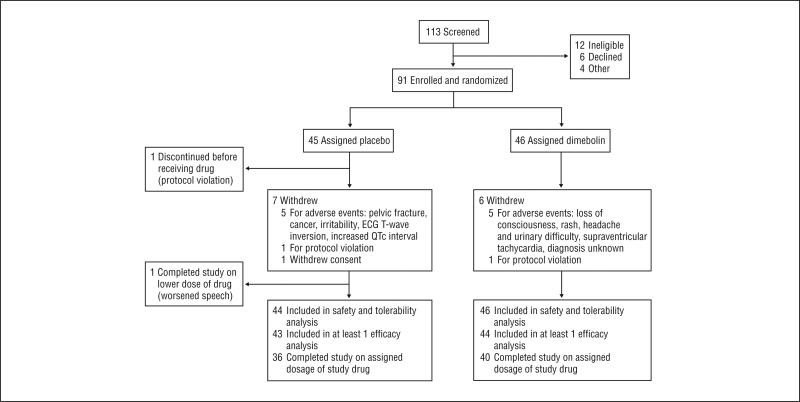
Participants: Ninety-one participants with mild to moderate HD enrolled at 17 US and UK centers from July 18, 2007, through July 16, 2008.
Intervention: Latrepirdine, 20 mg 3 times daily (n = 46), or matching placebo (n = 45) for a 90-day treatment period.
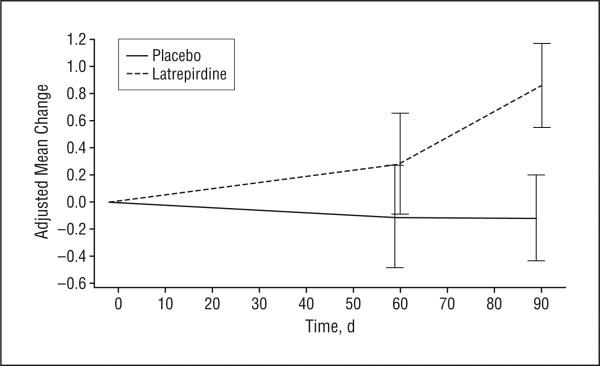
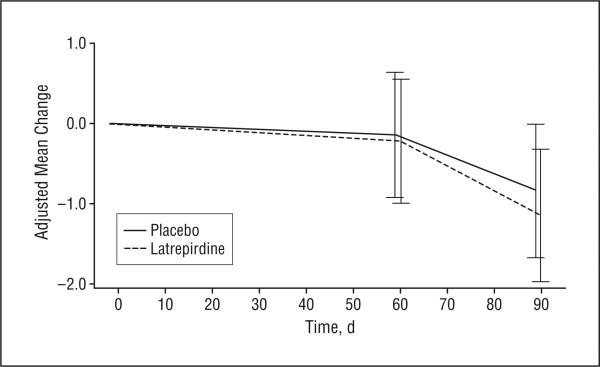
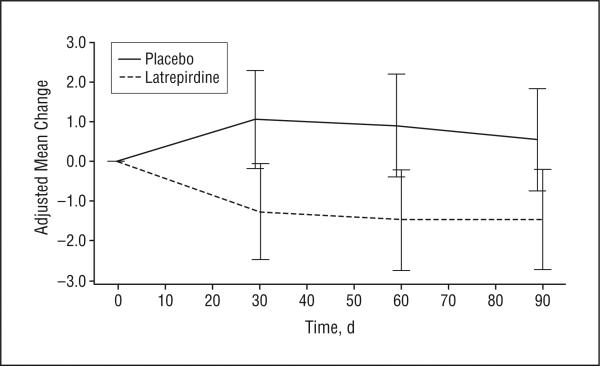
Main outcome measures: The primary outcome variable was tolerability, defined as the ability to complete the study at the assigned drug dosage. Secondary outcome variables included score changes from baseline to day 90 on the Unified Huntington's Disease Rating Scale (UHDRS), the Mini-Mental State Examination (MMSE), and the Alzheimer Disease Assessment Scale-cognitive subscale (ADAS-cog).
Results: Latrepirdine was well tolerated (87% of the patients given latrepirdine completed the study vs 82% in the placebo group), and adverse event rates were comparable in the 2 groups (70% in the latrepirdine group and 80% in the placebo group). Treatment with latrepirdine resulted in improved mean MMSE scores compared with stable performance in the placebo group (treatment effect, 0.97 points; 95% confidence interval, 0.10-1.85; P = .03). No significant treatment effects were seen on the UHDRS or the ADAS-cog.
Conclusions: Short-term administration of latrepirdine is well tolerated in patients with HD and may have a beneficial effect on cognition. Further investigation of latrepirdine is warranted in this population with HD.
Trial registration: ClinicalTrials.gov NCT00497159.
Figures
References
-
- Panov AV, Burke JR, Strittmatter WJ, Greenamyre JT. In vitro effects of polyglutamine tracts on Ca2+-dependent depolarization of rat and human mitochondria: relevance to Huntington's disease. Arch Biochem Biophys. 2003;410(1):1–6. - PubMed
-
- Bachurin S, Bukatina E, Lermontova N, et al. Antihistamine agent Dimebon as a novel neuroprotector and a cognition enhancer. Ann N Y Acad Sci. 2001;939:425–435. - PubMed
-
- Bernales SW, Protter SA, Hung DT. Dimebon incudes neurite outgrowth and mitochondrial stabilization.. Proceedings of the Society for Neuroscience Annual Meeting; Washington, DC. November 15-19, 2008; Washington, DC: Society of Neuroscience; 2008.
-
- Doody RS, Gavrilova SI, Sano M, et al. Dimebon Investigators. Effect of dime-bon on cognition, activities of daily living, behaviour, and global function in patients with mild-to-moderate Alzheimer's disease: a randomised, double-blind, placebo-controlled study. Lancet. 2008;372(9634):207–215. - PubMed