


Prevalence of the metabolic syndrome in acute myocardial infarction and its impact on hospital outcomes
- PMID: 20142868
- PMCID: PMC2812750
- DOI: 10.4103/0973-3930.53120
Prevalence of the metabolic syndrome in acute myocardial infarction and its impact on hospital outcomes
Abstract
Aims: To ascertain the prevalence of the metabolic syndrome in patients with acute myocardial infarction; to study the impact of the metabolic syndrome on hospital outcomes; and to find out the association of each component of the metabolic syndrome with acute myocardial infarction (AMI).
Setting: Coronary care unit, Department of Medicine, B P Koirala Institute of Health Sciences, Dharan, Nepal.
Design: Hospital-based cross-sectional study.
Materials and methods: A total of 84 unselected consecutive patients hospitalized with AMI (diagnosed on the basis of WHO criteria) were categorized according to NCEP ATP III criteria.
Statistical analysis: Data was analyzed by using the Student's t test and Chi-square test.
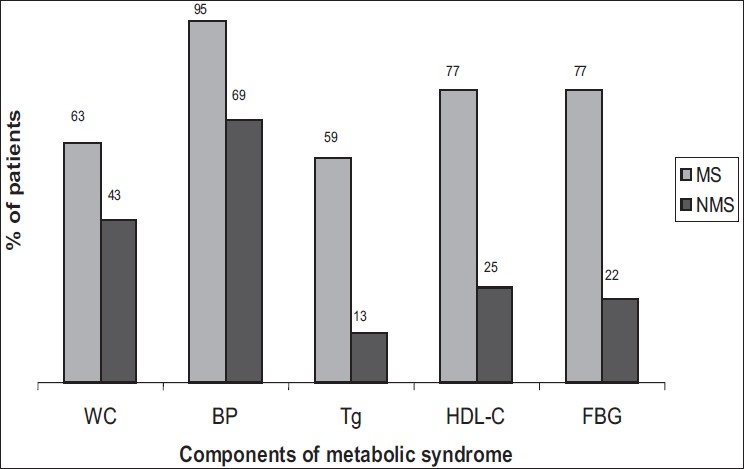
Results: Among the 84 AMI patients, 22 (26.19%) fulfilled the criteria for metabolic syndrome. Patients with the metabolic syndrome were older (86% were >50 years of age) and females (27%) were more affected than males (25%). In-hospital case fatality was higher in patients having the metabolic syndrome (5/22) than in those without the syndrome (3/62). Among the five components of the metabolic syndrome, the triglyceride levels had the highest positive predictive value (62%) in AMI; this was followed by fasting blood glucose levels (55%).
Conclusion: The prevalence of the metabolic syndrome is 26.19%; it is associated with high mortality; among its components, the triglyceride level has the highest positive predictive value in AMI patients.
Keywords: Metabolic syndrome; acute myocardial infarction.
Conflict of interest statement
Figures
References
-
- Alberti KG, Zimmet PZ. Definition, diagnosis and classification of diabetes mellitus and its complications. Part I: Diagnosis and classification of diabetes mellitus. Report of WHO consultation. Diabet Med. 1998;15:539–53. - PubMed
-
- Expert Panel on Detection, Evaluation, and Treatment of High Blood Cholesterol in Adults. Executive Summary of The Third Report of The National Cholesterol Education Program (NCEP) Expert Panel on Detection, Evaluation, And Treatment of High Blood Cholesterol In Adults (Adult Treatment Panel III) JAMA. 2001;285:2486–97. - PubMed
-
- Ford ES, Giles WH, Dietz WH. Prevalence of the metabolic syndrome among US adults: Findings from the Third National Health and Nutrition Examination Survey. JAMA. 2002;287:356–9. - PubMed
-
- Meigs JB, Wilson PW, Nathan DM, D'Agostino RB, Williams K, Haffner SM. Prevalence and characteristics of metabolic syndrome in the San Antonio Heart and Framingham Offspring studies. Diabetes. 2003;52:2160–7. - PubMed
-
- Olijhoek JK, van der Graaf Y, Banga JD, Algra A, Rabelink TJ, Visseren FL, et al. The metabolic syndrome is associated with advanced vascular damage in patients with coronary heart disease, stroke, peripheral arterial disease or abdominal aortic aneurysm. Eur Heart J. 2004;25:342–8. - PubMed
LinkOut - more resources
Full Text Sources