


Biomaterials/tissue interactions: possible solutions to overcome foreign body response
- PMID: 20143194
- PMCID: PMC2844517
- DOI: 10.1208/s12248-010-9175-3
Biomaterials/tissue interactions: possible solutions to overcome foreign body response
Abstract
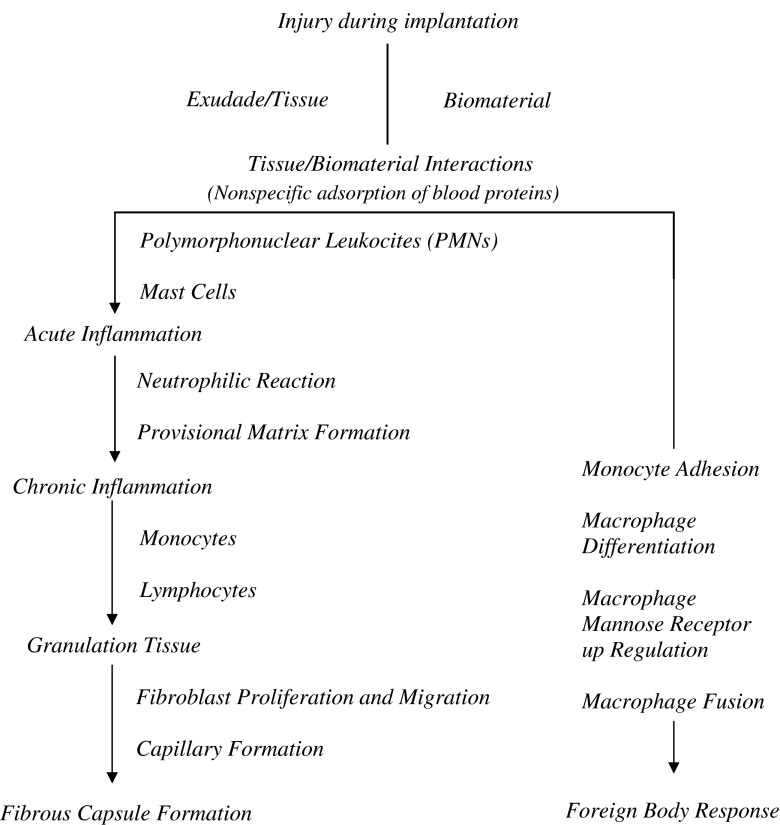
In recent years, a variety of biomaterial implantable devices has been developed. Of particular significance to pharmaceutical sciences is the progress made on the development of drug/implantable device combination products. However, the clinical application of these devices is still a critical issue due to the host response, which results from both the tissue trauma during implantation and the presence of the device in the body. Accordingly, the in vivo functionality and durability of any implantable device can be compromised by the body response to the foreign material. Numerous strategies to overcome negative body reactions have been reported. The aim of this review is to outline some key issues of biomaterial/tissue interactions such as foreign body response and biocompatibility and biocompatibility assessment. In addition, general approaches used to overcome the in vivo instability of implantable devices are presented, including (a) biocompatible material coatings, (b) steroidal and nonsteroidal anti-inflammatory drugs, and (c) angiogenic drugs. In particular, strategies to overcome host response to glucose biosensors are summarized.
Figures
Similar articles
-
Polymeric "smart" coatings to prevent foreign body response to implantable biosensors.J Control Release. 2013 Aug 10;169(3):341-7. doi: 10.1016/j.jconrel.2012.12.028. Epub 2013 Jan 5. J Control Release. 2013. PMID: 23298616
-
Glucose sensor membranes for mitigating the foreign body response.J Diabetes Sci Technol. 2011 Sep 1;5(5):1052-9. doi: 10.1177/193229681100500505. J Diabetes Sci Technol. 2011. PMID: 22027297 Free PMC article.
-
Multiple tissue response modifiers to promote angiogenesis and prevent the foreign body reaction around subcutaneous implants.J Control Release. 2015 Sep 28;214:103-11. doi: 10.1016/j.jconrel.2015.07.021. Epub 2015 Jul 26. J Control Release. 2015. PMID: 26216396
-
The foreign body response: at the interface of surgery and bioengineering.Plast Reconstr Surg. 2015 May;135(5):1489-1498. doi: 10.1097/PRS.0000000000001193. Plast Reconstr Surg. 2015. PMID: 25919260 Review.
-
Materials Strategies to Overcome the Foreign Body Response.Adv Healthc Mater. 2024 Jul;13(18):e2304478. doi: 10.1002/adhm.202304478. Epub 2024 May 2. Adv Healthc Mater. 2024. PMID: 38666550 Review.
Cited by
-
Biomimetic Electrospun Self-Assembling Peptide Scaffolds for Neural Stem Cell Transplantation in Neural Tissue Engineering.Pharmaceutics. 2023 Aug 31;15(9):2261. doi: 10.3390/pharmaceutics15092261. Pharmaceutics. 2023. PMID: 37765230 Free PMC article.
-
Argon plasma modified nanocomposite polyurethane scaffolds provide an alternative strategy for cartilage tissue engineering.J Nanobiotechnology. 2019 Apr 6;17(1):51. doi: 10.1186/s12951-019-0477-z. J Nanobiotechnology. 2019. PMID: 30954085 Free PMC article.
-
Carbon nanotube chemiresistor for wireless pH sensing.Sci Rep. 2014 Mar 26;4:4468. doi: 10.1038/srep04468. Sci Rep. 2014. PMID: 24667793 Free PMC article.
-
Controlled Release of Vascular Endothelial Growth Factor from Heparin-Functionalized Gelatin Type A and Albumin Hydrogels.Gels. 2017 Oct 9;3(4):35. doi: 10.3390/gels3040035. Gels. 2017. PMID: 30920532 Free PMC article.
-
Modulation of the foreign body reaction for implants in the subcutaneous space: microdialysis probes as localized drug delivery/sampling devices.J Diabetes Sci Technol. 2011 May 1;5(3):619-31. doi: 10.1177/193229681100500316. J Diabetes Sci Technol. 2011. PMID: 21722577 Free PMC article.
References
-
- Prokop A. Bioartificial organs in the twenty-first century: nano-biological devices. Ann NY Acad Sci. 2001;944:472–490. - PubMed
-
- Wilson GS, Zhang Y, Reach G, Moatti-Sirat D, Poitout V, Thévenot DR, et al. Progress toward the development of an implantable sensor for glucose. Clin Chem. 1992;38(9):1613–1617. - PubMed
-
- Klonoff DC. Technological advances in the treatment of diabetes mellitus: better bioengineering begets benefits in glucose measurement, the artificial pancreas, and insulin delivery. Pediatr Endocrinol Rev. 2003;1(2):94–100. - PubMed
Publication types
MeSH terms
Substances
Grants and funding
LinkOut - more resources
Full Text Sources
Other Literature Sources
