


Do race and ethnicity impact hemoglobin A1c independent of glycemia?
- PMID: 20144308
- PMCID: PMC2769981
- DOI: 10.1177/193229680900300406
Do race and ethnicity impact hemoglobin A1c independent of glycemia?
Abstract
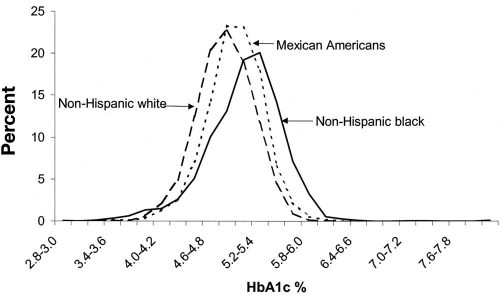
Hemoglobin A1c (HbA1c) is widely used as an index of mean glycemia, a measure of risk for the development of diabetes complications, and a measure of the quality of diabetes care. Emerging literature suggests that, although HbA1c levels change little over time within persons without diabetes, they vary considerably among individuals, suggesting that factors other than glycemia may impact HbA1c. Racial and ethnic differences in HbA1c have been described that do not appear to be explained by differences in glycemia. It is imperative that the nonglycemic factors that affect HbA1c be more clearly defined. Even more important, it must be determined whether differences among individuals or groups correlate with susceptibility to complications or merely reflect variation in hemoglobin glycation.
Copyright 2009 Diabetes Technology Society.
Figures
References
-
- Allen DW, Schroeder WA, Balog J. Observations on the chromatographic heterogeneity of normal adult and fetal human hemogloba study of the effects of crystallization and chromatography on the heterogeneity and isoleucine content. J Am Chem Soc. 1958;80(7):1628–1634.
-
- Rajbar S. An abnormal hemoglobin in red cells of diabetics. Clin Chem Acta. 1968;22(2):296–298. - PubMed
-
- Koenig RJ, Peterson CM, Kilo C, Cerami A, Williamson JR. Hemoglobin A1c as an indicator of the degree of glucose intolerance in diabetes. Diabetes. 1976;25(3):230–232. - PubMed
-
- Koenig RJ, Peterson CM, Jones RL, Saudek C, Lehrman M, Cerami A. Correlation of glucose regulation and hemoglobin A1c in diabetes mellitus. N Engl J Med. 1976;295(8):417–420. - PubMed
-
- National Glycohemoglobin Standardization Program http://www.ngsp.org/
Publication types
MeSH terms
Substances
Grants and funding
LinkOut - more resources
Full Text Sources
Medical
