


Genetic determinants of pubertal timing in the general population
- PMID: 20144687
- PMCID: PMC2891370
- DOI: 10.1016/j.mce.2010.01.038
Genetic determinants of pubertal timing in the general population
Abstract
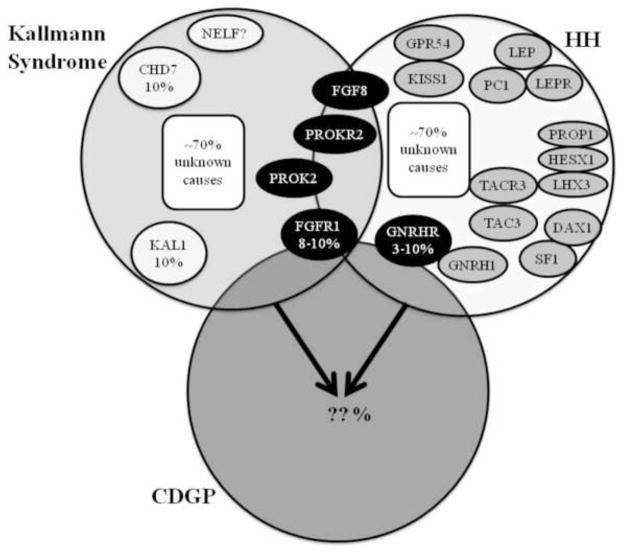
Puberty is an important developmental stage during which reproductive capacity is attained. The timing of puberty varies greatly among healthy individuals in the general population and is influenced by both genetic and environmental factors. Although genetic variation is known to influence the normal spectrum of pubertal timing, the specific genes involved remain largely unknown. Genetic analyses have identified a number of genes responsible for rare disorders of pubertal timing such as hypogonadotropic hypogonadism and Kallmann syndrome. Recently, the first loci with common variation reproducibly associated with population variation in the timing of puberty were identified at 6q21 in or near LIN28B and at 9q31.2. However, these two loci explain only a small fraction of the genetic contribution to population variation in pubertal timing, suggesting the need to continue to consider other loci and other types of variants. Here we provide an update of the genes implicated in disorders of puberty, discuss genes and pathways that may be involved in the timing of normal puberty, and suggest additional avenues of investigation to identify genetic regulators of puberty in the general population.
Copyright (c) 2010 Elsevier Ireland Ltd. All rights reserved.
Figures
References
-
- Parent AS, Teilmann G, Juul A, Skakkebaek NE, Toppari J, Bourguignon JP. The Timing of Normal Puberty and the Age Limits of Sexual Precocity: Variations around the World, Secular Trends, and Changes after Migration. Endocr Rev. 2003;24:668–693. - PubMed
-
- Gajdos ZK, Hirschhorn JN, Palmert MR. What controls the timing of puberty? An update on progress from genetic investigation. Curr Opin Endocrinol Diabetes Obes. 2009;16:16–24. - PubMed
-
- Hodges CA, Palmert MR. Genetic Regulation of the Variation in Pubertal Timing. In: Pescovitz OH, Walvoord EC, editors. When Puberty is Precocious: Scientific and Clinical Aspects. Humana Press, Inc; 2007. pp. 83–102.
-
- Palmert MR, Hirschhorn JN. Genetic approaches to stature, pubertal timing, and other complex traits. Mol Genet Metab. 2003;80:1–10. - PubMed
-
- Plant TM, Barker-Gibb ML. Neurobiological mechanisms of puberty in higher primates. Hum Reprod Update. 2004;10:67–77. - PubMed
Publication types
MeSH terms
Grants and funding
LinkOut - more resources
Full Text Sources
Medical
