


Sensitivity of psychophysical measures to signal processor modifications in cochlear implant users
- PMID: 20144699
- PMCID: PMC2864608
- DOI: 10.1016/j.heares.2010.02.003
Sensitivity of psychophysical measures to signal processor modifications in cochlear implant users
Abstract
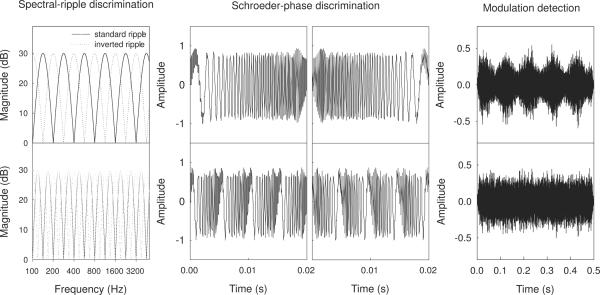
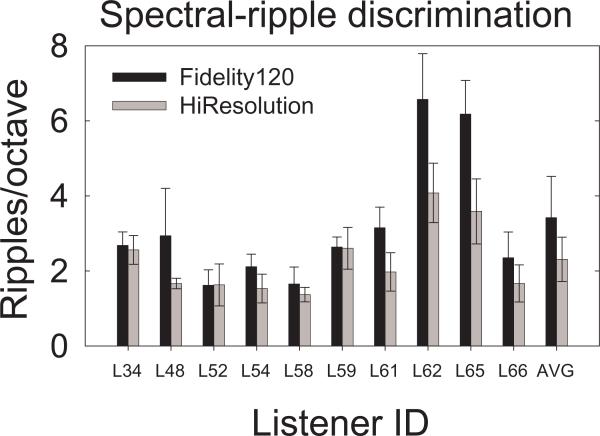
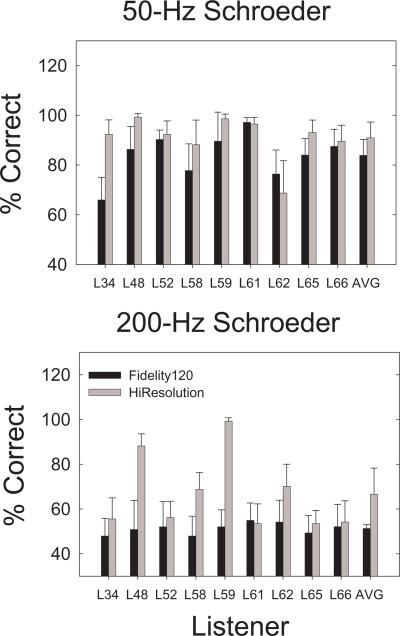
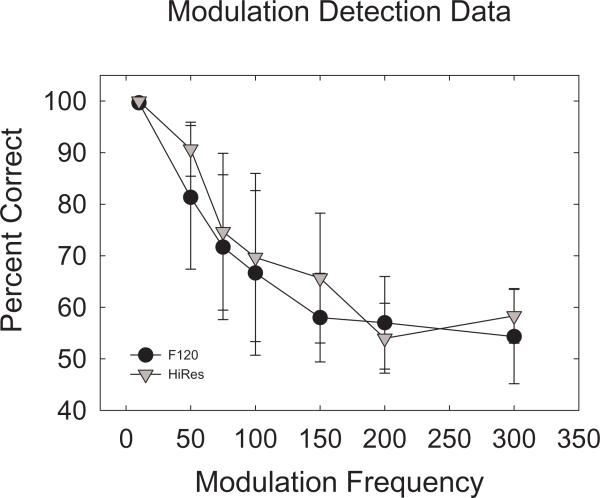
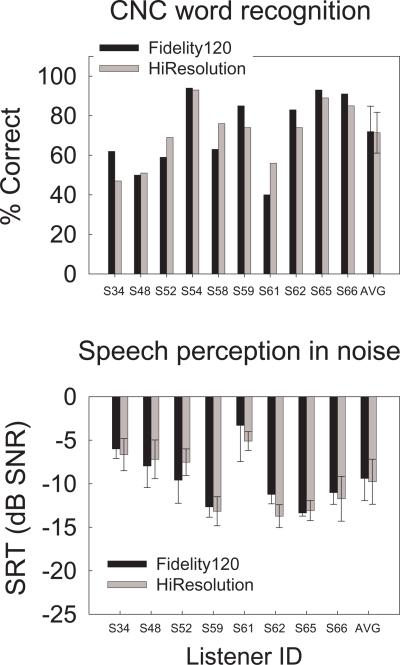
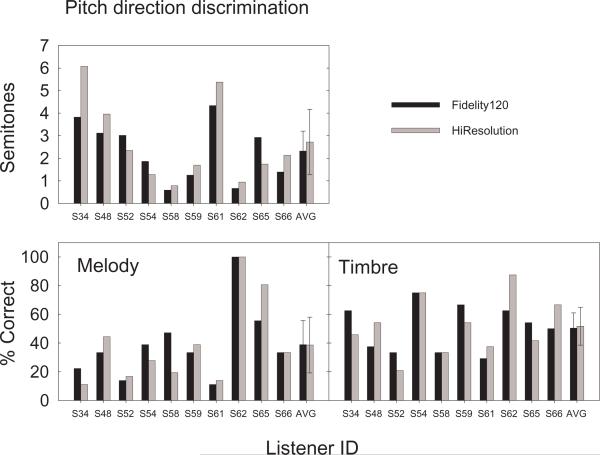
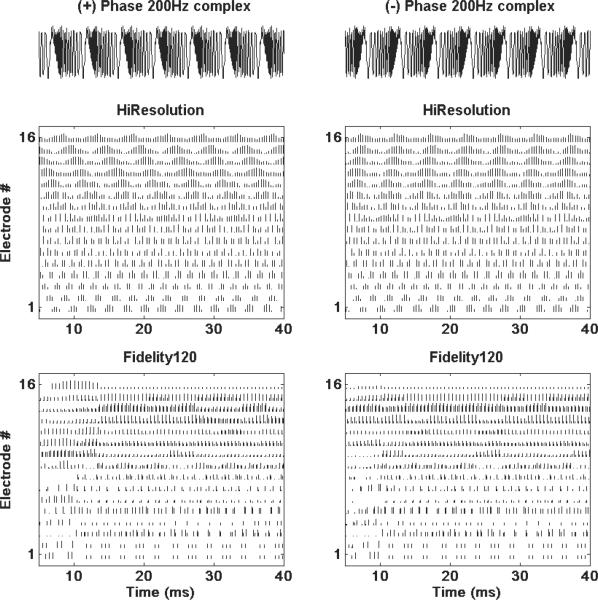
Experienced users of the Clarion cochlear implant were tested acutely with the HiResolution (HiRes) and HiRes Fidelity120 (F120) processing strategies. Three psychophysically-based tests were used including spectral-ripple discrimination, Schroeder-phase discrimination and temporal modulation detection. Three clinical outcome measures were used including consonant-nucleus-consonant (CNC) word recognition in quiet, word recognition in noise and the clinical assessment of music perception (CAMP). Listener's spectral-ripple discrimination ability improved with F120, but Schroeder-phase discrimination was worse with F120 than with HiRes. Listeners who had better than average acuity showed the biggest effects. There were no significant effects of the processing strategy on any of the clinical abilities nor on temporal modulation detection. Additionally, the listeners' day-to-day clinical strategy did not appear to influence the result suggesting that experience with the strategies did not play a significant role. The results underscore the value of acoustic psychophysical measures through the sound processor as a tool in clinical research, because these measures are more sensitive to changes in the processing strategies than traditional clinical measures, e.g. speech understanding. The measures allow for the evaluation of sensitivity to specific acoustic attributes revealing the extent to which different processing strategies affect these basic abilities and could thus improve the efficiency of the development of processing strategies.
Copyright 2010 Elsevier B.V. All rights reserved.
Figures
References
-
- Anderson ESC, Kreft HA, Oxenham AJ, Nelson DA. Comparing spatial tuning curves with local and global measures of spectral ripple resolution. 2009 Conference on Implantable Auditory Prostheses; Tahoe City, CA. 2009.
-
- Bacon SP, Viemeister NF. Temporal modulation transfer functions in normal-hearing and hearing-impaired listeners. Audiology. 1985;24:117–134. - PubMed
-
- Berenstein CK, Mens LHM, Mulder JJS, Vanpoucke FJ. Current steering and current focusing in cochlear implants: comparison of monopolar, tripolar and virtual channel electrode configurations. Ear Hear. 2008;29:250–260. - PubMed
-
- Brendel M, Buechner A, Krueger B, Frohne-Buechner C, Lenarz T. Evaluation of the Harmony sound processor in combination with the speech coding strategy HiRes120. Otol. Neurotol. 2008;29:199–202. - PubMed
-
- Buechner A, Brendel M, Krueger B, Frohne-Buechner C, Nogueira W, Edler B, Lenarz T. Current steering and results from novel speech coding strategies. Otol. Neurotol. 2008;29:203–207. - PubMed
Publication types
MeSH terms
Grants and funding
LinkOut - more resources
Full Text Sources
Other Literature Sources
Medical
