Fluoroquinolone resistance in Streptococcus dysgalactiae subsp. equisimilis and evidence for a shared global gene pool with Streptococcus pyogenes
- PMID: 20145082
- PMCID: PMC2863612
- DOI: 10.1128/AAC.01377-09
Fluoroquinolone resistance in Streptococcus dysgalactiae subsp. equisimilis and evidence for a shared global gene pool with Streptococcus pyogenes
Abstract
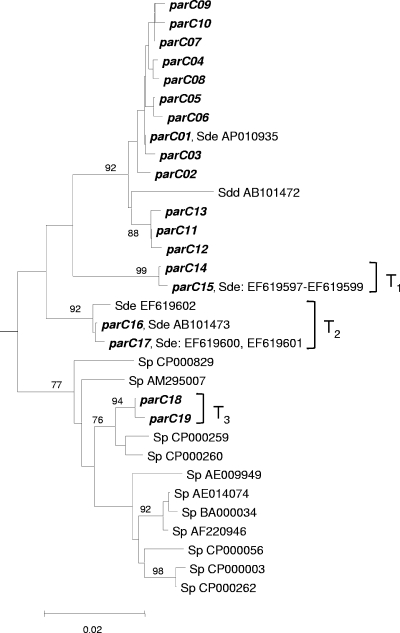
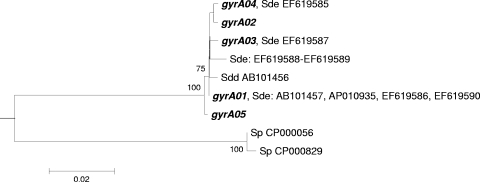
Quinolone resistance is an emerging problem in Streptococcus pyogenes, and recombination with Streptococcus dysgalactiae DNA has been implicated as a frequent mechanism leading to resistance. We have characterized a collection of S. dysgalactiae subsp. equisimilis isolates responsible for infections in humans (n = 314) and found a high proportion of levofloxacin-resistant isolates (12%). Resistance was associated with multiple emm types and genetic lineages, as determined by pulsed-field gel electrophoretic profiling. Since we could not find evidence for a role of efflux pumps in resistance, we sequenced the quinolone resistance-determining regions of the gyrA and parC genes of representative resistant and susceptible isolates. We found much greater diversity among the parC genes (19 alleles) than among the gyrA genes (5 alleles). While single mutations in either GyrA or ParC were sufficient to raise the MIC so that the strains were classified as intermediately resistant, higher-level resistance was associated with mutations in both GyrA and ParC. Evidence for recombination with S. pyogenes DNA was found in some parC alleles, but this was not exclusively associated with resistance. Our data support the existence of a common reservoir of genes conferring quinolone resistance shared between S. dysgalactiae subsp. equisimilis and S. pyogenes, while no recombination with the animal pathogen S. dysgalactiae subsp. dysgalactiae could be found.
Figures

References
-
- Albertí, S., G. Cortes, C. Garcia-Rey, C. Rubio, F. Baquero, J. A. Garcia-Rodriguez, E. Bouza, and L. Aguilar. 2005. Streptococcus pyogenes pharyngeal isolates with reduced susceptibility to ciprofloxacin in Spain: mechanisms of resistance and clonal diversity. Antimicrob. Agents Chemother. 49:418-420. - PMC - PubMed
-
- Bast, D. J., D. E. Low, C. L. Duncan, L. Kilburn, L. A. Mandell, R. J. Davidson, and J. C. de Azavedo. 2000. Fluoroquinolone resistance in clinical isolates of Streptococcus pneumoniae: contributions of type II topoisomerase mutations and efflux to levels of resistance. Antimicrob. Agents Chemother. 44:3049-3054. - PMC - PubMed
-
- Biedenbach, D. J., M. A. Toleman, T. R. Walsh, and R. N. Jones. 2006. Characterization of fluoroquinolone-resistant beta-hemolytic Streptococcus spp. isolated in North America and Europe including the first report of fluoroquinolone-resistant Streptococcus dysgalactiae subspecies equisimilis: report from the SENTRY Antimicrobial Surveillance Program (1997-2004). Diagn. Microbiol. Infect. Dis. 55:119-127. - PubMed
Publication types
MeSH terms
Substances
Associated data
- Actions
- Actions
- Actions
- Actions
- Actions
- Actions
- Actions
- Actions
- Actions
- Actions
- Actions
- Actions
- Actions
- Actions
- Actions
- Actions
- Actions
- Actions
- Actions
- Actions
- Actions
- Actions
- Actions
- Actions
LinkOut - more resources
Full Text Sources
Medical
Molecular Biology Databases