. 2010 Feb 15;70(4):1377-88.
doi: 10.1158/0008-5472.CAN-09-2598. Epub 2010 Feb 9.

p53 is a direct transcriptional target of MYCN in neuroblastoma

Affiliations

p53 is a direct transcriptional target of MYCN in neuroblastoma

Lindi Chen et al. Cancer Res. .

Abstract

MYCN amplification occurs in approximately 25% of neuroblastomas, where it is associated with rapid tumor progression and poor prognosis. MYCN plays a paradoxical role in driving cellular proliferation and inducing apoptosis. Based on observations of nuclear p53 accumulation in neuroblastoma, we hypothesized that MYCN may regulate p53 in this setting. Immunohistochemical analysis of 82 neuroblastoma tumors showed an association of high p53 expression with MYCN expression and amplification. In a panel of 5 MYCN-amplified and 5 nonamplified neuroblastoma cell lines, and also in the Tet21N-regulatable MYCN expression system, we further documented a correlation between the expression of MYCN and p53. In MYCN-amplified neuroblastoma cell lines, MYCN knockdown decreased p53 expression. In Tet21N MYCN+ cells, higher levels of p53 transcription, mRNA, and protein were observed relative to Tet21N MYCN- cells. In chromatin immunoprecipitation and reporter gene assays, MYCN bound directly to a Myc E-Box DNA binding motif located close to the transcriptional start site within the p53 promoter, where it could initiate transcription. E-Box mutation decreased MYCN-driven transcriptional activation. Microarray analysis of Tet21N MYCN+/- cells identified several p53-regulated genes that were upregulated in the presence of MYCN, including MDM2 and PUMA, the levels of which were reduced by MYCN knockdown. We concluded that MYCN transcriptionally upregulates p53 in neuroblastoma and uses p53 to mediate a key mechanism of apoptosis.


Figures
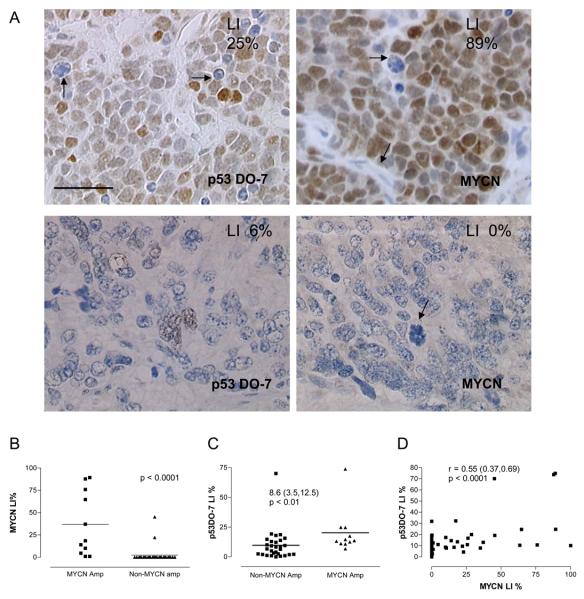
Figure 1
Figure 1. p53 expression is associated with MYCN amplification and MYCN protein expression in untreated neuroblastoma tumors
A) Upper panel Immunohistochemistry of a stroma-poor, undifferentiated, MYCN amplified, stage 4 primary neuroblastoma, using (Left) p53DO-7 antibody showing heterogeneous nuclear immunostaining, absent in apoptotic cells (arrowed) and (Right) MYCN antibody showing heterogeneous nuclear immunostaining with negative stroma and negative mitotic and apoptotic cells (arrowed). Lower Panel Immunohistochemistry of a stroma-poor nodule of a non-MYCN amplified, stage 4 primary nodular ganglioneuroblastoma, using (Left) p53DO-7 antibody showing low level nuclear immunostaining and (Right) MYCN antibody showing absent immunostaining and a mitotic cell (arrowed). Labeling Indices (LI) for antibodies are also shown in top right of images. Scale bar 50μM. B & C Scatter plots of Labeling Indices (LI) showing median expression (two tailed Mann-Whitney tests used) B) MYCN amplification vs MYCN LI, and C) MYCN amplification vs p53DO-7 LI (median difference shown and 95% Confidence Interval). D) Correlation between p53DO-7 LI and MYCN LI (Spearman Correlation and 95% Confidence Interval).
Figure 2
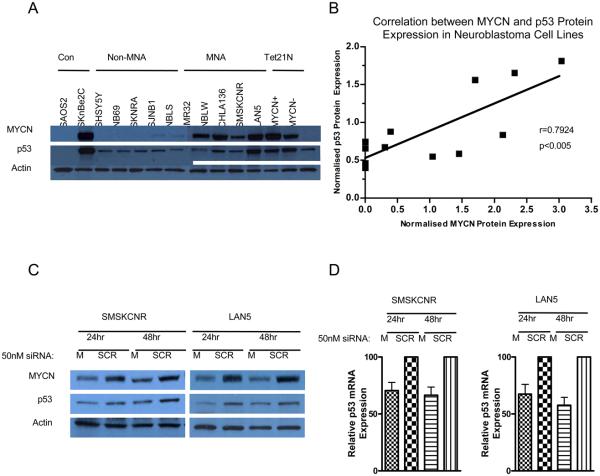
Figure 2. p53 expression correlates with MYCN status and expression in neuroblastoma cell lines
A) Western blot showing p53 and MYCN protein expression in neuroblastoma cell lines Con = control. B) Correlation between p53 protein and MYCN protein expression in neuroblastoma cell lines (Spearman Correlation, r=0.7924, p<0.005). p53 and MYCN expression was determined using densitometry, and normalized to actin. Knockdown of MYCN expression using siRNA (50nM) (M) in two MYCN amplified neuroblastoma cell lines, SMSKCNR and LAN5 compared with scrambled siRNA (SCR) led to decreased C) p53 protein expression and D) mRNA expression in both cell lines.
Figure 3
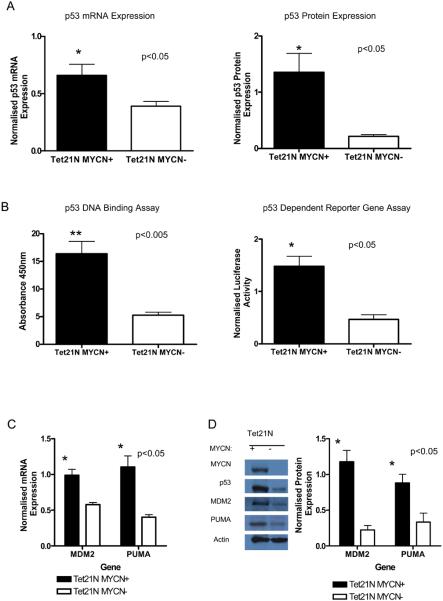
Figure 3. p53 mRNA and protein expression, and DNA binding and transcriptional activity in Tet21N cells
A) p53 (Left) mRNA and (Right) protein expression in the presence of MYCN, (paired t-test, p<0.05). B) (Left) p53 DNA binding capacity (paired t-test, p<0.005) and (Right) p53-dependent reporter gene activity (paired t-test, p<0.05) in the presence of MYCN. The luciferase activity of the p53-dependent pGL3-P2 reporter construct was normalized to β-galactosidase activity of pCMV-β-galactosidase plasmid construct. C) Bar chart showing higher mRNA expression of p53 target genes MDM2 and PUMA in the presence of MYCN (paired t-test, p<0.05). D) (Left) Western blot and (Right) densitometry analysis normalized to actin showing higher protein expression of p53 target genes MDM2 and PUMA in the presence of MYCN (paired t-test, p<0.05).
Figure 4
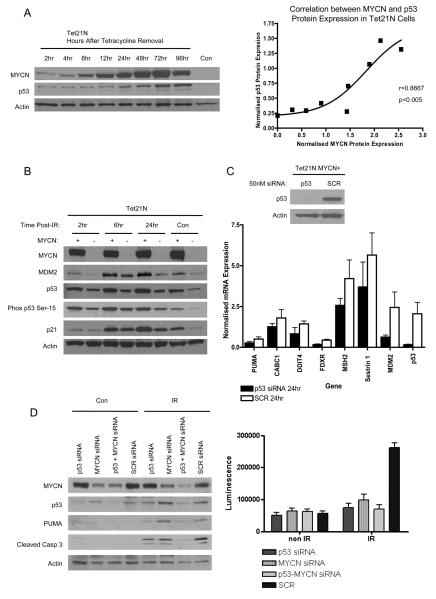
Figure 4. p53 expression in the presence of MYCN is functional after DNA damage, and necessary for apoptosis
A) (Left) Western blot and (Right) representative graph showing the positive correlation between MYCN protein and p53 protein expression in Tet21N cells harvested after tetracycline removal from growth media (Spearman Correlation, r=0.7924, p<0.005). Con, cells cultured continuously in the presence of tetracycline. B) Western analysis showing p53 is functional in both Tet21N MYCN+ and MYCN− cells after DNA damage, leading to induction of target genes p21WAF1 and MDM2. Con, non-irradiated samples. C) qRT-PCR analysis of 7 p53 regulated genes identified using microarray analysis, upregulated in the presence of MYCN and showed a decrease in expression after p53 siRNA treatment (50nM) for 24 hours. D) MYCN amplified NGP cells treated with MYCN siRNA (40nM), p53 siRNA (50nM), p53 and MYCN siRNA (35nM of each siRNA) or SCR siRNA (70nM) for 48 hours prior to irradiation induced DNA damage. 24 hours post irradiation cells were harvested and analyzed for the expression of apoptosis mediators cleaved caspase 3 and PUMA (Left) and Capsase-3/7 activity (Right).
Figure 5
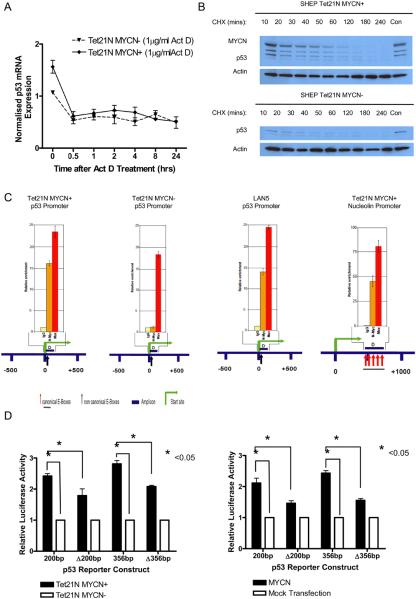
Figure 5. MYCN predominantly regulates p53 at the transcriptional level, via direct binding to the E-Box motif within the p53 promoter
A) qRT-PCR analysis of p53 mRNA expression in Tet21N MYCN+ and MYCN− cells after treatment with 1μg/ml Actinomycin D, shows a decrease in p53 mRNA expression, suggesting that MYCN regulates p53 transcription. B) Western blot showing p53 and MYCN protein expression in (Top) Tet21N MYCN+ and (Bottom) MYCN− cells harvested after treatment with 25μM of Cycloheximide (CHX), demonstrates a decrease in p53 expression suggesting that p53 is not predominantly post-translationally stabilized. C) MYCN ChIP analysis of the p53 promoter in (Left) Tet21N MYCN+ cells, (second from left) Tet21N MYCN− cells and (second from right) MYCN amplified LAN5 cells. (Right) As a positive control direct binding of MYCN to the nucleolin promoter in Tet21N MYCN+ cells is shown. D) Relative luciferase activity of p53 promoter constructs (pGL2-200bp, pGL2-Δ200bp, pGL2-356bp, pGL2-Δ356bp) transfected into (Left) Tet21N MYCN+ and MYCN− cells, and (Right) co-transfected with pCMV14-MYCN expression plasmid into SHEP cells.

References

    1. Matthay KK, Reynolds CP, Seeger RC, et al. Long-term results for children with high-risk neuroblastoma treated on a randomized trial of myeloablative therapy followed by 13-cis-retinoic acid: a children's oncology group study. Journal of Clinical Oncology. 2009;27:1007–13. - PMC - PubMed
    1. Pearson AD, Pinkerton CR, Lewis IJ, Imeson J, Ellershaw C, Machin D. High-dose rapid and standard induction chemotherapy for patients aged over 1 year with stage 4 neuroblastoma: a randomised trial. The lancet oncology. 2008;9:247–56. - PubMed
    1. Cohn SL, Tweddle DA. MYCN amplification remains prognostically strong 20 years after its “clinical debut”. European Journal of Cancer. 2004;40:2639–42. - PubMed
    1. Grandori C, Eisenman RN. Myc target genes. Trends in Biochemical Sciences. 1997;22:177–81. - PubMed
    1. Zeller KI, Jegga AG, Aronow BJ, O'Donnell KA, Dang CV. An integrated database of genes responsive to the Myc oncogenic transcription factor: identification of direct genomic targets. Genome biology. 2003;4:R69. - PMC - PubMed

Publication types

MeSH terms