. 2010 Feb;22(2):364-75.
doi: 10.1105/tpc.109.071209. Epub 2010 Feb 9.

Very-long-chain fatty acids are involved in polar auxin transport and developmental patterning in Arabidopsis

Affiliations

Very-long-chain fatty acids are involved in polar auxin transport and developmental patterning in Arabidopsis

François Roudier et al. Plant Cell. 2010 Feb.

Abstract

Very-long-chain fatty acids (VLCFAs) are essential for many aspects of plant development and necessary for the synthesis of seed storage triacylglycerols, epicuticular waxes, and sphingolipids. Identification of the acetyl-CoA carboxylase PASTICCINO3 and the 3-hydroxy acyl-CoA dehydratase PASTICCINO2 revealed that VLCFAs are important for cell proliferation and tissue patterning. Here, we show that the immunophilin PASTICCINO1 (PAS1) is also required for VLCFA synthesis. Impairment of PAS1 function results in reduction of VLCFA levels that particularly affects the composition of sphingolipids, known to be important for cell polarity in animals. Moreover, PAS1 associates with several enzymes of the VLCFA elongase complex in the endoplasmic reticulum. The pas1 mutants are deficient in lateral root formation and are characterized by an abnormal patterning of the embryo apex, which leads to defective cotyledon organogenesis. Our data indicate that in both tissues, defective organogenesis is associated with the mistargeting of the auxin efflux carrier PIN FORMED1 in specific cells, resulting in local alteration of polar auxin distribution. Furthermore, we show that exogenous VLCFAs rescue lateral root organogenesis and polar auxin distribution, indicating their direct involvement in these processes. Based on these data, we propose that PAS1 acts as a molecular scaffold for the fatty acid elongase complex in the endoplasmic reticulum and that the resulting VLCFAs are required for polar auxin transport and tissue patterning during plant development.


Figures
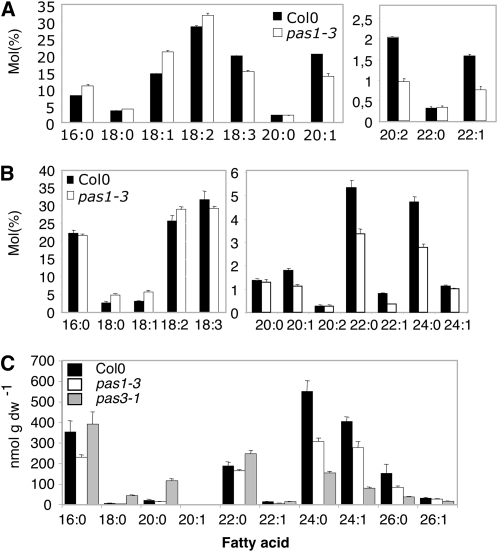
Figure 1.
Figure 1.
Lipids with Very Long Acyl Chains Are Altered in pas1-3 and pas3-1 Mutants. (A) Triacylglycerol composition of wild-type (Col-0; black bars) and pas1-3 seeds (white bars). (B) Total fatty acid composition of wild-type (Col-0; black bars) and pas1-3 mutant 10-d-old roots (white bars). (C) Sphingolipid composition of wild-type (Col-0; black bars), pas1-3 (white bars), and pas3-1 (gray bars) seedlings. Data represents the mean of three independent analyses. Error bar indicates se.
Figure 2.
Figure 2.
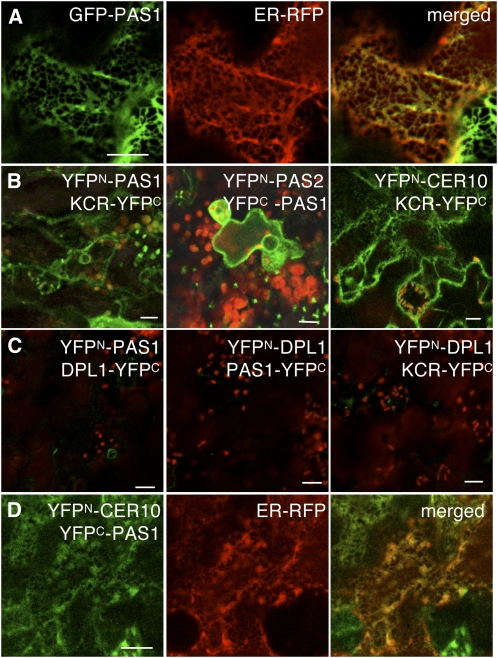
PAS1 Interacts with Elongase Enzymes in the ER of Arabidopsis Epidermal Cells. (A) Coexpression of 35S:GFP-PAS1 (left) and ER marker CD3-959:mCherry (middle) showed colocalization (merged, right). (B) Coexpression of the split YFP pairs YFPN-PAS1/KCR-YFPC, YFPN-PAS2/ YFPC-PAS1, and YFPN-CER10/KCR-YFPC led to BiFC of YFP (green). Chloroplast autofluorescence is red. (C) Coexpression of split YFP pairsYFPN-PAS1/ YFPC-DPL1, YFPN-DPL1/ YFPC-PAS1, and YFPN-CER10/YFPC-DPL1 did not produce any YFP fluorescence. (D) Coexpression of YFPN-CER10/YFPC-PAS1 GFP (left) and ER marker CD3-959:mCherry (middle) showed BiFC colocalization in the ER (merged, right). Bars = 10 μm in (A) to (C) and 40 μm in (D).
Figure 3.
Figure 3.
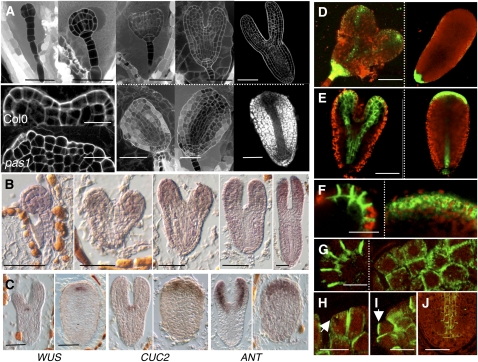
PAS1 Is Required for Cell Patterning and Polarity in the Embryo Apex. (A) Development of wild-type (top row) embryo at the dermatogen, globular, heart, torpedo, and late torpedo stage, respectively (from left to right). The first phenotypic alteration in pas1-3 embryos is visible at the heart stage with the absence of cotyledon formation (bottom row). Mutant embryos (bottom) were taken at the same respective stage (i.e., from the same silique) as the wild type (top row). Apical cells of pas1 embryos have lost their polar growth (inset, bottom) compared with the wild type (inset, top). Embryos were fixed and stained with propidium iodide. (B) In situ hybridization of PAS1 mRNA during embryo development in the wild type. Embryos were taken at globular, young heart, late heart, young torpedo, and late torpedo stages (left to right). (C) In situ hybridization of WUS, CUC2, and ANTEGUMENTA (ANT) mRNA in wild-type (left panel of each pair) and pas1-3 (right panel of each pair) embryos. Bars = 40 μm except for the inset in (A), which is10 μm. (D) pDR5-GFP distribution in the wild type (left) and pas1-3 mutant (right). (E) pPIN1:PIN1-GFP distribution in the wild type (left) and pas1-3 mutant (right). (F) Detail of pPIN1:PIN1-GFP distribution in the tip of a wild-type cotyledon (left) and the apex of pas1-3 embryo (right) at heart stage. (G) to (J) Immunolocalization of PIN1 in wild-type and pas1-3 embryos. (G) Detail of PIN1 distribution in the tip of a wild-type cotyledon (left) and in the apex of the pas1-3 mutant where aggregates are visible (right). (H) and (I) Altered polar distribution of PIN1 in the apex of the pas1-3 mutant with PIN1 localizations facing each other in adjacent cells ([H], arrow) or facing outward ([I], arrow). (J) PIN1 polarity is normal in pas1-3 provascular and root pole cells. Bars = 40 μm in (D) and (E), 20 μm in (F), 10 μm in (G) to (I), and 30 μm in (J).
Figure 4.
Figure 4.
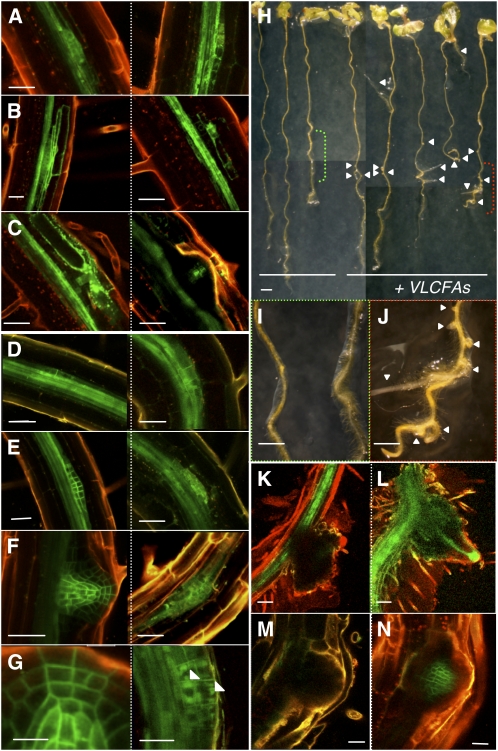
VLCFAs Are Involved in Lateral Root Development and Auxin Polar Distribution. (A) to (G) pDR5:GFP ([A] to [C]) and pPIN1:PIN1-GFP ([D] to [G]) expression during sequential steps of lateral root development in the wild type (left) and the pas1-3 mutant (right). In the pas1 mutant, PIN1-GFP was found accumulated inside primordia cells ([E] to [G], right) often in aggregates ([G], arrows). (H) to (J) Exogenous application of VLCFAs restored lateral root development in pas1-3 mutants. Seedlings were grown in presence ([H], right) or absence ([H], left) of 200 μM fatty acids (18:0, 20:0, 22:0, and 24:0). Details of control ([I], green bracket in [H]) or treated roots ([J], red bracket in [H]) are shown. Arrows point to lateral root outgrowth in the pas1-3 mutant ([H] and [J]). (K) to (N) VLCFA application restores polar auxin transport in pas1-3 lateral roots. Normal pDR5:GFP ([K] and [L]) and pPIN1:PIN1-GFP ([M] and [N]) expression patterns were observed in treated pas1-3 lateral root tips ([L] and [N]) but not in untreated mutant roots ([K] and [M]). Bars = 45 μm in (A) to (F), 30 μm in (G) (left), 20 μm in (G) (right), 1 mm in (H), 300 μm in (I) and (J), and 20 μm in (K) to (N).
Figure 5.
Figure 5.
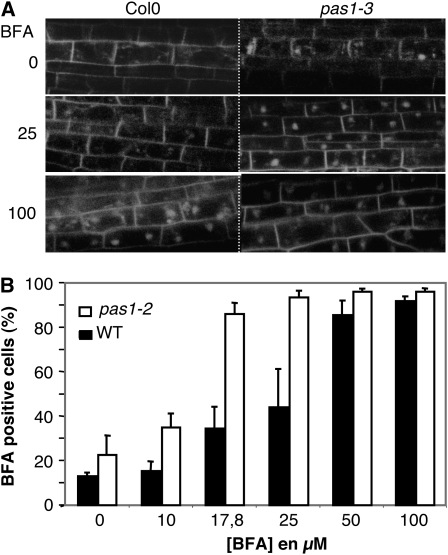
BFA-Dependent PIN1-GFP Aggregation Is Enhanced in pas1 Mutant Cells. (A) BFA induction of PIN1-GFP aggregation in pas1. In contrast with the wild type (left), PIN1-GFP aggregation can be observed in the pas1-3 mutant (right) even in the absence of BFA (0 μM) and is strongly enhanced with 25 μM BFA treatment. (B) The pas1-3 mutation enhances sensitivity to BFA. The relative number of vascular cells showing BFA compartments as illustrated in (A) at 100 μM was monitored in the wild type and pas1 according to the BFA concentration. Data are the mean of three replicates of 25 roots ± se.
Figure 6.
Figure 6.
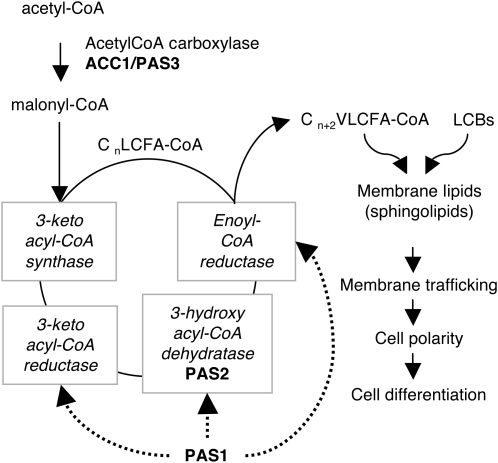
A Model for the Role of PAS Proteins and VLCFAs in Plant Cell Differentiation. Fatty acid elongation requires long-chain fatty acyl-CoA (Cn LCFA-CoA) of n carbons and malonyl-CoA produced by the acetyl-CoA carboxylase PAS3. Elongation occurs in the ER membrane with four sequential reactions (boxed enzymes) to eventually produce very-long-chain fatty acyl-CoA of n+2 carbons (Cn+2 VLCFA-CoA). PAS1, by its association with elongase enzymes (dashed arrows), is required for fatty acid elongation. The role of VLCFA-CoA on plant development is most probably associated with the synthesis of membrane sphingolipids with long-chain bases (LCBs). Sphingolipids have been described to be involved in membrane trafficking and cell polarity, which are key determinants of cell differentiation.

References

    1. Aida M., Vernoux T., Furutani M., Traas J., Tasaka M. (2002). Roles of PIN-FORMED1 and MONOPTEROS in pattern formation of the apical region of the Arabidopsis embryo. Development 129: 3965–3974 - PubMed
    1. Bach L., et al. (2008). The plant very long chain hydroxy fatty Acyl-CoA dehydratase PASTICCINO2 is essential and limiting for plant development. Proc. Natl. Acad. Sci. USA 105: 14727–14731 - PMC - PubMed
    1. Barik S. (2006). Immunophilins: for the love of proteins. Cell. Mol. Life Sci. 63: 2889–2900 - PMC - PubMed
    1. Baud S., Bellec Y., Miquel M., Bellini C., Caboche M., Lepiniec L., Faure J.D., Rochat C. (2004). gurke and pasticcino3 mutants affected in embryo development are impaired in acetyl-CoA carboxylase. EMBO Rep. 5: 1–6 - PMC - PubMed
    1. Baud S., Guyon V., Kronenberger J., Wuillème S., Miquel M., Caboche M., Lepiniec L., Rochat C. (2003). Multifonctional acetyl-CoA carboxylase 1 is essential for very long chain fatty acids elongation and embryo development in Arabidopsis. Plant J. 33: 75–86 - PubMed

Publication types

MeSH terms