


Comparison of trial participants and open access users of a web-based physical activity intervention regarding adherence, attrition, and repeated participation
- PMID: 20147006
- PMCID: PMC3838478
- DOI: 10.2196/jmir.1361
Comparison of trial participants and open access users of a web-based physical activity intervention regarding adherence, attrition, and repeated participation
Abstract
Background: Web-based interventions are popular for promoting healthy lifestyles such as physical activity. However, little is known about user characteristics, adherence, attrition, and predictors of repeated participation on open access physical activity websites.
Objective: The focus of this study was Active-online, a Web-based individually tailored physical activity intervention. The aims were (1) to assess and compare user characteristics and adherence to the website (a) in the open access context over time from 2003 to 2009, and (b) between trial participants and open access users; and (2) to analyze attrition and predictors of repeated use among participants in a randomized controlled trial compared with registered open access users.
Methods: Data routinely recorded in the Active-online user database were used. Adherence was defined as: the number of pages viewed, the proportion of visits during which a tailored module was begun, the proportion of visits during which tailored feedback was received, and the time spent in the tailored modules. Adherence was analyzed according to six one-year periods (2003-2009) and according to the context (trial or open access) based on first visits and longest visits. Attrition and predictors of repeated participation were compared between trial participants and open access users.
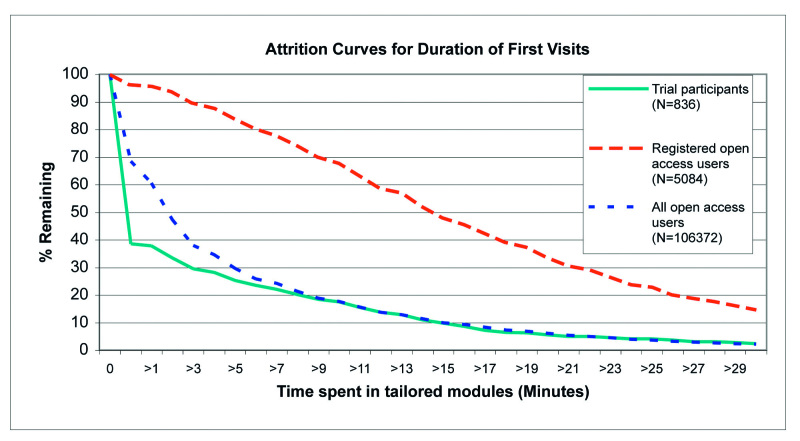
Results: The number of recorded visits per year on Active-online decreased from 42,626 in 2003-2004 to 8343 in 2008-2009 (each of six one-year time periods ran from April 23 to April 22 of the following year). The mean age of users was between 38.4 and 43.1 years in all time periods and both contexts. The proportion of women increased from 49.5% in 2003-2004 to 61.3% in 2008-2009 (P< .001). There were differences but no consistent time trends in adherence to Active-online. The mean age of trial participants was 43.1 years, and 74.9% were women. Comparing contexts, adherence was highest for registered open access users. For open access users, adherence was similar during the first and the longest visits; for trial participants, adherence was lower during the first visits and higher during the longest visits. Of registered open access users and trial participants, 25.8% and 67.3% respectively visited Active-online repeatedly (P< .001). Predictors of repeated use were male sex (odds ratio [OR] = 1.2, 95% confidence interval [CI] = 1.04-1.38) and increasing age category in registered open access users, and age 46-60 versus < 30 years (OR = 3.04, 95% CI = 1.25-7.38) and Swiss nationality (OR(nonSwiss)= 0.64, 95% CI = 0.41-1.00) in trial participants. Despite reminder emails, attrition was much higher in registered open access users compared with trial participants, with a median lifetime website usage of 0 days in open access users and 290 days in trial participants.
Conclusions: Adherence, patterns of use, attrition, and repeated participation differed between trial participants and open access users. Reminder emails to encourage repeated participation were effective for trial participants but not for registered open access users. These issues are important when interpreting results of randomized controlled effectiveness trials.
Conflict of interest statement
Conflicts of Interest: None declared.
Figures




References
-
- Oenema A, Tan F, Brug J. Short-term efficacy of a web-based computer-tailored nutrition intervention: main effects and mediators. Ann Behav Med. 2005;29(1):54–63. - PubMed
-
- Walters ST, Wright JA, Shegog R. A review of computer and Internet-based interventions for smoking behavior. Addict Behav. 2006;31(2):264–277. - PubMed
-
- van den Berg Marleen H, Schoones Johannes W, Vliet Vlieland Theodora P M. Internet-based physical activity interventions: a systematic review of the literature. J Med Internet Res. 2007;9(3):e26. doi: 10.2196/jmir.9.3.e26. http://www.jmir.org/2007/3/e26/ - DOI - PMC - PubMed
-
- Vandelanotte C, Spathonis KM, Eakin EG, Owen N. Website-delivered physical activity interventions a review of the literature. Am J Prev Med. 2007;33(1):54–64. - PubMed
-
- Oenema A, Brug J, Dijkstra A, de Weerdt I, de Vries H. Efficacy and use of an internet-delivered computer-tailored lifestyle intervention, targeting saturated fat intake, physical activity and smoking cessation: a randomized controlled trial. Ann Behav Med. 2008;35(2):125–135. - PubMed
Publication types
MeSH terms
LinkOut - more resources
Full Text Sources
Miscellaneous
