


Reduced caloric intake during endotoxemia reduces arginine availability and metabolism
- PMID: 20147469
- PMCID: PMC6443292
- DOI: 10.3945/ajcn.2009.27812
Reduced caloric intake during endotoxemia reduces arginine availability and metabolism
Abstract
Background: Inadequate caloric intake increases the risk of sepsis-induced complications. Metabolic changes during sepsis indicate that the availability of the amino acid l-arginine decreases. Availability of arginine may further decrease during reduced caloric intake, which thereby limits the adaptive response of arginine-nitric oxide metabolism during sepsis.
Objective: We tested the hypothesis that reduced caloric intake during endotoxemia, as an experimental model for sepsis, further reduces arginine availability.
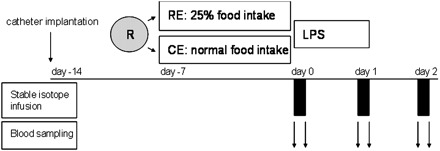
Design: In a randomized trial, a 7-d reduced caloric intake feed regimen (RE; n = 9) was compared with a normal control feed regimen (CE; n = 9), before 24 h of endotoxemia, as a model for sepsis. Whole-body arginine-nitric oxide metabolism and protein metabolism were measured by using a stable-isotope infusion of [(15)N(2)]arginine, [(13)C-(2)H(2)]citrulline, [(2)H(5)]phenylalanine, and [(2)H(2)]tyrosine. Plasma pyruvate and lactate concentrations were determined by fully automated HPLC.
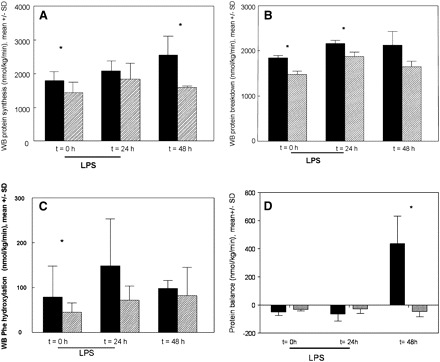
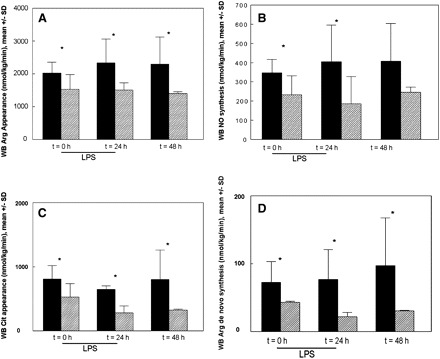
Results: Pre-endotoxin arginine appearance was significantly lower in the RE group than in the CE group (P = 0.002). During endotoxemia, arginine appearance increased in the CE animals but not in the RE animals (P = 0.04). In addition, nitric oxide production was significantly lower in the RE animals (P < 0.0001). Protein synthesis was significantly lower at the start of endotoxin infusion (P < 0.05) and remained lower during endotoxemia in the RE group than in the CE group (P < 0.001). The lactate:pyruvate ratio was not higher in the RE group than in the CE group before endotoxemia but increased significantly during endotoxemia in the RE group (P = 0.04).
Conclusion: A well-nourished condition before prolonged endotoxemia results in a better ability to adapt to endotoxin-induced metabolic deterioration of arginine-nitric oxide metabolism than does reduced caloric intake before endotoxemia.
Figures
References
-
- Barr J, Hecht M, Flavin KE, Khorana A, Gould MK.. Outcomes in critically ill patients before and after the implementation of an evidence-based nutritional management protocol. Chest 2004;125:1446–57. - PubMed
-
- Ing AF, Meakins JL, McLean AP, Christou NV.. Determinants of susceptibility to sepsis and mortality: malnutrition vs anergy. J Surg Res 1982;323:249–55. - PubMed
-
- Milewski PJ, Threlfall CJ, Heath DF, Holbrook IB, Wilford K, Irving MH.. Intracellular free amino acids in undernourished patients with or without sepsis. Clin Sci (Lond) 1982;621:83–91. - PubMed
-
- McClave SA, Mitoraj TE, Thielmeier KA, Greenburg RA.. Differentiating subtypes (hypoalbuminemic vs marasmic) of protein-calorie malnutrition: incidence and clinical significance in a university hospital setting. JPEN J Parenter Enteral Nutr 1992;16:337–42. - PubMed
-
- Beisel WR.. Metabolic response to infection. Annu Rev Med 1975;26:9–20. - PubMed
Publication types
MeSH terms
Substances
Grants and funding
LinkOut - more resources
Full Text Sources
