


Neuroligin-1 deletion results in impaired spatial memory and increased repetitive behavior
- PMID: 20147539
- PMCID: PMC2824441
- DOI: 10.1523/JNEUROSCI.4517-09.2010
Neuroligin-1 deletion results in impaired spatial memory and increased repetitive behavior
Abstract
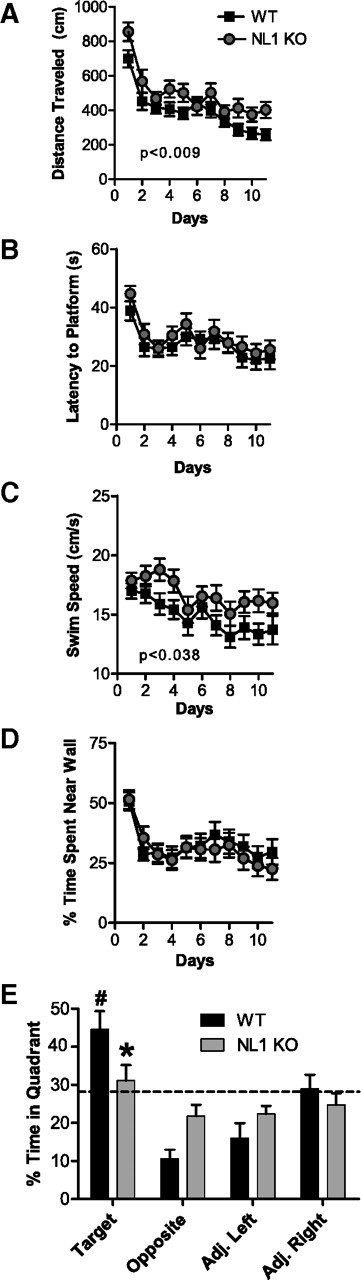
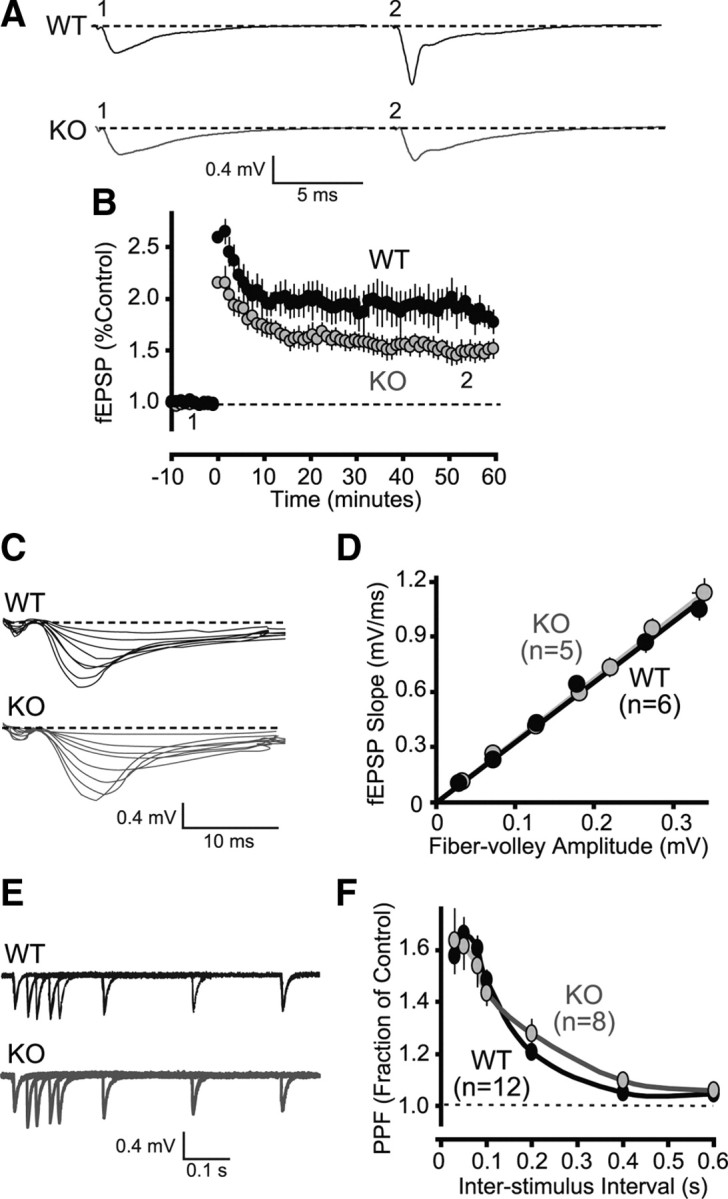
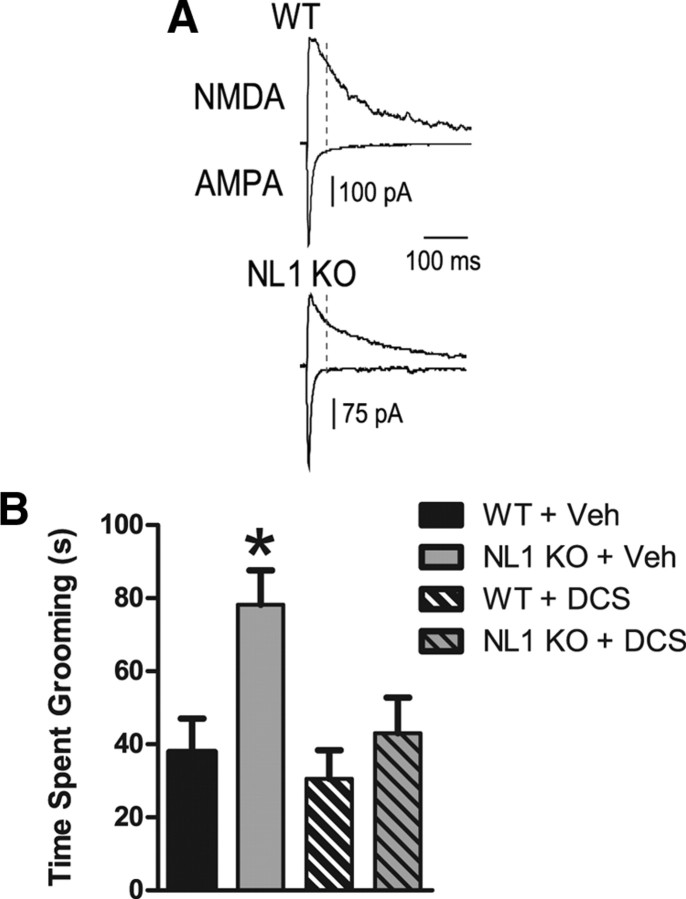
Neuroligins (NLs) are a family of neural cell-adhesion molecules that are involved in excitatory/inhibitory synapse specification. Multiple members of the NL family (including NL1) and their binding partners have been linked to cases of human autism and mental retardation. We have now characterized NL1-deficient mice in autism- and mental retardation-relevant behavioral tasks. NL1 knock-out (KO) mice display deficits in spatial learning and memory that correlate with impaired hippocampal long-term potentiation. In addition, NL1 KO mice exhibit a dramatic increase in repetitive, stereotyped grooming behavior, a potential autism-relevant abnormality. This repetitive grooming abnormality in NL1 KO mice is associated with a reduced NMDA/AMPA ratio at corticostriatal synapses. Interestingly, we further demonstrate that the increased repetitive grooming phenotype can be rescued in adult mice by administration of the NMDA receptor partial coagonist d-cycloserine. Broadly, these data are consistent with a role of synaptic cell-adhesion molecules in general, and NL1 in particular, in autism and implicate reduced excitatory synaptic transmission as a potential mechanism and treatment target for repetitive behavioral abnormalities.
Figures
References
-
- Aldridge JW, Berridge KC, Rosen AR. Basal ganglia neural mechanisms of natural movement sequences. Can J Physiol Pharmacol. 2004;82:732–739. - PubMed
-
- American Psychiatric Association. Diagnostic and statistical manual of mental disorders DSM-IV-TR. Washington, DC: American Psychiatric Association; 2000.
-
- Berton O, McClung CA, Dileone RJ, Krishnan V, Renthal W, Russo SJ, Graham D, Tsankova NM, Bolanos CA, Rios M, Monteggia LM, Self DW, Nestler EJ. Essential role of BDNF in the mesolimbic dopamine pathway in social defeat stress. Science. 2006;311:864–868. - PubMed
-
- Bienvenu OJ, Wang Y, Shugart YY, Welch JM, Grados MA, Fyer AJ, Rauch SL, McCracken JT, Rasmussen SA, Murphy DL, Cullen B, Valle D, Hoehn-Saric R, Greenberg BD, Pinto A, Knowles JA, Piacentini J, Pauls DL, Liang KY, Willour VL, et al. Sapap3 and pathological grooming in humans: Results from the OCD collaborative genetics study. Am J Med Genet B Neuropsychiatr Genet. 2009;150B:710–720. - PMC - PubMed
-
- Borsini F, Podhorna J, Marazziti D. Do animal models of anxiety predict anxiolytic-like effects of antidepressants? Psychopharmacology (Berl) 2002;163:121–141. - PubMed
Publication types
MeSH terms
Substances
Grants and funding
LinkOut - more resources
Full Text Sources
Medical
Molecular Biology Databases
Research Materials
