Comparative Study
. 2010 Mar 15;184(6):3186-90.
doi: 10.4049/jimmunol.0901860. Epub 2010 Feb 10.

IL-4 regulates skin homeostasis and the predisposition toward allergic skin inflammation

Affiliations
Comparative Study

IL-4 regulates skin homeostasis and the predisposition toward allergic skin inflammation

Sarita Sehra et al. J Immunol. .

Abstract

IL-4 promotes the development of Th2 cells and allergic inflammation. In atopic dermatitis lesions, IL-4 decreases the expression of multiple genes associated with innate defense, including genes in the epidermal differentiation complex (EDC) that regulate epidermal barrier function. However, it is not clear whether IL-4 also contributes to homeostatic control of EDC genes. In this report, we demonstrate that expression of EDC genes and barrier function is increased in the absence of endogenous IL-4. Mice that express a constitutively active Stat6 (Stat6VT) are prone to the development of allergic skin inflammation and have decreased expression of EDC genes. IL-4 deficiency protects Stat6VT transgenic mice from the development of allergic skin inflammation and decreased recovery time in barrier function following skin irritation, with a concomitant increase in EDC gene expression. These data suggest that IL-4 plays an important role in regulating epidermal homeostasis and innate barrier function.


Figures
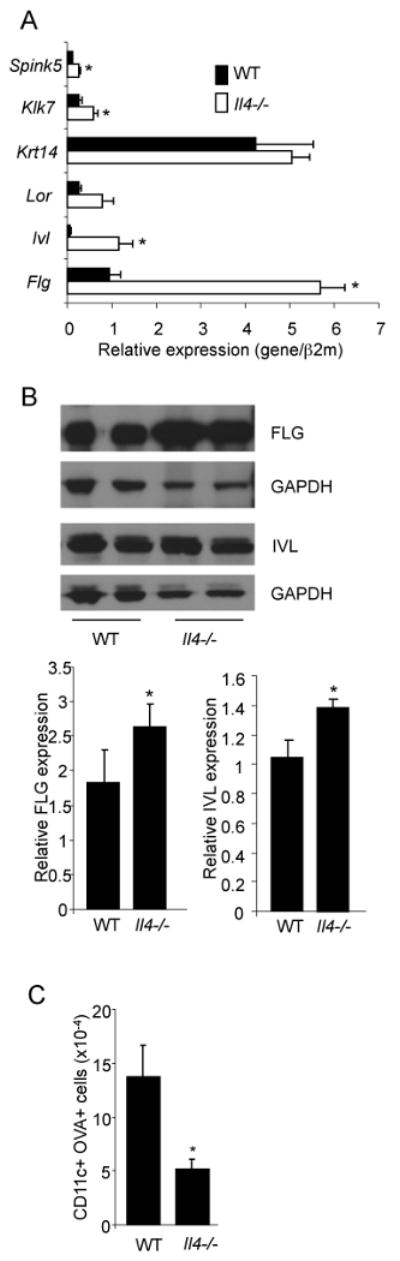
Figure 1
Figure 1
IL-4-deficiency increases skin barrier function. A, RNA was isolated from wild type and Il4-/- ear tissue before analysis of gene expression by qPCR. Results are the average ± SEM from samples of 4-6 mice. Results are presented as expression of each gene relative to the control (β2-microglobulin) using the 2-ΔCt method. B, Immunoblots of protein extracts from epidermis of WT and Il4-/- mice for filaggrin (FLG) and involucrin (IVL) with GAPDH as a loading control. Bar graphs represent the average densitometry of 3-5 samples normalized to expression of GAPDH. C, The backs of wild type and Il4-/- mice were shaved and applied with OVA-Alexa647. Twenty-four hours later draining lymph nodes were isolated and dendritic cells (CD11c+MHCIIhi) were examined for Alexa647 fluorescence. Numbers are the average ± SEM of 4 mice, calculated as percent Alexa647+ DC multiplied by cell number, and is representative of 3 experiments. *, significantly different from WT, p<0.05.
Figure 2
Figure 2
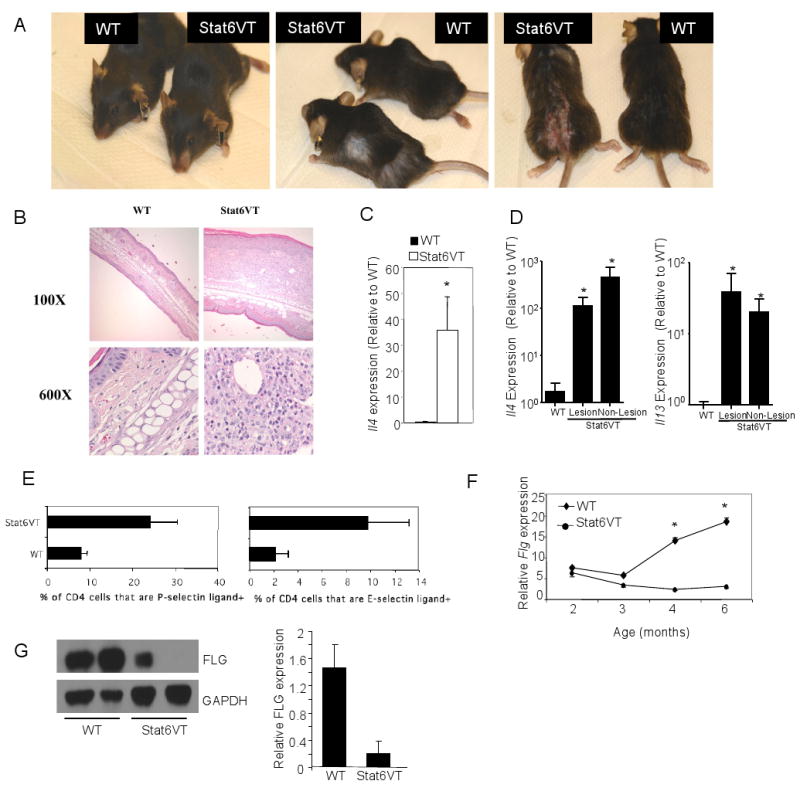
Mice expressing constitutively active Stat6 in T cells develop allergic skin inflammation. A, Photographs of Stat6VT transgenic mice and littermate controls showing areas affected by skin inflammation. B, Histological analysis of ear tissue from wild type and Stat6VT transgenic mice. Samples were fixed and stained with hematoxylin/eosin. C, RNA was isolated from skin of wild type and Stat6VT transgenic mice that did not have lesions before analysis of cytokine mRNA using qPCR. D, RNA was isolated from skin of wild type and lesional or non-lesional skin of Stat6VT transgenic mice that had active lesions before analysis of cytokine mRNA using qPCR. Results are the average ± SEM of 4-5 mice. E, Selectin ligand expression was examined on CD4+ splenic T cells using flow cytometry. Results are the average ± SD of 2-4 mice and are representative of two experiments. F, RNA was isolated from skin of wild type and Stat6VT transgenic mice that did not have lesions before analysis of Flg mRNA using qPCR. G, Immunoblots of protein extracts from epidermis of WT and Stat6VT transgenic mice for filaggrin (FLG) with GAPDH as a loading control. Bar graphs represent the average densitometry of 3-5 samples normalized to expression of GAPDH. Results in panels C, D and F are the average ± SEM of 5-9 mice. *, significantly different from WT, p<0.05.
Figure 3
Figure 3
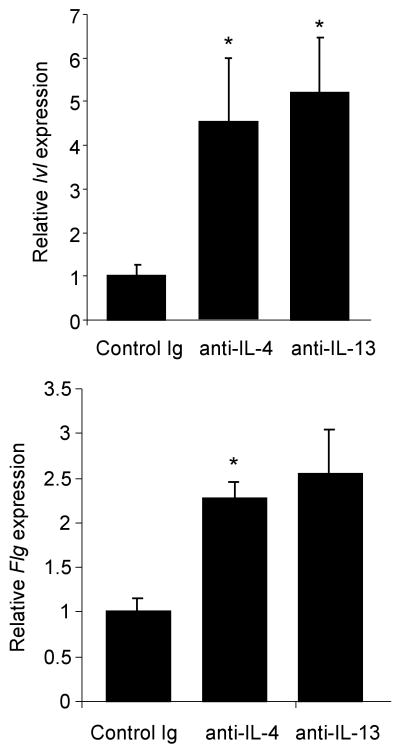
Antibodies to Th2 cytokines increase EDC gene expression in Stat6VT transgenic mice. Antibodies (control, anti-IL-4, anti-IL-13; all IgG1) were injected intradermally into the dorsal side of the ears of Stat6VT transgenic mice daily for two days. Eighteen hours after the last injection RNA was isolated from ear tissue and used for qPCR of Ivl and Flg expression. Results are the average ± SEM of 3-5 mice. *, significantly different from control Ig treated mice, p<0.05.
Figure 4
Figure 4
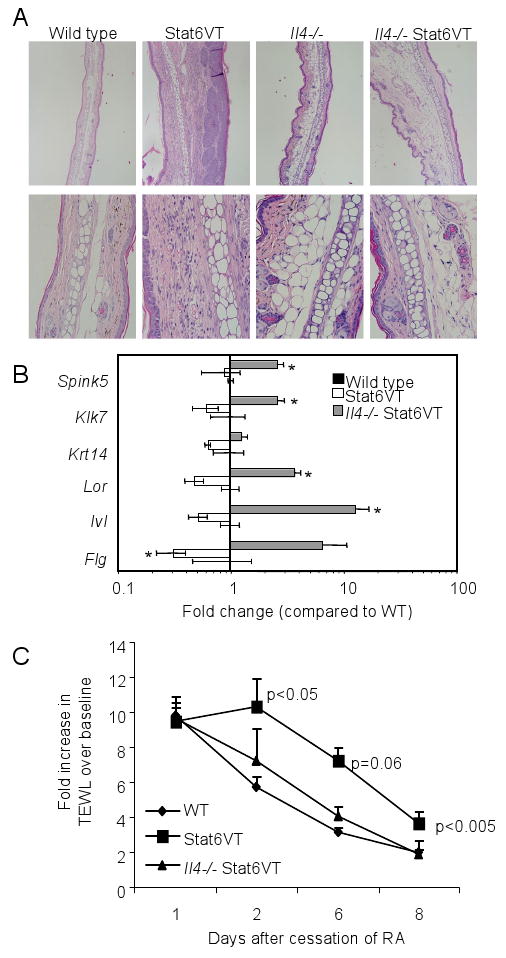
IL-4-deficiency protects from the development of allergic skin inflammation and promotes recovery from injury. A, Histology of ear tissue from mice of the indicated genotypes. Samples were fixed and stained with hematoxylin/eosin. B, RNA was isolated from ear tissue of wild type, Stat6VT transgenic and Il4-/- Stat6VT transgenic mice before analysis of gene expression by qPCR. Results are the average ± SEM from samples of 4-6 mice. Wild type values are equal to one, and are not above the axis. C, Fold-increase in pre-treatment TEWL following retinoic acid application was examined at the indicated time points. Results are the average ± SEM of 4-6 mice. *, significantly different from WT, p<0.05.

References

    1. Bieber T. Atopic dermatitis. N Engl J Med. 2008;358:1483–1494. - PubMed
    1. Leung DY, Boguniewicz M, Howell MD, Nomura I, Hamid QA. New insights into atopic dermatitis. J Clin Invest. 2004;113:651–657. - PMC - PubMed
    1. Sehra S, Tuana FM, Holbreich M, Mousdicas N, Tepper RS, Chang CH, Travers JB, Kaplan MH. Scratching the surface: towards understanding the pathogenesis of atopic dermatitis. Crit Rev Immunol. 2008;28:15–43. - PubMed
    1. Howell MD, Gallo RL, Boguniewicz M, Jones JF, Wong C, Streib JE, Leung DY. Cytokine milieu of atopic dermatitis skin subverts the innate immune response to vaccinia virus. Immunity. 2006;24:341–348. - PubMed
    1. Howell MD, Kim BE, Gao P, Grant AV, Boguniewicz M, Debenedetto A, Schneider L, Beck LA, Barnes KC, Leung DY. Cytokine modulation of atopic dermatitis filaggrin skin expression. J Allergy Clin Immunol. 2007;120:150–155. - PMC - PubMed

Publication types

MeSH terms