


Migraine and cardiovascular disease: a population-based study
- PMID: 20147658
- PMCID: PMC3462501
- DOI: 10.1212/WNL.0b013e3181d0cc8b
Migraine and cardiovascular disease: a population-based study
Abstract
Objectives: Although the relationship between migraine and cardiovascular disease (CVD) has been studied, several questions remain unanswered. Herein we contrast the rate of diagnosed CVD as well as of risk factors for CVD in individuals with migraine with and without aura (MA and MO) and in controls.
Methods: In this case-control study, migraineurs (n = 6,102) and controls (n = 5,243) were representative of the adult US population. Headache diagnosis was formally assigned using a validated mailed questionnaire which also obtained details on treatment, comorbidities, and other variables. CVD events were obtained based on self-reported medical diagnosis. Risk factors for CVD and modified Framingham scores were computed.
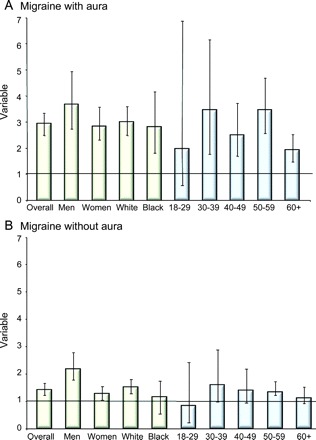
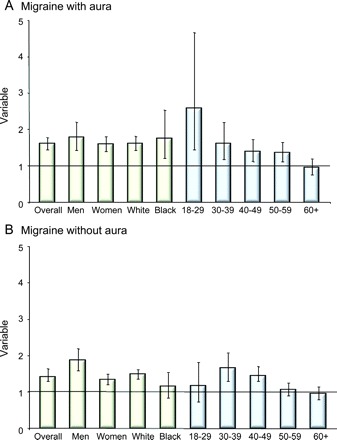
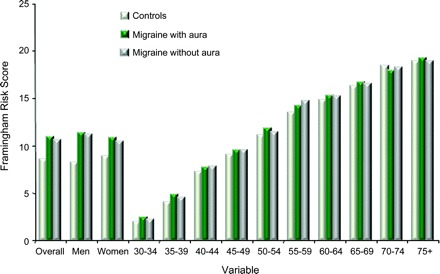
Results: In unadjusted analyses, migraine overall and MA were associated with myocardial infarction, stroke, and claudication, and MO was associated with myocardial infarction and claudication. Migraineurs were more likely than controls to have a medical diagnosis of diabetes (12.6% vs 9.4%, odds ratio [OR] 1.4, 95% confidence interval [CI] 1.2-1.6), hypertension (33.1% vs 27.5%, OR 1.4, 95% CI 1.3-1.6), and high cholesterol (32.7% vs 25.6%, OR 1.4, 95% CI 1.3-1.5). Risk was highest in MA, but remained elevated in MO. Framingham scores were significantly higher in MO and MA than in controls. After adjustments (gender, age, disability, treatment, CVD risk factors), migraine remained significantly associated with myocardial infarction (OR 2.2, 95% CI 1.7-2.8), stroke (OR 1.5, 95% CI 1.2-2.1), and claudication (OR 2.69, 95% CI 1.98-3.23).
Conclusion: Both migraine with and without aura are associated with cardiovascular disease (CVD) and with risk factors for CVD. However, since our sample size is large, the clinical relevance of the differences is yet to be established.
Figures
Comment in
-
Is migraine a dangerous disease?Neurology. 2010 Feb 23;74(8):622-3. doi: 10.1212/WNL.0b013e3181d0ce4a. Epub 2010 Feb 10. Neurology. 2010. PMID: 20147657 No abstract available.
References
-
- Elliott D. Migraine and stroke: current perspectives. Neurol Res 2008;30:801–812. - PubMed
-
- Kruit MC, van Buchem MA, Hofman PA, et al. Migraine as a risk factor for subclinical brain lesions. JAMA 2004;291:427–434. - PubMed
-
- Kurth T, Slomke MA, Kase CS, et al. Migraine, headache, and the risk of stroke in women: a prospective study. Neurology 2005;64:1020–1026. - PubMed
-
- MacClellan LR, Mitchell BD, Cole JW, et al. Familial aggregation of ischemic stroke in young women: the Stroke Prevention in Young Women Study. Genet Epidemiol 2006;30:602–608. - PubMed
-
- Kruit MC, Launer LJ, Ferrari MD, van Buchem MA. Brain stem and cerebellar hyperintense lesions in migraine. Stroke 2006;37:1109–1112. - PubMed
Publication types
MeSH terms
Grants and funding
LinkOut - more resources
Full Text Sources
Miscellaneous
