


Review
doi: 10.1074/jbc.R109.075044.
Epub 2010 Feb 10.
Transcriptional switches: chemical approaches to gene regulation
Affiliations
- PMID: 20147748
- PMCID: PMC2856975
- DOI: 10.1074/jbc.R109.075044
Item in Clipboard
Review
Transcriptional switches: chemical approaches to gene regulation
J Biol Chem.
.
Abstract
Given the role of transcriptional misregulation in the pathogenesis of human disease, there is enormous interest in the development of molecules that exogenously control transcription in a defined manner. The past decade has seen many exciting advancements in the identification of molecules that mimic or inhibit the interactions between natural transcriptional activators and their binding partners. In this minireview, we focus on four activator.target protein complexes, highlighting recent advances as well as challenges in the field.
Figures
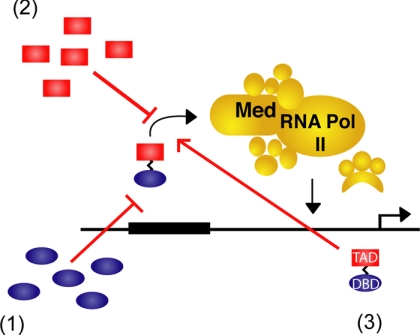
Strategies to modulate transcriptional activation. 1, interference of the endogenous activator DBD-DNA interaction using non-natural DBD mimics to inhibit transcriptional activation. 2, interference of the endogenous activator TAD-coactivator interaction using TAD mimics to inhibit transcription. TAD mimics can also be used to block activator TAD-masking protein interactions, thus stimulating transcriptional activation. 3, reconstitution of activator function using ATFs consisting of a non-natural TAD localized to the gene of interest using a DBD. Med, Mediator; RNA Pol II, RNA polymerase II.
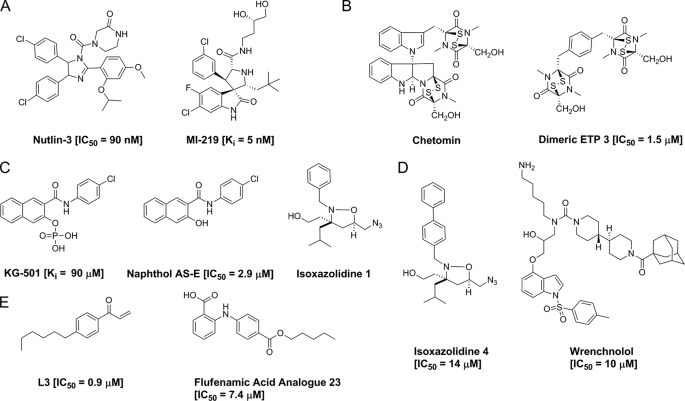
Small molecule transcriptional activator TAD mimics and NR inhibitors. A, p53 TAD mimic shown to inhibit p53-MDM2 interaction; B, TAD-CH1 domain (CBP/p300) inhibitors; C, TAD-KIX domain (CBP/p300) inhibitors; D, ESX mimics; E, inhibitors of thyroid receptors (L3) and ARs (23).
References
-
- Hainaut P., Hollstein M. (2000) Adv. Cancer Res. 77, 81–137 - PubMed
-
- Hollstein M., Sidransky D., Vogelstein B., Harris C. C. (1991) Science 253, 49–53 - PubMed
-
- Arndt H. D. (2006) Angew. Chem. Int. Ed. Engl. 45, 4552–4560 - PubMed
-
- Berg T. (2008) Curr. Opin. Chem. Biol. 12, 464–471 - PubMed
-
- Dervan P. B. (2001) Bioorg. Med. Chem. 9, 2215–2235 - PubMed
Publication types
MeSH terms
Substances
LinkOut - more resources
Full Text Sources
Other Literature Sources
Research Materials
Miscellaneous
