Review
doi: 10.1146/annurev-physiol-021909-135931.
The FoxO family in cardiac function and dysfunction
Affiliations
- PMID: 20148668
- PMCID: PMC2908381
- DOI: 10.1146/annurev-physiol-021909-135931
Item in Clipboard
Review
The FoxO family in cardiac function and dysfunction
Annu Rev Physiol.
2010.
Abstract
The Forkhead family of transcription factors mediates many aspects of physiology, including stress response, metabolism, commitment to apoptosis, and development. The Forkhead box subfamily O (FoxO) proteins have garnered particular interest due to their involvement in the modulation of cardiovascular biology. In this review, we discuss the mechanisms of FoxO regulation and outcomes of FoxO signaling under normal and pathological cardiovascular contexts.
Figures
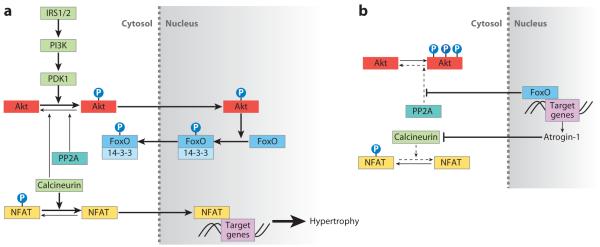
Akt and FoxO signaling pathways in cardiac hypertrophy. (a) Insulin receptor signaling activates the PI3K (phosphoinositide-3 kinase) signaling cascade, leading to Akt phosphorylation and translocation into the nucleus. Akt phosphorylates three conserved FoxO residues to promote FoxO association with 14-3-3 proteins and nuclear export to the cytosol, where the complex remains transcriptionally inactive. Calcineurin dephosphorylates NFAT (n uclear f actor of a ctivated T cells), allowing NFAT nuclear translocation and subsequent transcription of NFAT target genes, such as those encoding α-skeletal actin and β-myosin heavy chain. PP2A and calcineurin provide negative feedback by dephosphorylating Akt. (b) In the absence of PI3K signaling, FoxO is able to transcribe target genes such as atrogin-1, which encodes a ubiquitin ligase that promotes calcineurin degradation and prevents NFAT activation. The decrease in calcineurin levels reduces Akt-associated phosphatase activity. FoxO also reduces PP2A phosphatase activity on Akt. The reduction in calcineurin and PP2A-associated phosphatase activity leads to Akt hyperphosphorylation, which eventually inhibits FoxO activity.
References
-
- Weigel D, Jurgens G, Kuttner F, Seifert E, Jackle H. The homeotic gene fork head encodes a nuclear protein and is expressed in the terminal regions of the Drosophila embryo. Cell. 1989;57:645–58. - PubMed
-
- Tuteja G, Kaestner KH. Forkhead transcription factors II. Cell. 2007;131:192. - PubMed
-
- Tuteja G, Kaestner KH. SnapShot: forkhead transcription factors I. Cell. 2007;130:1160. - PubMed
-
- Kops GJ, Dansen TB, Polderman PE, Saarloos I, Wirtz KW, et al. Forkhead transcription factor FOXO3a protects quiescent cells from oxidative stress. Nature. 2002;419:316–21. - PubMed
Publication types
MeSH terms
Substances
Grants and funding
LinkOut - more resources
Full Text Sources
Other Literature Sources
Medical