Relationships between metabolic syndrome and other baseline factors and the efficacy of ezetimibe/simvastatin and atorvastatin in patients with type 2 diabetes and hypercholesterolemia
- PMID: 20150290
- PMCID: PMC2858166
- DOI: 10.2337/dc09-1762
Relationships between metabolic syndrome and other baseline factors and the efficacy of ezetimibe/simvastatin and atorvastatin in patients with type 2 diabetes and hypercholesterolemia
Abstract
Objective: To investigate relationships between baseline factors and treatment-associated efficacy changes in type 2 diabetes.
Research design: AND METHODS Multivariable analyses of treatment response in 1,229 type 2 diabetic patients with hypercholesterolemia who received ezetimibe/simvastatin or atorvastatin in a randomized double-blind 6-week study.
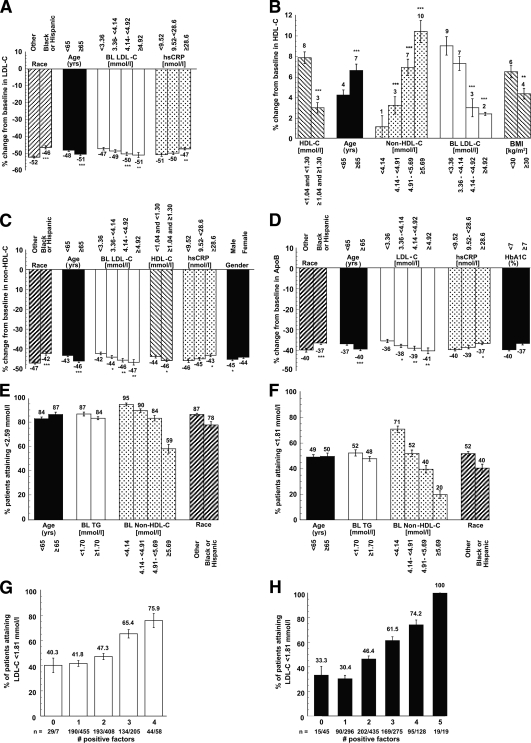
Results: Increasing age was related to improvements in all lipid assessments. Men had greater triglyceride and non-HDL cholesterol reductions than women, and black/Hispanic patients had less favorable lipid effects than other races/ethnicities. Increasing baseline LDL cholesterol was associated with improvements in most lipids; higher baseline non-HDL cholesterol with improved HDL cholesterol and triglycerides; higher baseline HDL cholesterol with greater non-HDL cholesterol and high-sensitivity C-reactive protein (hs-CRP) reductions; and higher baseline hs-CRP with smaller LDL cholesterol, non-HDL cholesterol, and apolipoprotein B reductions. Patients with high baseline non-HDL cholesterol or triglycerides less frequently attained LDL cholesterol targets. Obesity was inversely related to HDL cholesterol and hs-CRP changes, and higher baseline A1C to smaller apolipoprotein B reductions. Metabolic syndrome was not a significant predictor.
Conclusions: Treatment responses in type 2 diabetic patients were related to baseline factors, although treatment effects (ezetimibe/simvastatin being more effective than atorvastatin) remained consistent. The presence of predictive factors should be considered in planning lipid-altering therapy.
Figures
References
-
- Grundy SM, Cleeman JI, Merz CN, Brewer HB, Jr, Clark LT, Hunninghake DB, Pasternak RC, Smith SC, Jr, Stone NJ: the National Heart, Lung, and Blood Institute, the American College of Cardiology Foundation, the American Heart Association. Implications of recent clinical trials for the National Cholesterol Education Program Adult Treatment Panel III guidelines. Circulation 2004; 110: 227– 239 - PubMed
-
- Grundy SM, Cleeman JI, Daniels SR, Donato KA, Eckel RH, Franklin BA, Gordon DJ, Krauss RM, Savage PJ, Smith SC, Jr, Spertus JA, Costa F: the American Heart Association, the National Heart, Lung, and Blood Institute. Diagnosis and management of the metabolic syndrome: an American Heart Association/National Heart, Lung, and Blood Institute Scientific Statement. Circulation 2005; 112: 2735– 2752 - PubMed
-
- Brunzell JD, Davidson M, Furberg CD, Goldberg RB, Howard BV, Stein JH, Witztum JL: the American Diabetes Association, the American College of Cardiology Foundation. Lipoprotein management in patients with cardiometabolic risk: consensus statement from the American Diabetes Association and the American College of Cardiology Foundation. Diabetes Care 2008; 31: 811– 822 - PubMed
-
- Simon JA, Lin F, Hulley SB, Blanche PJ, Waters D, Shiboski S, Rotter JI, Nickerson DA, Yang H, Saad M, Krauss RM: Phenotypic predictors of response to simvastatin therapy among African-Americans and Caucasians: the Cholesterol and Pharmaeogenetics (CAP) Study. Am J Cardiol 2006; 97: 843– 850 - PubMed
-
- Streja L, Packard CJ, Shepherd J, Cobbe S, Ford I: the WOSCOPS Group. Factors affecting low-density lipoprotein and high-density lipoprotein cholesterol response to pravastatin in the West of Scotland Coronary Prevention Study (WOSCOPS). Am J Cardiol 2002; 90: 731– 736 - PubMed
Publication types
MeSH terms
Substances
LinkOut - more resources
Full Text Sources
Medical
Research Materials
Miscellaneous