Lexical-semantic organization in children with specific language impairment
- PMID: 20150406
- PMCID: PMC3328209
- DOI: 10.1044/1092-4388(2009/08-0160)
Lexical-semantic organization in children with specific language impairment
Abstract
Purpose: To determine whether children with specific language impairment (SLI) show deficits in lexical-semantic organization and, if so, whether these deficits are commensurate with their delay in vocabulary size and whether the deficits affect all children with SLI.
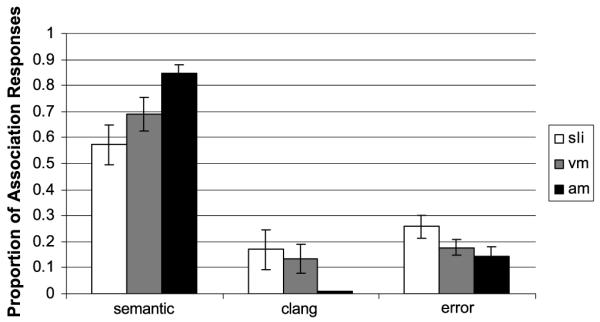
Method: Fourteen children with SLI, 14 age matches (AM), and 14 expressive vocabulary matches (VM) generated 3 associations to each of 48 words. Associations were coded as semantic (e.g., dog-pet), clang (e.g., cow-how), or erroneous (e.g., spoon-Disney).
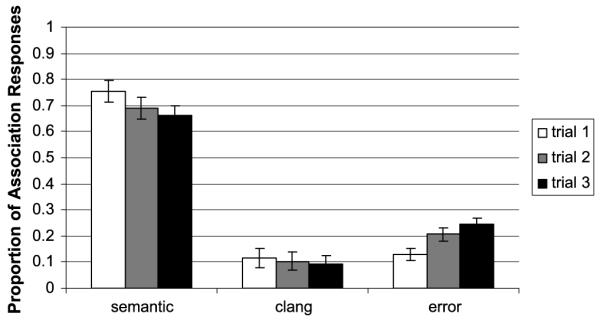
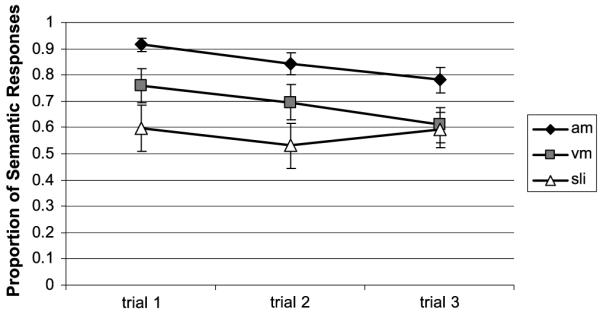
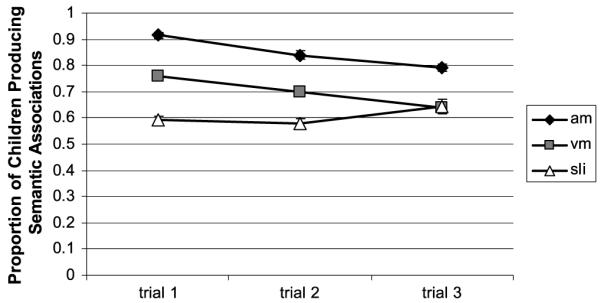
Results: Relative to the AM children, children with SLI produced fewer semantic responses, more clangs, and more errors. Relative to the VM children, fewer semantic responses and more errors in the children with SLI were found in by-item analyses. Across elicitation trials, semantic responses decreased in the AM and VM children but remained stable in the SLI children. Examination of individual performance in the SLI group revealed that poor semantic performance was associated with a deficit in expressive vocabulary and a gap between receptive and expressive vocabularies.
Conclusions: Significant variability in lexical-semantic organization skills exists among children with SLI. Deficits in lexical-semantic organization were demonstrated by a subgroup of children with SLI who likely had concomitant word-finding difficulties.
Figures
References
-
- Alt M, Plante E. Factors that influence lexical and semantic fast-mapping of young children with specific language impairment. Journal of Speech, Language, and Hearing Research. 2006;49:941–954. - PubMed
-
- Alt M, Plante E, Creusere M. Semantic features in fast-mapping: Performance of preschoolers with specific language impairment versus preschoolers with normal language. Journal of Speech, Language, and Hearing Research. 2004;47:407–420. - PubMed
-
- American Speech-Language-Hearing Association Guidelines for screening for hearing impairments and middle ear disorders. Asha. 1990;32(Suppl. 2):17–24. - PubMed
-
- Bishop DVM. The underlying nature of specific language impairment. Journal of Child Psychology and Psychiatry and Allied Disciplines. 1992;33:3–66. - PubMed
-
- Bishop DVM. Uncommon understandings. Psychology Press; East Sussex, United Kingdom: 1997.
Publication types
MeSH terms
Grants and funding
LinkOut - more resources
Full Text Sources
Medical
Miscellaneous