


Significant blood resistance to nitric oxide transfer in the lung
- PMID: 20150569
- PMCID: PMC2867528
- DOI: 10.1152/japplphysiol.00904.2009
Significant blood resistance to nitric oxide transfer in the lung
Abstract
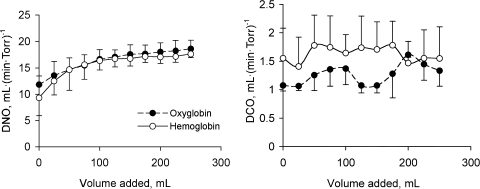
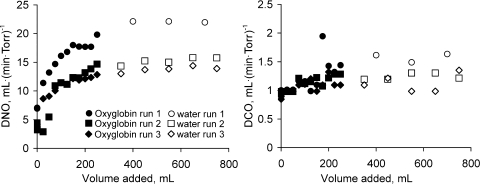
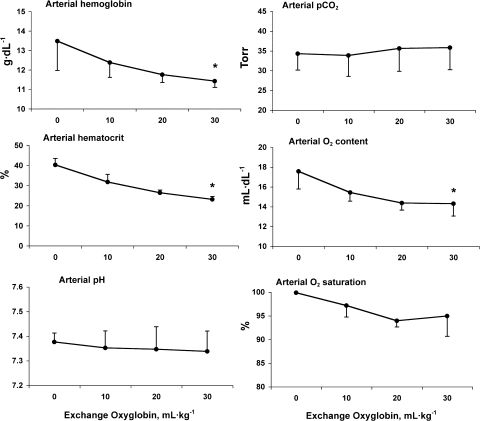
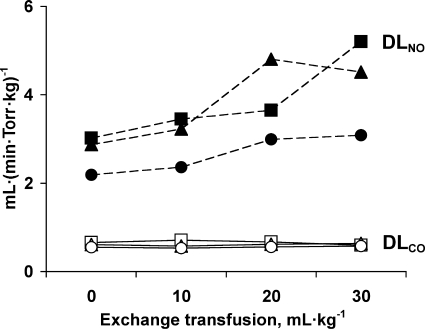
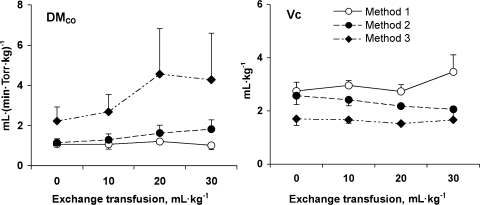
Lung diffusing capacity for nitric oxide (DLNO) is used to measure alveolar membrane conductance (DMNO), but disagreement remains as to whether DMNO=DLNO, and whether blood conductance (thetaNO)=infinity. Our previous in vitro and in vivo studies suggested that thetaNO<infinity. We now show in a membrane oxygenator model perfused with whole blood that addition of a cell-free bovine hemoglobin (Hb) glutamer-200 solution increased diffusing capacity of the circuit (D) for NO (DNO) by 39%, D for carbon monoxide (DCO) by 24%, and the ratio of DNO to DCO by 12% (all P<0.001). In three anesthetized dogs, DLNO and DLCO were measured by a rebreathing technique before and after three successive equal volume-exchange transfusions with bovine Hb glutamer-200 (10 ml/kg each, total exchange 30 ml/kg). At baseline, DLNO/DLCO=4.5. After exchange transfusion, DLNO rose 57+/-16% (mean+/-SD, P=0.02) and DLNO/DLCO=7.1, whereas DLCO remained unchanged. Thus, in vitro and in vivo data directly demonstrate a finite thetaNO. We conclude that the erythrocyte and/or its immediate environment imposes considerable resistance to alveolar-capillary NO uptake. DLNO is sensitive to dynamic hematological factors and is not a pure index of conductance of the alveolar tissue membrane. With successive exchange transfusion, the estimated in vivo thetaNO [5.1 ml NO.(ml blood.min.Torr)(-1)] approached 4.5 ml NO.(ml blood.min.Torr)(-1), which was derived from in vitro measurements by Carlsen and Comroe (J Gen Physiol 42: 83-107, 1958). Therefore, we suggest use of thetaNO=4.5 ml NO.(min.Torr.ml blood)(-1) for calculation of DM(NO) and pulmonary capillary blood volume from DLNO and DLCO.
Figures
Comment in
-
No red cell resistance to NO? I think not!J Appl Physiol (1985). 2010 May;108(5):1027-9. doi: 10.1152/japplphysiol.00240.2010. Epub 2010 Mar 11. J Appl Physiol (1985). 2010. PMID: 20224003 No abstract available.
References
-
- Borland C. NO and CO transfer. Eur Respir J 3: 977–978, 1990 - PubMed
-
- Borland C, Dunningham H, Bottrill F, Vuylsteke A. Can a membrane oxygenator be a model for lung NO and CO transfer? J Appl Physiol 100: 1527–1538, 2006 - PubMed
-
- Borland C, Mist B, Zammit M, Vuylsteke A. Steady-state measurement of NO and CO lung diffusing capacity on moderate exercise in men. J Appl Physiol 90: 538–544, 2001 - PubMed
-
- Borland CD, Cox Y. Effect of varying alveolar oxygen partial pressure on diffusing capacity for nitric oxide and carbon monoxide, membrane diffusing capacity and lung capillary blood volume. Clin Sci (Lond) 81: 759–765, 1991 - PubMed
-
- Borland CD, Higenbottam TW. A simultaneous single breath measurement of pulmonary diffusing capacity with nitric oxide and carbon monoxide. Eur Respir J 2: 56–63, 1989 - PubMed
Publication types
MeSH terms
Substances
Grants and funding
LinkOut - more resources
Full Text Sources
