


New insights into an old story: Agrobacterium-induced tumour formation in plants by plant transformation
- PMID: 20150897
- PMCID: PMC2845280
- DOI: 10.1038/emboj.2010.8
New insights into an old story: Agrobacterium-induced tumour formation in plants by plant transformation
Abstract
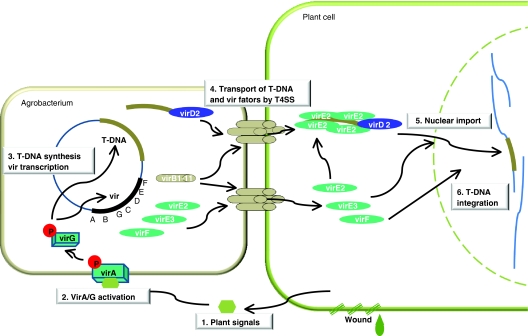
Agrobacterium tumefaciens causes tumour formation in plants. Plant signals induce in the bacteria the expression of a range of virulence (Vir) proteins and the formation of a type IV secretion system (T4SS). On attachment to plant cells, a transfer DNA (T-DNA) and Vir proteins are imported into the host cells through the bacterial T4SS. Through interaction with a number of host proteins, the Vir proteins suppress the host innate immune system and support the transfer, nuclear targeting, and integration of T-DNA into host cell chromosomes. Owing to extensive genetic analyses, the bacterial side of the plant-Agrobacterium interaction is well understood. However, progress on the plant side has only been achieved recently, revealing a highly complex molecular choreography under the direction of the Vir proteins that impinge on multiple processes including transport, transcription, and chromosome status of their host cells.
Conflict of interest statement
The authors declare that they have no conflict of interest.
Figures

References
-
- Abuodeh RO, Orbach MJ, Mandel MA, Das A, Galgiani JN (2000) Genetic transformation of Coccidioides immitis facilitated by Agrobacterium tumefaciens. J Infect Dis 181: 2106–2110 - PubMed
-
- Asai T, Tena G, Plotnikova J, Willmann MR, Chiu WL, Gomez-Gomez L, Boller T, Ausubel FM, Sheen J (2002) MAP kinase signalling cascade in Arabidopsis innate immunity. Nature 415: 977–983 - PubMed
Publication types
MeSH terms
Substances
Grants and funding
LinkOut - more resources
Full Text Sources
Other Literature Sources
