


Efficacy of a progressive walking program and glucosamine sulphate supplementation on osteoarthritic symptoms of the hip and knee: a feasibility trial
- PMID: 20152042
- PMCID: PMC2875659
- DOI: 10.1186/ar2932
Efficacy of a progressive walking program and glucosamine sulphate supplementation on osteoarthritic symptoms of the hip and knee: a feasibility trial
Abstract
Introduction: Management of osteoarthritis (OA) includes the use of non-pharmacological and pharmacological therapies. Although walking is commonly recommended for reducing pain and increasing physical function in people with OA, glucosamine sulphate has also been used to alleviate pain and slow the progression of OA. This study evaluated the effects of a progressive walking program and glucosamine sulphate intake on OA symptoms and physical activity participation in people with mild to moderate hip or knee OA.
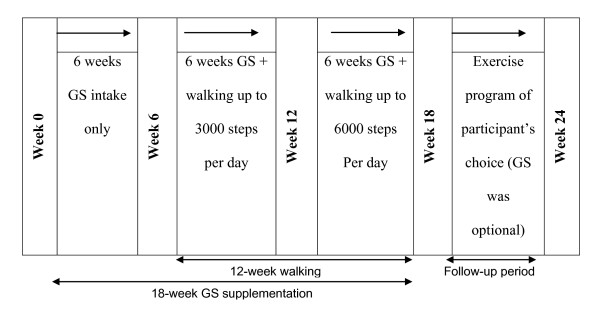
Methods: Thirty-six low active participants (aged 42 to 73 years) were provided with 1500 mg glucosamine sulphate per day for 6 weeks, after which they began a 12-week progressive walking program, while continuing to take glucosamine. They were randomized to walk 3 or 5 days per week and given a pedometer to monitor step counts. For both groups, step level of walking was gradually increased to 3000 steps/day during the first 6 weeks of walking, and to 6000 steps/day for the next 6 weeks. Primary outcomes included physical activity levels, physical function (self-paced step test), and the WOMAC Osteoarthritis Index for pain, stiffness and physical function. Assessments were conducted at baseline and at 6-, 12-, 18-, and 24-week follow-ups. The Mann Whitney Test was used to examine differences in outcome measures between groups at each assessment, and the Wilcoxon Signed Ranks Test was used to examine differences in outcome measures between assessments.
Results: During the first 6 weeks of the study (glucosamine supplementation only), physical activity levels, physical function, and total WOMAC scores improved (P < 0.05). Between the start of the walking program (Week 6) and the final follow-up (Week 24), further improvements were seen in these outcomes (P < 0.05) although most improvements were seen between Weeks 6 and 12. No significant differences were found between walking groups.
Conclusions: In people with hip or knee OA, walking a minimum of 3000 steps (approximately 30 minutes), at least 3 days/week, in combination with glucosamine sulphate, may reduce OA symptoms. A more robust study with a larger sample is needed to support these preliminary findings.
Trial registration: Australian Clinical Trials Registry ACTRN012607000159459.
Figures
References
-
- Lawrence RC, Felson DT, Helmick CG, Arnold LM, Choi H, Deyo RA, Gabriel S, Hirsch R, Hochberg MC, Hunder GG, Jordan JM, Katz JN, Kremers HM, Wolfe F. National Arthritis Data Workgroup. Estimates of the prevalence of arthritis and other rheumatic conditions in the United States. Part II. Arthritis Rheum. 2008;58:26–35. - PMC - PubMed
-
- Access Economics. Painful Realities: The Economic Impact of Arthritis on Australia in 2007. Sydney: Arthritis Australia; 2007.
-
- Access Economics. The Prevalence, Cost, and Burden of Disease of Arthritis in Australia. Canberra, Australia: The Arthritis Foundation of Australia; 2001.
-
- American College of Rheumatology Subcommittee on Osteoarthritis Guidelines. Recommendations for the medical management of osteoarthritis on the hip and knee. Arthritis Rheum. 2000;43:1905–1915. - PubMed
-
- Scott DL, Shipley M, Dawson A, Edwards S, Symmons DP, Woolf AD. The clinical management of rheumatoid arthritis and osteoarthritis: strategies for improving clinical effectiveness. Br J Rheumatol. 1998;37:546–554. - PubMed
Publication types
MeSH terms
Substances
LinkOut - more resources
Full Text Sources
Other Literature Sources
