


The prevalence of childhood adversity among healthcare workers and its relationship to adult life events, distress and impairment
- PMID: 20153051
- PMCID: PMC7124651
- DOI: 10.1016/j.chiabu.2009.04.008
The prevalence of childhood adversity among healthcare workers and its relationship to adult life events, distress and impairment
Abstract
Objective: We investigated the prevalence of childhood adversity among healthcare workers and if such experiences affect responses to adult life stress.
Methods: A secondary analysis was conducted of a 2003 study of 176 hospital-based healthcare workers, which surveyed lifetime traumatic events, recent life events, psychological distress, coping, social support, and days off work due to stress or illness.
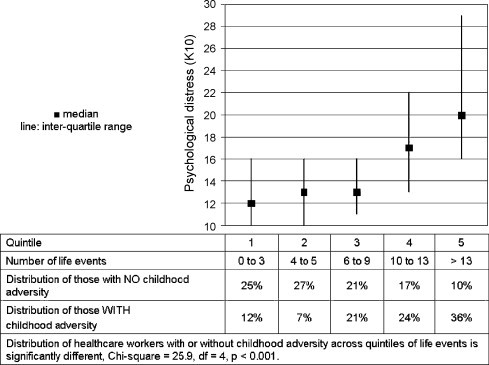
Results: Sixty eight percent (95% CI 61.1-74.9) of healthcare workers had one or more experience of violence, abuse or neglect, 33% (95% CI 26.1-40.0) before the age of 13. Compared to healthcare workers who did not experience childhood adversity, those who did reported more recent life events (median 11 vs. 5 over the previous 6 months, p<.001) and greater psychological distress (median score 17 vs. 13, p<.001). The relationship between life events and psychological distress was not linear. Most healthcare workers without childhood adversity (73%) reported a low number of life events which were not associated with psychological distress. Most healthcare workers with childhood adversity (81%) reported a higher number of life events, for which the correlation between events and distress was moderately strong (Spearman's rho=.50, p<.001). Childhood adversity was also associated with more missed work days. Each of these outcomes was higher in 22 healthcare workers (13%) who had experienced more than one type of childhood adversity.
Conclusions: Childhood adversity is common among healthcare workers and is associated with a greater number of life events, more psychological distress and impairment.
Copyright (c) 2010 Elsevier Ltd. All rights reserved.
Figures
References
-
- Aiken L.H., Clarke S.P., Sloane D.M. Hospital staffing, organization, and quality of care: Cross-national findings. International Journal for Quality in Health Care. 2002;14:5–13. - PubMed
-
- Aiken L.H., Clarke S.P., Sloane D.M., Sochalski J., Silber J.H. Hospital nurse staffing and patient mortality, nurse burnout, and job dissatisfaction. Journal of the American Medical Association. 2002;288:1987–1993. - PubMed
-
- Arata C.M., Langhinrichsen-Rohling J., Bowers D., O’Brien N. Differential correlates of multi-type maltreatment among urban youth. Child Abuse & Neglect. 2007;31:393–415. - PubMed
-
- Berkman L.F., Leo-Summers L., Horwitz R.I. Emotional support and survival after myocardial infarction. A prospective, population-based study of the elderly. Annals of Internal Medicine. 1992;117:1003–1009. - PubMed
Publication types
MeSH terms
Grants and funding
LinkOut - more resources
Full Text Sources
Medical
