


The effect of subacute denervation on the electrical anisotropy of skeletal muscle: implications for clinical diagnostic testing
- PMID: 20153247
- PMCID: PMC2893732
- DOI: 10.1016/j.clinph.2010.01.017
The effect of subacute denervation on the electrical anisotropy of skeletal muscle: implications for clinical diagnostic testing
Abstract
Objective: Applied electrical current flows preferentially along rather than across muscle fibers, a characteristic called anisotropy. In this study, we investigate the alteration in muscle anisotropy after denervation.
Methods: Eight adult male rats underwent sciatic nerve crush and the gastrocnemius was harvested from 1 to 2.5 weeks later. Muscle from 12 additional healthy rats was also obtained. Multifrequency electrical impedance measurements were made on the tissue and its conductivity and relative permittivity (i.e., its polarizability) calculated. Anisotropy of the tissue was determined by calculating conductivity and permittivity differences, subtracting transverse from longitudinal values. Muscle fiber and blood vessel quantification were also performed.
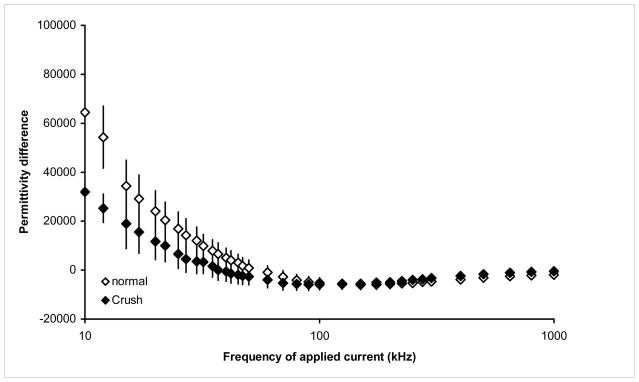
Results: The mean conductivity difference for sciatic crush animals was higher (p<0.05) than for the healthy animals across the frequency spectrum, due to a greater increase in longitudinal conductivity than in transverse conductivity. For example, at 10 kHz, the conductivity difference was 0.15S/m for healthy animals and 0.29 S/m for post-crush animals. Relative permittivity difference values, however, were similar between groups. There was a strong correlation of conductivity anisotropy to muscle fiber size but not to blood vessel area.
Conclusions: Anisotropy of muscle conductivity increases markedly after subacute denervation injury.
Significance: This alteration in anisotropy has direct relevance to the clinical application of electrical impedance myography. We also speculate that it may impact other forms of diagnostic testing, including needle electromyography and magnetic resonance imaging.
Copyright 2010 International Federation of Clinical Neurophysiology. Published by Elsevier Ireland Ltd. All rights reserved.
Figures

References
-
- Aaron R, Huang M, Shiffman CA. Anisotropy of human muscle via non-invasive impedance measurements. Phys Med Biol. 1997;42:1245–62. - PubMed
-
- Baumann SB, Wozny DR, Kelly SK, Meno FM. The electrical conductivity of human cerebrospinal fluid at body temperature. IEEE Trans Biomed Eng. 1997;44:220–3. - PubMed
-
- Bendszus M, Wessig C, Solymosi L, Reiners K, Koltzenburg M. MRI of peripheral nerve degeneration and regeneration: correlation with electrophysiology and histology. Exp Neurol. 2004;188:171–7. - PubMed
Publication types
MeSH terms
Grants and funding
LinkOut - more resources
Full Text Sources
Other Literature Sources
