


Curcumin: a novel nutritionally derived ligand of the vitamin D receptor with implications for colon cancer chemoprevention
- PMID: 20153625
- PMCID: PMC2891903
- DOI: 10.1016/j.jnutbio.2009.09.012
Curcumin: a novel nutritionally derived ligand of the vitamin D receptor with implications for colon cancer chemoprevention
Abstract
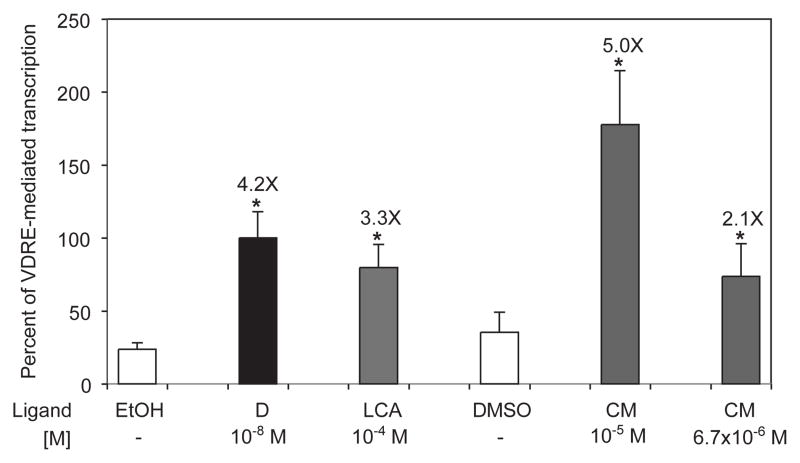
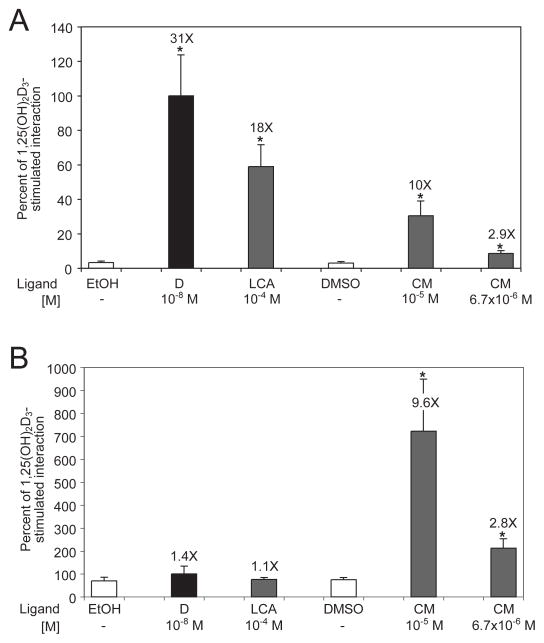
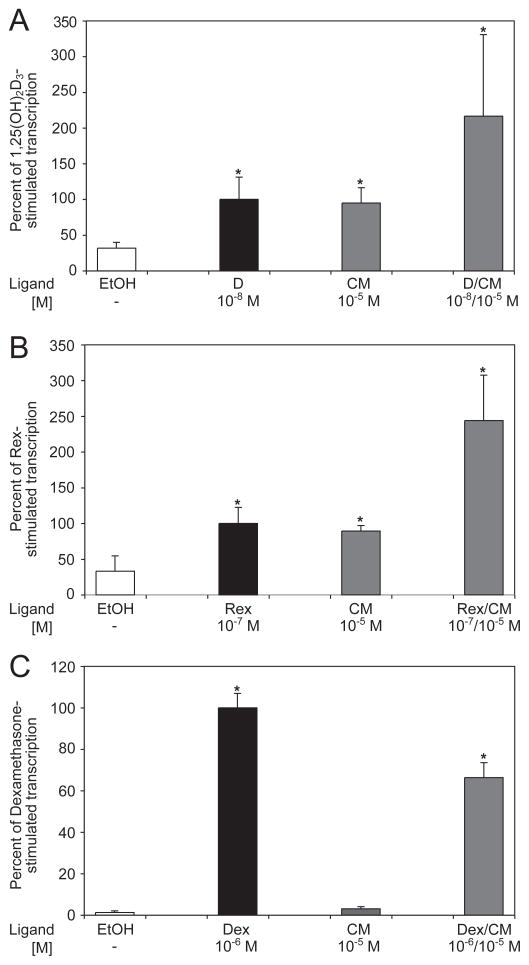
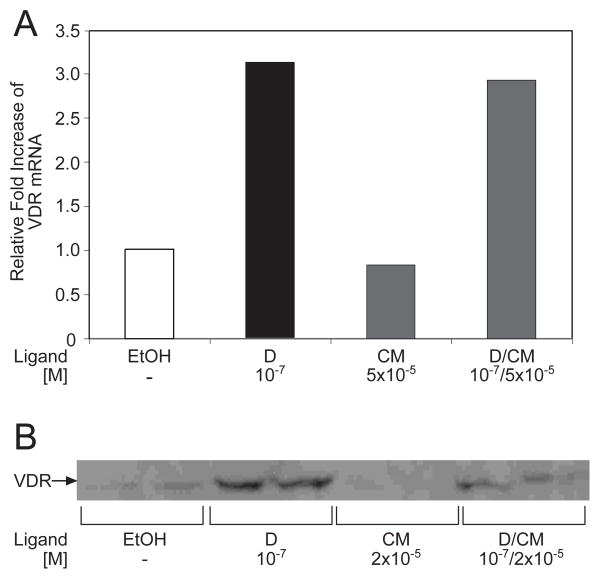
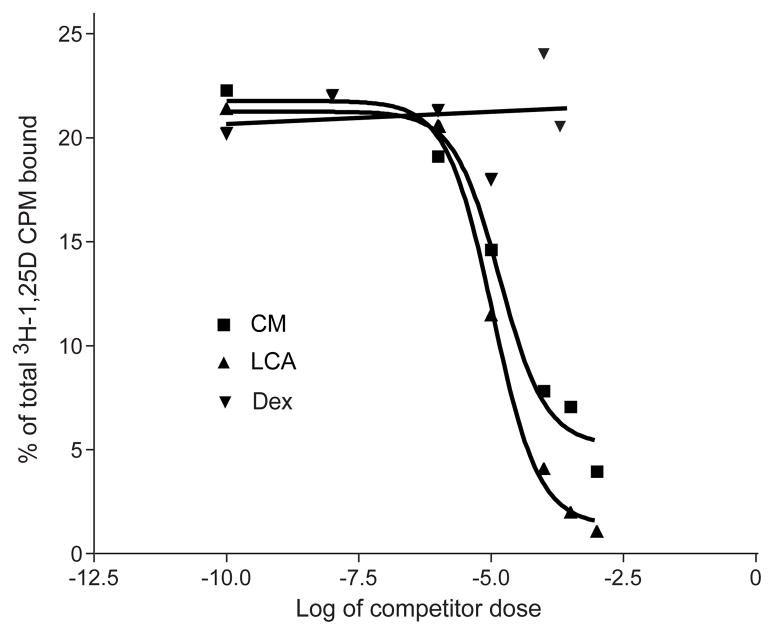
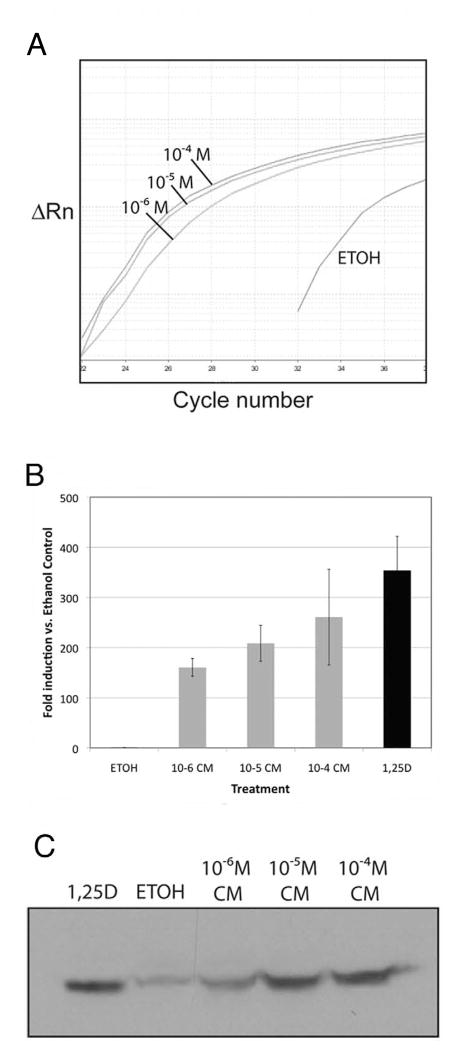
The nuclear vitamin D receptor (VDR) mediates the actions of 1,25-dihydroxyvitamin D(3) (1,25D) to regulate gene transcription. Recently, the secondary bile acid, lithocholate (LCA), was recognized as a novel VDR ligand. Using reporter gene and mammalian two-hybrid systems, immunoblotting, competitive ligand displacement and quantitative real-time PCR, we identified curcumin (CM), a turmeric-derived bioactive polyphenol, as a likely additional novel ligand for VDR. CM (10(-5) M) activated transcription of a luciferase plasmid containing the distal vitamin D responsive element (VDRE) from the human CYP3A4 gene at levels comparable to 1,25D (10(-8) M) in transfected human colon cancer cells (Caco-2). While CM also activated transcription via a retinoid X receptor (RXR) responsive element, activation of the glucocorticoid receptor (GR) by CM was negligible. Competition binding assays with radiolabeled 1,25D confirmed that CM binds directly to VDR. In mammalian two-hybrid assays employing transfected Caco-2 cells, CM (10(-5) M) increased the ability of VDR to recruit its heterodimeric partner, RXR, and steroid receptor coactivator-1 (SRC-1). Real-time PCR studies revealed that CM-bound VDR can activate VDR target genes CYP3A4, CYP24, p21 and TRPV6 in Caco-2 cells. Numerous studies have shown chemoprotection by CM against intestinal cancers via a variety of mechanisms. Small intestine and colon are important VDR-expressing tissues where 1,25D has known anticancer properties that may, in part, be elicited by activation of CYP-mediated xenobiotic detoxification and/or up-regulation of the tumor suppressor p21. Our results suggest the novel hypothesis that nutritionally-derived CM facilitates chemoprevention via direct binding to, and activation of, VDR.
Copyright © 2010 Elsevier Inc. All rights reserved.
Figures
References
-
- Whitfield GK, Jurutka PW, Haussler CA, Hsieh JC, Barthel TK, Jacobs ET, et al. Nuclear vitamin D receptor: structure-function, molecular control of gene transcription, and novel bioactions. In: Feldman D, Pike JW, Glorieux FH, editors. Vitamin D. Oxford, UK: Elsevier Academic Press; 2005. pp. 219–61.
-
- Jurutka PW, Whitfield GK, Hsieh JC, Thompson PD, Haussler CA, Haussler MR. Molecular nature of the vitamin D receptor and its role in regulation of gene expression. Rev Endocr Metab Disord. 2001;2:203–16. - PubMed
-
- Haussler MR, Whitfield GK, Haussler CA, Hsieh JC, Thompson PD, Selznick SH, et al. The nuclear vitamin D receptor: biological and molecular regulatory properties revealed. J Bone Miner Res. 1998;13:325–49. - PubMed
-
- Holick MF. Will 1,25-dihydroxyvitamin D3, MC 903, and their analogues herald a new pharmacologic era for the treatment of psoriasis? Arch Dermatol. 1989;125:1692–7. - PubMed
-
- El-Domyati M, Barakat M, Abdel-Razek R, El-Din Anbar T. Apoptosis, P53 and Bcl-2 expression in response to topical calcipotriol therapy for psoriasis. Int J Dermatol. 2007;46:468–74. - PubMed
Publication types
MeSH terms
Substances
Grants and funding
LinkOut - more resources
Full Text Sources
Medical
Research Materials
Miscellaneous
