


Experimental adaptation of Burkholderia cenocepacia to onion medium reduces host range
- PMID: 20154121
- PMCID: PMC2849210
- DOI: 10.1128/AEM.01930-09
Experimental adaptation of Burkholderia cenocepacia to onion medium reduces host range
Abstract
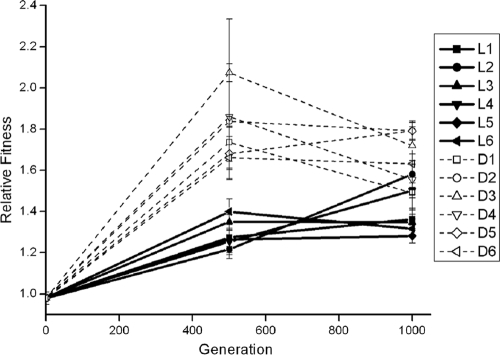
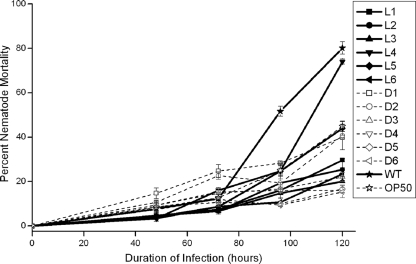
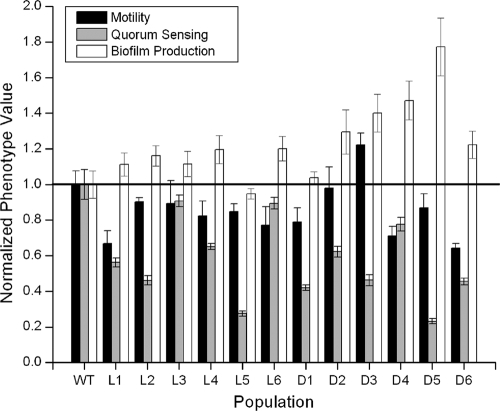
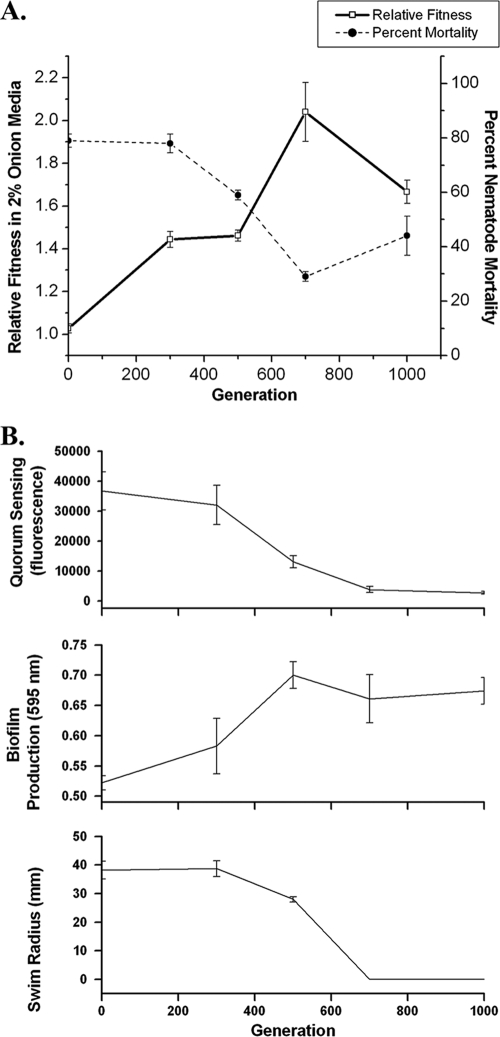
It is unclear whether adaptation to a new host typically broadens or compromises host range, yet the answer bears on the fate of emergent pathogens and symbionts. We investigated this dynamic using a soil isolate of Burkholderia cenocepacia, a species that normally inhabits the rhizosphere, is related to the onion pathogen B. cepacia, and can infect the lungs of cystic fibrosis patients. We hypothesized that adaptation of B. cenocepacia to a novel host would compromise fitness and virulence in alternative hosts. We modeled adaptation to a specific host by experimentally evolving 12 populations of B. cenocepacia in liquid medium composed of macerated onion tissue for 1,000 generations. The mean fitness of all populations increased by 78% relative to the ancestor, but significant variation among lines was observed. Populations also varied in several phenotypes related to host association, including motility, biofilm formation, and quorum-sensing function. Together, these results suggest that each population adapted by fixing different sets of adaptive mutations. However, this adaptation was consistently accompanied by a loss of pathogenicity to the nematode Caenorhabditis elegans; by 500 generations most populations became unable to kill nematodes. In conclusion, we observed a narrowing of host range as a consequence of prolonged adaptation to an environment simulating a specific host, and we suggest that emergent pathogens may face similar consequences if they become host-restricted.
Figures
References
-
- Bennett, A. F., R. E. Lenski, and J. E. Mittler. 1992. Evolutionary adaptation to temperature. I. Fitness responses of Escherichia coli to changes in its thermal environment. Evolution 46:16-30. - PubMed
-
- Carvalho, A. P. D., G. M. C. Ventura, C. B. Pereira, R. S. Leao, T. W. Folescu, L. Higa, L. M. Teixeira, M. C. M. Plotkowski, V. L. C. Merquior, R. M. Albano, and E. A. Marques. 2007. Burkholderia cenocepacia, B. multivorans, B. ambifaria and B. vietnamiensis isolates from cystic fibrosis patients have different profiles of exoenzyme production. APMIS 115:311-318. - PubMed
-
- Choi, K.-H., D. DeShazer, and H. P. Schweizer. 2006. Mini-Tn7 insertion in bacteria with multiple attTn7 sites: example Burkholderia mallei ATCC 23344. Nat. Protoc. 1:162-169. - PubMed
-
- Choi, K.-H., J. B. Gaynor, K. G. White, C. Lopez, C. M. Bosio, R. R. Karkhoff-Schweizer, and H. P. Schweizer. 2005. A Tn7-based broad host-trange bacterial cloning and expression system. Nat. Methods 2:443-450. - PubMed
-
- Coenye, T., and P. Vandamme. 2003. Diversity and significance of Burkholderia species occupying diverse ecological niches. Environ. Microbiol. 5:719-729. - PubMed
Publication types
MeSH terms
Substances
LinkOut - more resources
Full Text Sources
Molecular Biology Databases
