


Prediction of epidermal growth factor receptor mutations in the plasma/pleural effusion to efficacy of gefitinib treatment in advanced non-small cell lung cancer
- PMID: 20155428
- PMCID: PMC11828193
- DOI: 10.1007/s00432-010-0785-z
Prediction of epidermal growth factor receptor mutations in the plasma/pleural effusion to efficacy of gefitinib treatment in advanced non-small cell lung cancer
Abstract
Purpose: Recently, mutations in the epidermal growth factor receptor (EGFR) gene were reported to correlate with EGFR tyrosine kinase inhibitor response in advanced non-small cell lung cancer (NSCLC). In this study, we attempted to detect EGFR mutations in plasma and pleural effusion samples and to make clear its correlations with gefitinib response and survival in NSCLC patients.
Methods: The free DNA was isolated from the plasma of 56 cases and pleural effusion of another 32 cases of advanced NSCLC. Five common types of EGFR mutations were analyzed by LightCycle PCR with Taqman-MGB probes.
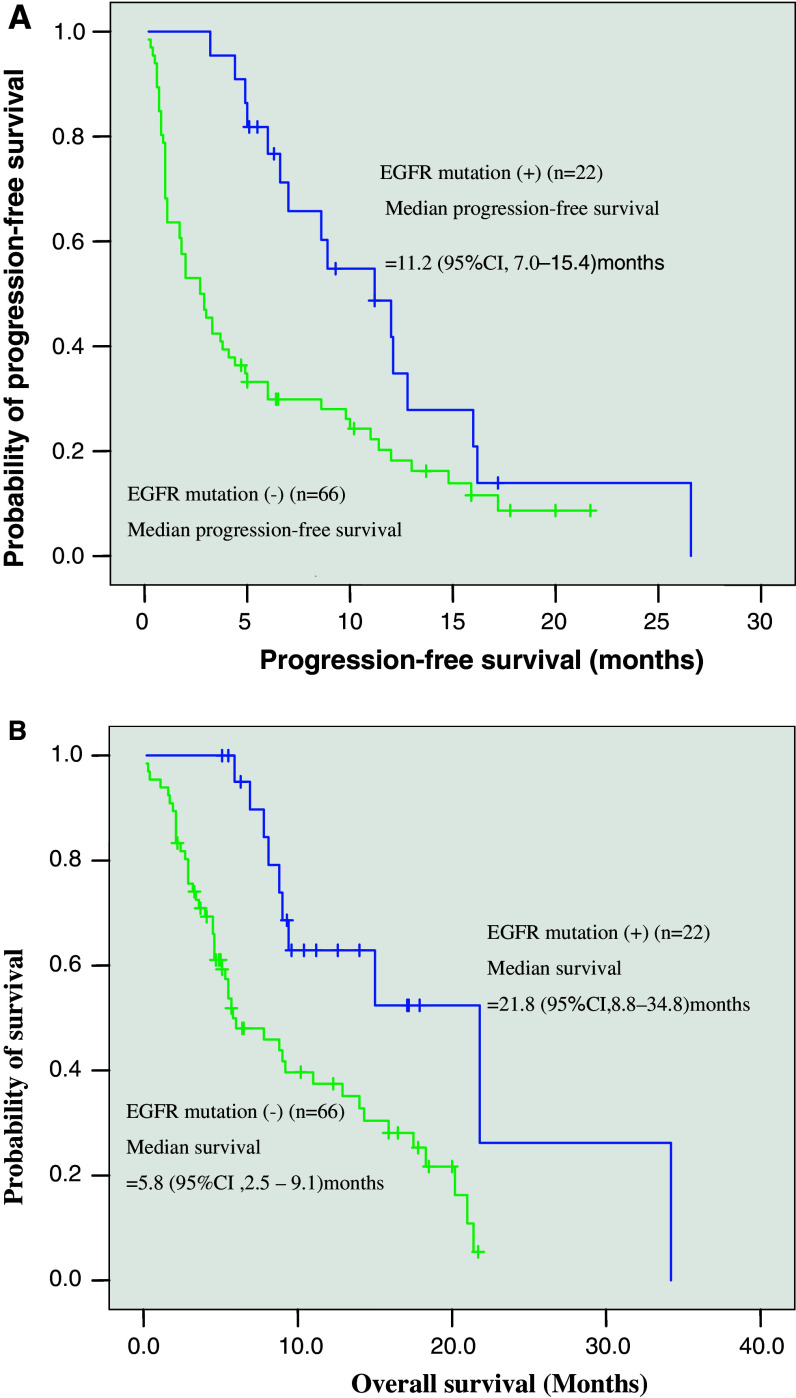
Results: EGFR gene mutations were found in 22 of all the 88 (25%) NSCLC patients (23.2% of 56 plasma samples, 28.1% of another 32 pleural effusion samples). EGFR mutations were more frequently present in females, never-smokers and adenocarcinomas (P < 0.01). It also showed that patients with EGFR mutations had a significantly better response rate when compared with that of the wild-type patients (P < 0.001). The median progression-free survival (11.2 vs. 2.7 months P = 0.005) and overall survival (21.8 vs. 5.8 months P = 0.003) were significantly higher in patients with EGFR mutations than in patients with wild-type EGFR.
Conclusions: The EGFR mutations in the serum and the pleural effusion from advanced NSCLC patients can be detected with LightCycle PCR using Taqman-MGB probes. The mutations highly predict the efficacy of gefitinib in advanced NSCLC.
Figures
References
-
- Bosari S, Marchetti A, Buttitta F, Graziani D, Borsani G, Loda M et al (1995) Detection of p53 mutations by single-strand conformation polymorphisms (SSCP) gel electrophoresis. A comparative study of radioactive and nonradioactive silver-stained SSCP analysis. Diagn Mol Pathol 4:249–255. doi:10.1097/00019606-199512000-00004 - PubMed
-
- Breathnach OS, Freidlin B, Conley B, Green MR, Johnson DH, Gandara DR et al (2001) Twenty-two years of phase III trials for patients with advanced non-small-cell lung cancer: sobering results. J Clin Oncol 19:1734–1742 - PubMed
-
- Dong Q, Huang J, Zhou Y, Li L, Bao G, Feng J et al (2002) Hematogenous dissemination of lung cancer cells during surgery; quantitative detection by flow cytometry and prognostic significance. Lung Cancer 37:293–301. doi:10.1016/S0169-5002(02)00102-2 - PubMed
-
- Esteller M, Sanchez-Cespedes M, Rosell R, Sidransky D, Baylin SB, Herman JG (1999) Detection of aberrant promoter hypermethylation of tumor suppressor genes in serum DNA from non-small-cell lung cancer patients. Cancer Res 59:67–70 - PubMed
-
- Fan X, Furnari FB, Cavenee WK, Castresana JS (2001) Non-isotopic silverstained SSCP is more sensitive than automated direct sequencing for the detection of PTEN mutations in a mixture of DNA extracted from normal and tumor cells. Int J Oncol 18:1023–1026 - PubMed
MeSH terms
Substances
LinkOut - more resources
Full Text Sources
Other Literature Sources
Medical
Research Materials
Miscellaneous
