


Sphingosine kinase: Role in regulation of bioactive sphingolipid mediators in inflammation
- PMID: 20156522
- PMCID: PMC2878898
- DOI: 10.1016/j.biochi.2010.02.008
Sphingosine kinase: Role in regulation of bioactive sphingolipid mediators in inflammation
Abstract
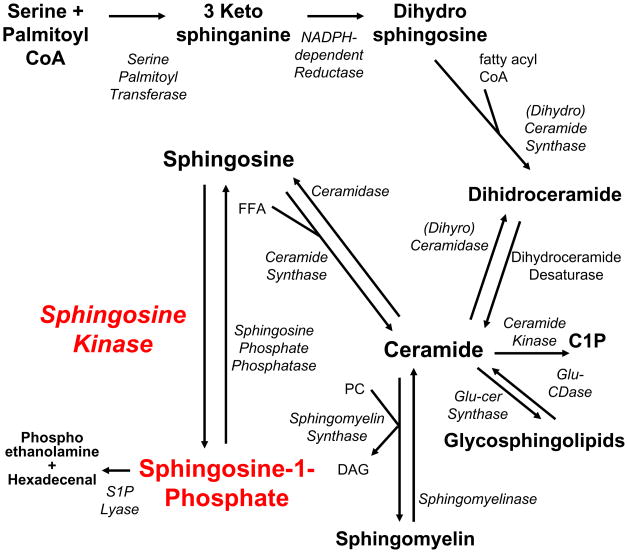
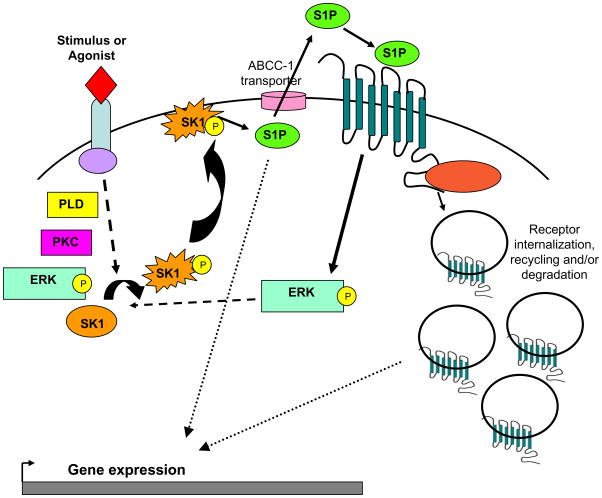
Sphingolipids and their synthetic enzymes are emerging as important mediators in inflammatory responses and as regulators of immune cell functions. In particular, sphingosine kinase (SK) and its product sphingosine-1-phosphate (S1P) have been extensively implicated in these processes. SK catalyzes the phosphorylation of sphingosine to S1P and exists as two isoforms, SK1 and SK2. SK1 has been shown to be activated by cytokines including tumor necrosis factor-alpha (TNF-alpha) and interleukin1-beta (IL1-beta). The activation of SK1 in this pathway has been shown to be, at least in part, required for mediating TNF-alpha and IL1-beta inflammatory responses in cells, including induction of cyclo-oxygenase 2 (COX2). In addition to their role in inflammatory signaling, SK and S1P have also been implicated in various immune cell functions including, mast cell degranulation, migration of neutrophils, and migration and maturation of lymphocytes. The involvement of sphingolipids and sphingolipid metabolizing enzymes in inflammatory signaling and immune cell functions has implicated these mediators in numerous inflammatory disease states as well. The contribution of these mediators, specifically SK1 and S1P, to inflammation and disease are discussed in this review.
Published by Elsevier Masson SAS.
Figures
References
-
- Ogretmen B, Hannun YA. Biologically active sphingolipids in cancer pathogenesis and treatment. Nat Rev Cancer. 2004;4:604–616. - PubMed
-
- Hannun YA, Obeid LM. Mechanisms of ceramide-mediated apoptosis. Adv Exp Med Biol. 1997;407:145–149. - PubMed
-
- Zitomer NC, Mitchell T, Voss KA, Bondy GS, Pruett ST, Garnier-Amblard EC, Liebeskind LS, Park H, Wang E, Sullards MC, Merrill AH, Jr, Riley RT. Ceramide synthase inhibition by fumonisin B1 causes accumulation of 1-deoxysphinganine: a novel category of bioactive 1-deoxysphingoid bases and 1-deoxydihydroceramides biosynthesized by mammalian cell lines and animals. The Journal of biological chemistry. 2009;284:4786–4795. - PMC - PubMed
-
- Chalfant CE, Spiegel S. Sphingosine 1-phosphate and ceramide 1-phosphate: expanding roles in cell signaling. Journal of cell science. 2005;118:4605–4612. - PubMed
-
- Olivera A, Kohama T, Tu Z, Milstien S, Spiegel S. Purification and characterization of rat kidney sphingosine kinase. The Journal of biological chemistry. 1998;273:12576–12583. - PubMed
Publication types
MeSH terms
Substances
Grants and funding
LinkOut - more resources
Full Text Sources
Research Materials
