


Human vagal baroreflex mechanisms in space
- PMID: 20156846
- PMCID: PMC2853000
- DOI: 10.1113/jphysiol.2009.186650
Human vagal baroreflex mechanisms in space
Abstract
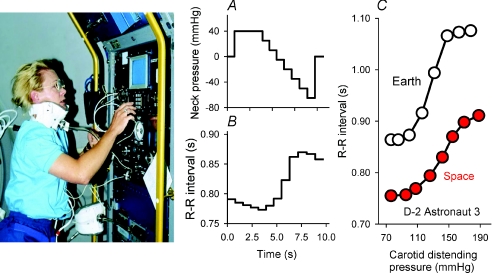
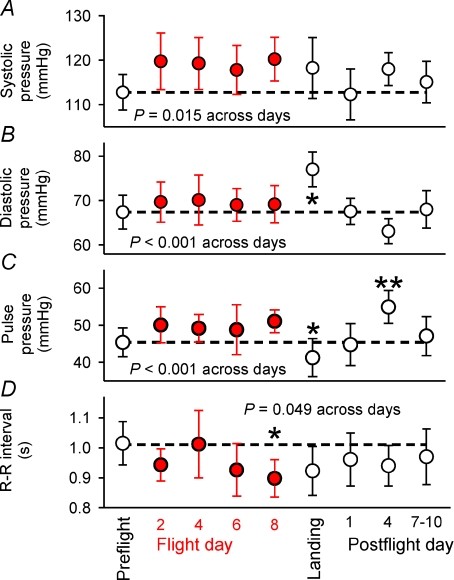
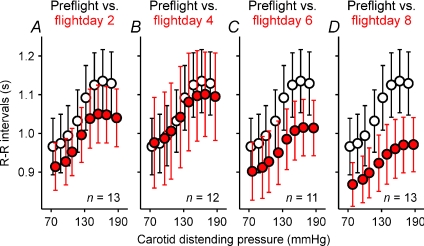
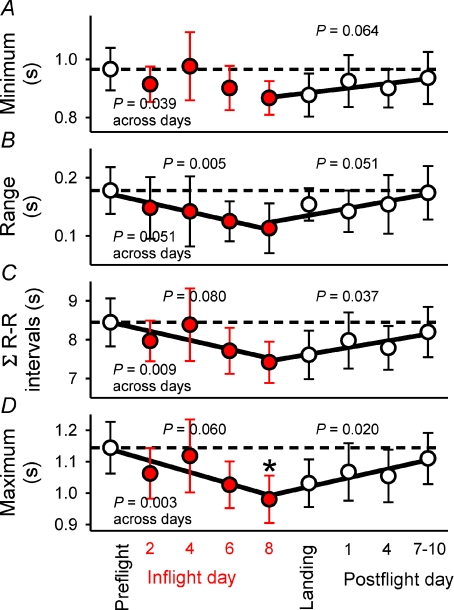
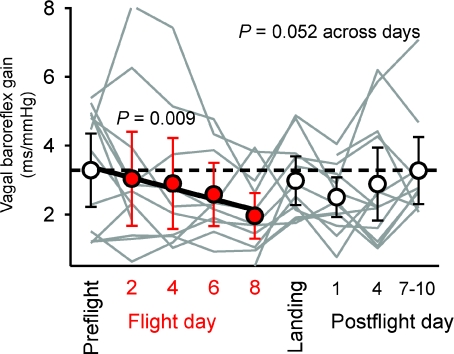
Although astronauts' cardiovascular function is normal while they are in space, many have altered haemodynamic responses to standing after they return to Earth, including inordinate tachycardia, orthostatic hypotension, and uncommonly, syncope. Simulated microgravity impairs vagal baroreceptor-cardiac reflex function and causes orthostatic hypotension. Actual microgravity, however, has been shown to either increase, or not change vagal baroreflex gain. In this study, we tested the null hypothesis that spaceflight does not impair human baroreflex mechanisms. We studied 11 American and two German astronauts before, during (flight days 2-8), and after two, 9- and 10-day space shuttle missions, with graded neck pressure and suction, to elicit sigmoid, vagally mediated carotid baroreflex R-R interval responses. Baseline systolic pressures tended to be higher in space than on Earth (P = 0.015, repeated measures analysis of variance), and baseline R-R intervals tended to be lower (P = 0.049). Baroreceptor-cardiac reflex relations were displaced downward on the R-R interval axis in space. The average range of R-R interval responses to neck pressure changes declined from preflight levels by 37% on flight day 8 (P = 0.051), maximum R-R intervals declined by 14% (P = 0.003), and vagal baroreflex gain by 9% (P = 0.009). These measures returned to preflight levels by 7-10 days after astronauts returned to Earth. This study documents significant increases of arterial pressure and impairment of vagal baroreflex function in space. These results and results published earlier indicate that microgravity exposure augments sympathetic, and diminishes vagal cardiovascular influences.
Figures
References
-
- Alfrey CP, Udden MM, Leach-Huntoon C, Driscoll T, Pickett MH. Control of red blood cell mass in spaceflight. J Appl Physiol. 1996;81:98–104. - PubMed
-
- Arbeille P, Fomina G, Roumy J, Alferova I, Tobal N, Herault S. Adaptation of the left heart, cerebral and femoral arteries, and jugular and femoral veins during short- and long-term head-down tilt and spaceflights. Eur J Appl Physiol. 2001;86:157–168. - PubMed
-
- Baevsky RM, Baranov VM, Funtova II, Diedrich A, Pashenko AV, Chernikova AG, Drescher J, Jordan J, Tank J. Autonomic cardiovascular and respiratory control during prolonged spaceflights aboard the International Space Station. J Appl Physiol. 2007;103:156–161. - PubMed
-
- Beckers F, Verheyden B, Liu J, Aubert AE. Cardiovascular autonomic control after short-duration spaceflights. Acta Astronaut. 2009;65:804–812.
-
- Billman GE, Schwartz PJ, Stone HL. Baroreceptor reflex control of heart rate: a predictor of sudden cardiac death. Circulation. 1982;66:874–880. - PubMed
Publication types
MeSH terms
LinkOut - more resources
Full Text Sources
