


Impact of supplemental site grants to increase African American accrual for the Selenium and Vitamin E Cancer Prevention Trial
- PMID: 20156960
- PMCID: PMC3956599
- DOI: 10.1177/1740774509357227
Impact of supplemental site grants to increase African American accrual for the Selenium and Vitamin E Cancer Prevention Trial
Abstract
Background: African American accrual to prevention trials at rates representative of the disease burden experienced by this population requires additional resources and focused efforts.
Purpose: To describe the rationale, context, and criteria for selection of sites that received Minority Recruitment Enhancement Grants (MREGs) to increase African American recruitment to the Selenium and Vitamin E Cancer Prevention Trial (SELECT). To determine if African American accrual was higher among the 15 MREG sites when compared with similar nonawarded sites.
Methods: Changes in African American accrual at sites that received MREGs are compared with changes in a group of 15, frequency-matched, nonawarded sites using a quasi-experimental, post hoc analysis. Successful and unsuccessful recruitment strategies reported by the MREG sites are described.
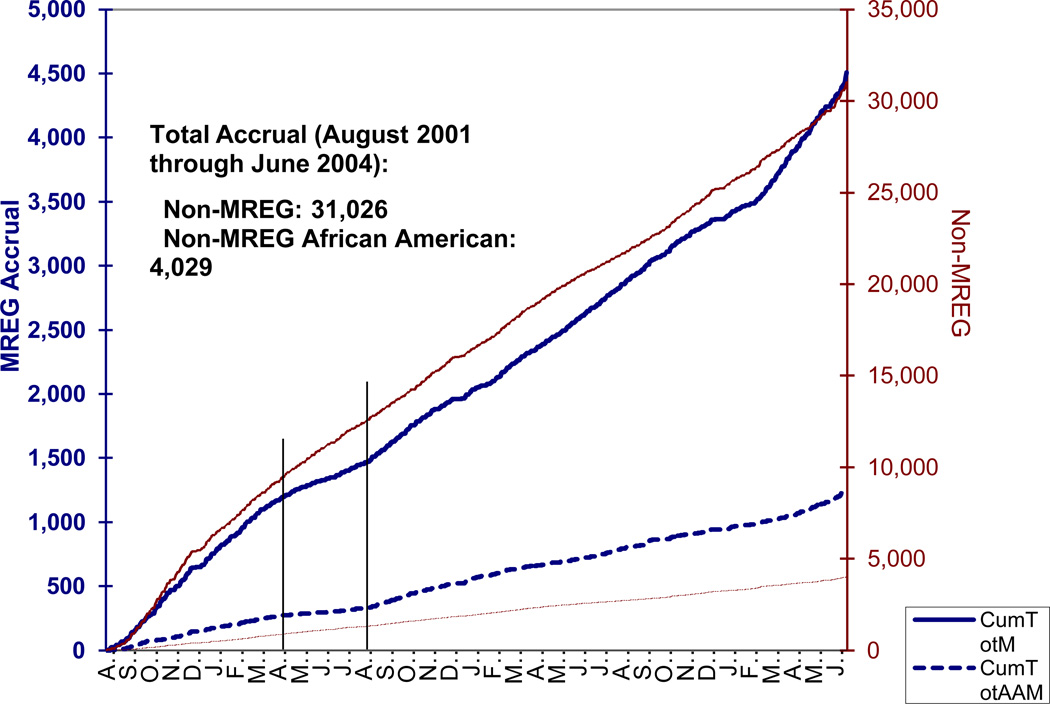
Results: The increased number of African American participants accrued per month at MREG sites post-funding was higher than the change at comparison sites by a factor of 3.38 (p = 0.004, 95% CI: 1.51-7.57). An estimated 602 additional African American participants were recruited at MREG sites due to MREG funding, contributing to the overall 14.9% African American recruitment. Successful recruitment strategies most reported by MREG sites included increasing staff, transportation resources, recruiting through the media, mailings, and prostate cancer screening clinics during off-hours.
Limitations: Comparison sites were chosen retrospectively, not by randomization. Although comparison sites were selected to be similar to MREG sites with regard to potential confounding factors, it is possible that unknown factors could have biased results. Cost-effective analyses were not conducted.
Conclusions: MREG sites increased African American accrual in the post-funding period more than comparison sites, indicating MREG funding enhanced the sites' abilities to accrue African American participants. Targeted grants early in the accrual period may be a useful multi-site intervention to increase African American accrual for a prevention study where adequate African American representation is essential.
Trial registration: ClinicalTrials.gov NCT00006392.
Figures
References
-
- American Cancer Society: Cancer Facts and Figures 2007. Atlanta, GA: American Cancer Society; 2007. [last accessed 12/14/2007]. http://www.cancer.org/downloads/STT/CAFF2007PWSecured.pdf.
-
- American Cancer Society: Cancer Facts and Figures for African American 2007–2008. Atlanta, GA: American Cancer Society; 2007. [last accessed 12/14/2007]. http://www.cancer.org/downloads/STT/CAFF2007AAacspdf2007.pdf.
-
- Ries LAG, Melbert D, Krapcho M, et al. Bethesda, MD: National Cancer Institute; [Last accessed 12/14/2007]. SEER Cancer Statistics Review, 1975–2004. http://seer.cancer.gov/csr/1975_2004/, based on November 2006 SEER data submission, posted to the SEER web site, 2007.
-
- Thompson IM, et al. Phase III prostate cancer prevention trials: are the costs justified? J Clin Oncol. 2005;23(32):8161–8164. - PubMed
-
- Feigl P, et al. Design of the Prostate Cancer Prevention Trial (PCPT) Control Clin Trials. 1995;16(3):150–163. - PubMed
Publication types
MeSH terms
Substances
Associated data
Grants and funding
LinkOut - more resources
Full Text Sources
Medical
