Glycyrrhizin Attenuates MPTP Neurotoxicity in Mouse and MPP-Induced Cell Death in PC12 Cells
- PMID: 20157396
- PMCID: PMC2817536
- DOI: 10.4196/kjpp.2008.12.2.65
Glycyrrhizin Attenuates MPTP Neurotoxicity in Mouse and MPP-Induced Cell Death in PC12 Cells
Abstract
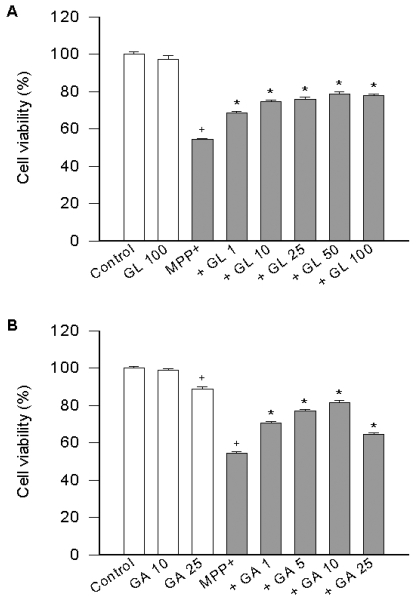
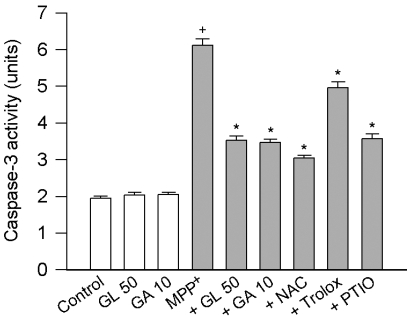
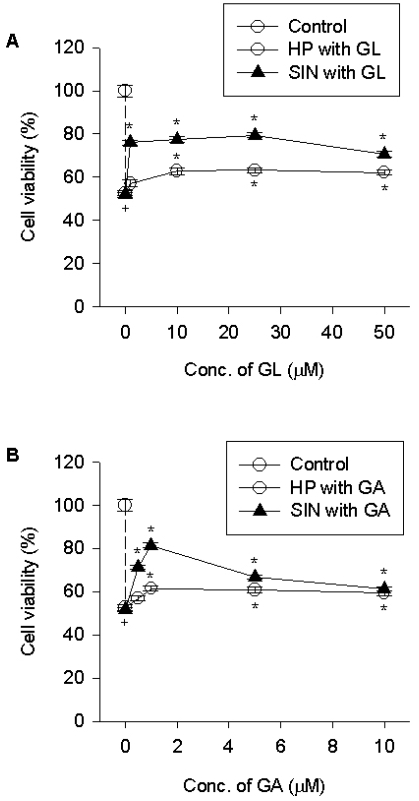
The present study examined the inhibitory effect of licorice compounds glycyrrhizin and a metabolite 18beta-glycyrrhetinic acid on the neurotoxicity of 1-methyl-4-phenyl-1,2,3,6-tetrahydropyridine (MPTP) in the mouse and on the 1-methyl-4-phenylpyridinium (MPP(+))-induced cell death in differentiated PC12 cells. MPTP treatment increased the activities of total superoxide dismutase, catalase and glutathione peroxidase and the levels of malondialdehyde and carbonyls in the brain compared to control mouse brain. Co-administration of glycyrrhizin (16.8 mg/kg) attenuated the MPTP effect on the enzyme activities and formation of tissue peroxidation products. In vitro assay, licorice compounds attenuated the MPP(+)-induced cell death and caspase-3 activation in PC12 cells. Glycyrrhizin up to 100microM significantly attenuated the toxicity of MPP(+). Meanwhile, 18beta-glycyrrhetinic acid showed a maximum inhibitory effect at 10microM; beyond this concentration the inhibitory effect declined. Glycyrrhizin and 18beta-glycyrrhetinic acid attenuated the hydrogen peroxide- or nitrogen species-induced cell death. Results from this study indicate that glycyrrhizin may attenuate brain tissue damage in mice treated with MPTP through inhibitory effect on oxidative tissue damage. Glycyrrhizin and 18beta-glycyrrhetinic acid may reduce the MPP(+) toxicity in PC12 cells by suppressing caspase-3 activation. The effect seems to be ascribed to the antioxidant effect.
Keywords: Brain tissue damage; Cell death; Glycyrrhizin; Inhibitory effect; MPP+; MPTP.
Figures
References
-
- Aebi H. Catalase in vitro. Methods Enzymol. 1984;105:121–126. - PubMed
-
- Agarwal MK, Iqbal M, Athar M. Inhibitory effect of 18β-glycyrrhetinic acid on 12-O-tetradecanoyl phorbol-13-acetate- induced cutaneous oxidative stress and tumor promotion in mice. Redox Rep. 2005;10:151–157. - PubMed
-
- Bonuccelli U, Del Dotto P. New pharmacological horizons in the treatment of Parkinson disease. Neurology. 2006;67(7 Suppl 2):S30–S38. - PubMed
-
- Cassarino DS, Fall CP, Swerdlow RH, Smith TS, Halvorsen EM, Miller SW, Parks JP, Parker WD, Jr, Bennet JP., Jr Elevated reactive oxygen species and antioxidant enzyme activities in animal and cellular models of Parkinson's disease. Biochim Biophys Acta. 1997;1362:77–80. - PubMed
-
- Cassarino DS, Parks JK, Parker WD, Jr, Bennett JP., Jr The Parkinsonian neurotoxin MPP+ opens the mitochondrial permeability transition pore and releases cytochrome c in isolated mitochondria via an oxidative mechanism. Biochim Biophys Acta. 1999;1453:49–62. - PubMed
LinkOut - more resources
Full Text Sources
Research Materials