. 2009 Mar 2;1(3):316-27.
doi: 10.18632/aging.100028.

Oncogenic viral protein HPV E7 up-regulates the SIRT1 longevity protein in human cervical cancer cells

Affiliations

Oncogenic viral protein HPV E7 up-regulates the SIRT1 longevity protein in human cervical cancer cells

Simon J Allison et al. Aging (Albany NY). .

Abstract

Senescence is blocked in human cervical keratinocytes infected with high risk human papillomavirus (e.g. HPV type16). Viral oncoproteins HPV E6 and HPV E7 access the cell cycle via cellular p53 and retinoblastoma proteins respectively. Previously we have shown that HPV E7, not HPV E6, is also responsible for cervical cancer cell survival (SiHa cells; HPV type16). We now present evidence that SIRT1, an aging-related NAD-dependent deacetylase, mediates HPV E7 survival function in SiHa cervical cancer cells. Moreover, HPV E7 up-regulates SIRT1 protein when expressed in primary human keratinocytes. Conversely, SIRT1 levels decrease following RNAi-mediated silencing of HPV E7 in SiHa cells. Silencing HPV E6 has no effect on SIRT1 but, as expected, causes marked accumulation of p53 protein accompanied by p53-mediated up-regulation of p21. However, p53 acetylation (K382Ac) was barely detectable. Since p53 is a known SIRT1 substrate we propose that elevated SIRT1 levels (induced by HPV E7) attenuate p53 pro-apoptotic capacity via its de-acetylation. Our discovery that HPV E7 up-regulates SIRT1 links a clinically important oncogenic virus with the multi-functional SIRT1 protein. This link may open the way for a more in-depth understanding of the process of HPV-induced malignant transformation and also of the inter-relationships between aging and cancer.

Keywords: HPV E7; HPV E6; SIRT1; p53; aging; cancer.


Conflict of interest statement

The authors have no conflict of interests to declare.

Figures

Figure 1.
Figure 1.. RNAi-mediated knock-down of HPV E6 and HPV E7 in SiHa and CaSki cells, and effects on p53 and retinoblastoma protein.
(A) mRNA qRT-PCR determinations 48h post-transfection as indicated, mean ± s.d. of three determinations. Asterix indicates differential effect of E7 siRNA on E6 mRNA levels in SiHa versus CaSki cells. (B) Relative positions of siRNA sequences along the bicistronic E6/E7 transcript. (C) Relative levels of E6 and E7 mRNAs 48h post-transfection of SiHa cells with the indicated siRNAs. (D, E) Immunoblots showing effects of E6 or E7 depletion on levels of p53, p21 and hyperphosphorylated Rb (pRb*) in SiHa cells.
Figure 2.
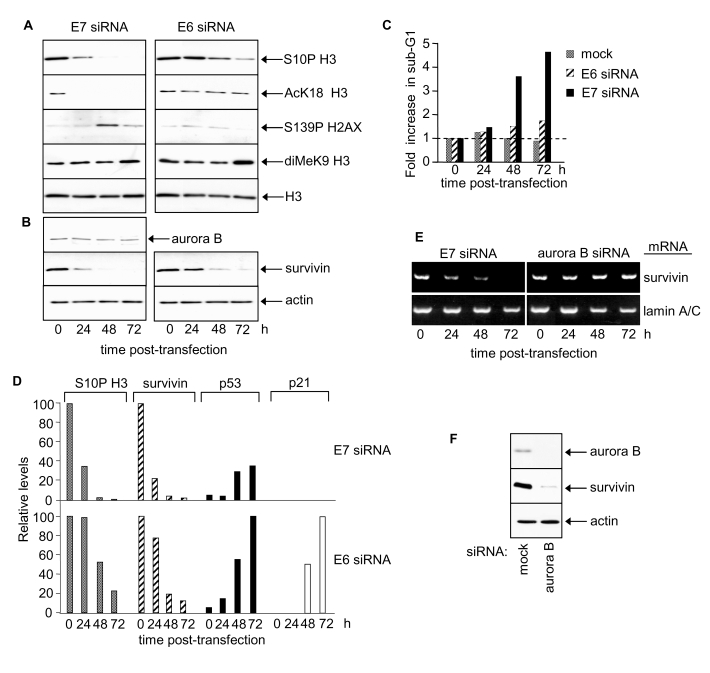
Figure 2.. HPV E7 maintains survivin protein and induces site-specific changes in histone H3 modifications.
(A) Histone H3 modifications at 24, 48 and 72 h post-transfection with E6 or E7 siRNA. Equivalent exposures for each pair of immunoblots shown. (B) Aurora B and survivin protein levels following E6 or E7 silencing. (C) Cell death after E6 or E7 siRNA treatment. (D) Relative changes in S10P H3, survivin, p53 and p21 proteins in response to E7 or E6 siRNA. (E) RT-PCR determinations of survivin and lamin A/C mRNA levels in SiHa cells as indicated. (F) Immunoblots showing effect of aurora B silencing on survivin protein levels at 48h post siRNA transfection.
Figure 3.
Figure 3.. Effects of RNAi-mediated silencing of survivin and aurora B on S10P histone H3 and SiHa cell phenotype.
(A) Survivin, aurora B and S10P histone H3 protein levels 48h post-transfection. (B) Phase contrast images of SiHa cells as indicated. (C) Cell cycle distribution at 0, 24, 48 and 72h post-transfection with indicated siRNAs. (D) Induction of polyploidy in SiHa cells following survivin depletion indicated by percentage of >G2 cells and appearance of multinuclear cells.
Figure 4.
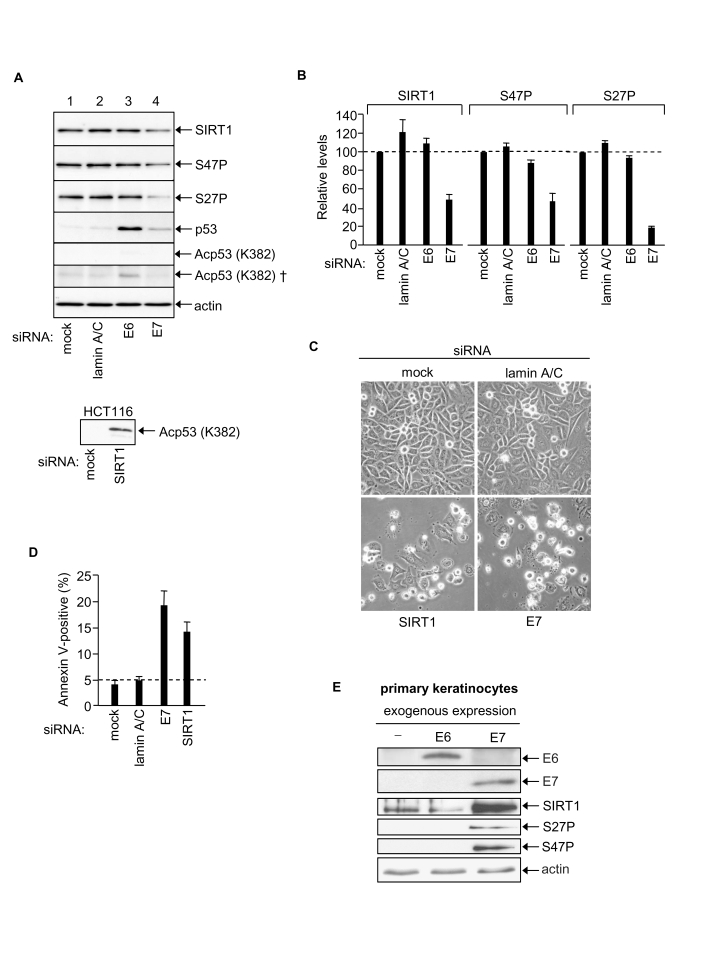
Figure 4.. HPV E7 enables SiHa cervical cancer cell survival via up-regulation of SIRT1 protein levels.
(A) Equal amounts of protein analysed by immunoblotting as indicated, upper panels SiHa cells (50 μg protein). Bottom panel HCT116 cell positive control for p53 K382Ac detection (40 μg protein, 2 minute exposure). Note that p53 K382Ac is undetectable in SiHa cells (5 min exposure) and requires 2 h exposure for detection (†). (B) Relative levels of SIRT1, SIRT1 S47P and SIRT1 S27P 48h post-transfection with indicated siRNAs, mean of two experiments. (C) Phase contrast images of SiHa cells post-transfection with the indicated siRNAs. (D) Apoptotic SiHa cells 48h post-transfection with the indicated siRNAs. (E) Primary human keratinocytes 48h post-transfection with expression vectors for HPV E6 and HPV16 E7 and equivalent samples immunoblotted for HPV E6, HPV E7, SIRT1, SIRT1 S27P and SIRT1 S47P.
Figure 5.
Figure 5.
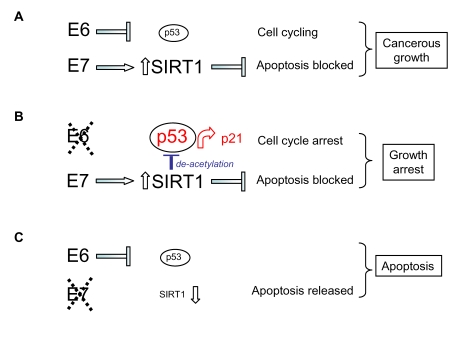
Model for the respective effects of HPV E6 and HPV E7 on human cervical cancer cell survival and proliferation taking into account (A) up-regulation of SIRT1 protein by HPV E7, (B) SIRT1-mediated de-acetylation of p53 and (C) SIRT1 cervical cancer cell survival functions (see text).

References

    1. Finkel T, Serrano M, Blasco MA. The common biology of cancer and ageing. Nature. 2007;448:767–774. - PubMed
    1. Oberdoerffer P, Sinclair DA. The role of nuclear architecture in genomic instability and ageing. Nat Rev Mol Cell Biol. 2007;8:692–702. - PubMed
    1. Rubbi CP, Milner J. p53 is a chromatin accessibility factor for nucleotide excision repair of DNA damage. EMBO J. 2003;22:975–986. - PMC - PubMed
    1. Allison SJ, Milner J. Loss of p53 has site-specific effects on histone H3 modification, including serine 10 phosphorylation important for maintenance of ploidy. Cancer Res. 2003;63:6674–6679. - PubMed
    1. Allison SJ, Milner J. Remodelling chromatin on a global scale: a novel protective function of p53. Carcinogenesis. 2004;25:1551–1557. - PubMed

Publication types

MeSH terms