


Review
doi: 10.1111/j.1582-4934.2010.01031.x.
Epub 2010 Feb 16.
Inter-connection between mitochondria and HIFs
Affiliations
- PMID: 20158574
- PMCID: PMC2987233
- DOI: 10.1111/j.1582-4934.2010.01031.x
Item in Clipboard
Review
Inter-connection between mitochondria and HIFs
J Cell Mol Med.
2010 Apr.
Abstract
The transcription factors hypoxia inducible factors 1 and 2 (HIF-1 and HIF-2) regulate multiple responses to physiological hypoxia such as transcription of the hormone erythropoietin to enhance red blood cell proliferation, vascular endothelial growth factor to promote angiogenesis and glycolytic enzymes to increase glycolysis. Recent studies indicate that HIFs also regulate mitochondrial respiration and mitochondrial oxidative stress. Interestingly, mitochondrial metabolism, respiration and oxidative stress also regulate activation of HIFs. In this review, we examine the evidence that mitochondria and HIFs are intimately connected to regulate each other resulting in appropriate responses to hypoxia.
Figures

Overview of oxidative phosphorylation. Oxidative phosphorylation is the flow of electrons from NADH and FADH2 to O2 through the mitochondrial electron transport chain resulting in pumping of protons across the inner mitochondrial membrane into the intermembrane space. This creates a proton-motive force which is utilized to generate ATP through the ATP synthase.

Mitochondrial electron transport chain generates superoxide. Complexes I, II and III generate superoxide into the mitochondrial matrix. Complex III can also release superoxide into the intermembrane space. Complex IV does not generate superoxide. Complex III generates superoxide through the Ubiquinone (Q) cycle.
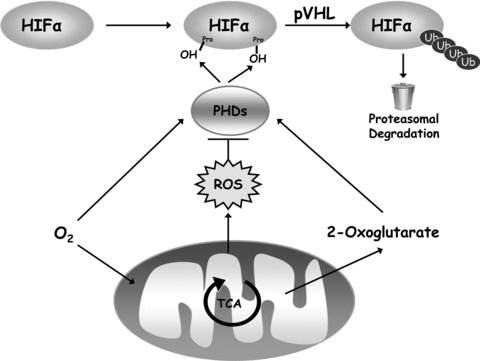
Mitochondria regulate HIFs. HIFs are hetrodimers between the HIFα proteins and HIF1β protein. HIFα proteins are hydroxylated at two distinct proline residues by PHDs under normoxic conditions. The hydroxylation directs the HIFα proteins for pVHL mediated ubiquitin-dependent degradation. The hydroxylation reaction requires oxygen and 2-oxoglutarate as substrates. Mitochondria can regulate hydroxylation by controlling the availability of oxygen and the TCA cycle intermediate 2-oxolgultrate to the PHDs. Furthermore, under hypoxic conditions, the release of ROS from mitochondrial complex III results in prevention of hydroxylation and stabilization of HIFα proteins. Thus, mitochondria regulate HIFα proteins through ROS, oxygen and 2-oxogluatrate availability.
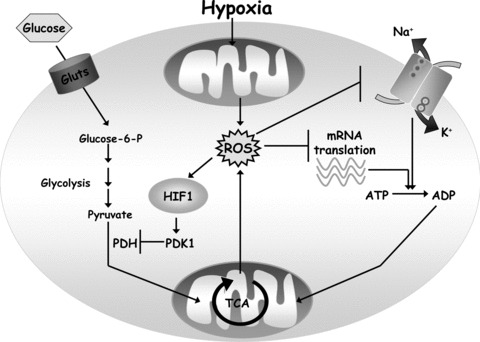
Hypoxia regulates mitochondrial respiration. Mitochondrial respiration is regulated by the oxygen, ADP and reducing equivalents (NADH, FADH2 from TCA cycle) availability. Oxygen is limiting for respiration under severe hypoxic conditions (<0.5% O2). Thus under physiological hypoxia (1–3% O2) oxygen is not limiting to conduct maximal respiration. The major controller of mitochondrial respiration is ADP availability from the cellular ATP utilization. Hypoxia through mitochondrial ROS also diminishes the activity of Na/K ATPase and mRNA translation. This results in a decrease in cellular ATP utilization and a decrease in ADP availability to mitochondria. Hypoxia also stimulates the release of mitochondrial ROS from complex III to activate HIF-1, which induces the transcription of PDK1. PDK1 negatively regulates pyruvate dehydrogenase, an enzyme that converts pyruvate to acetyl-CoA. Thus, an increase in HIF-1-dependent PDK1 expression results in diminished availability of acetyl-CoA. This also contributes to diminished respiration during hypoxia by decreasing TCA cycle activity.
References
-
- Semenza GL. Life with oxygen. Science. 2007;318:62–4. - PubMed
-
- Bunn HF, Poyton RO. Oxygen sensing and molecular adaptation to hypoxia. Physiol Rev. 1996;76:839–85. - PubMed
-
- Harris AL. Hypoxia–a key regulatory factor in tumour growth. Nat Rev Cancer. 2002;2:38–47. - PubMed
-
- Wang GL, Semenza GL. Purification and characterization of hypoxia-inducible factor 1. J Biol Chem. 1995;270:1230–7. - PubMed
Publication types
MeSH terms
Substances
Grants and funding
LinkOut - more resources
Full Text Sources
Other Literature Sources
