


Predicting phenotype from genotype: normal pigmentation
- PMID: 20158590
- PMCID: PMC3626268
- DOI: 10.1111/j.1556-4029.2009.01317.x
Predicting phenotype from genotype: normal pigmentation
Abstract
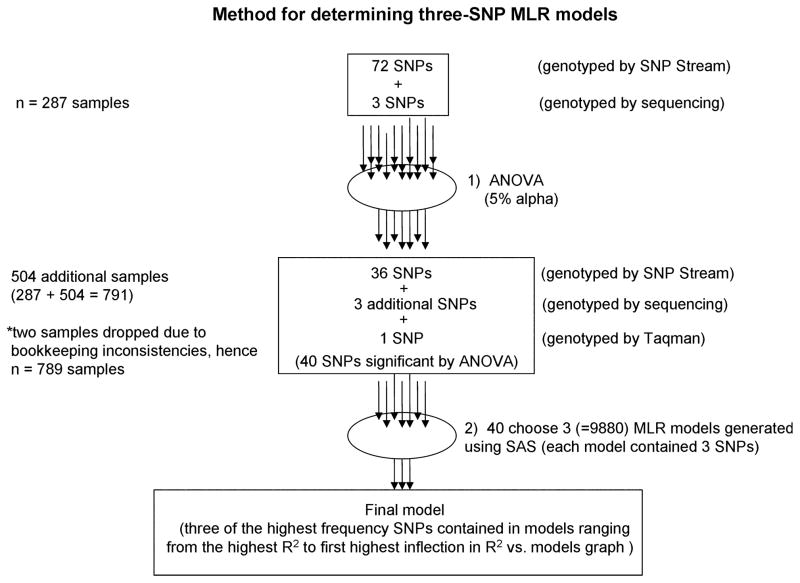
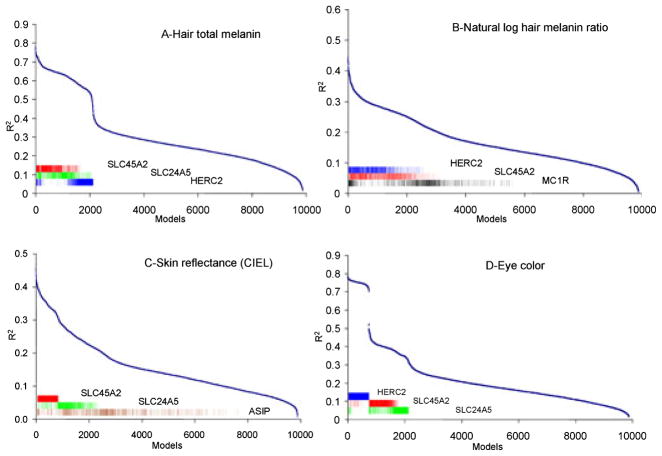
Genetic information in forensic studies is largely limited to CODIS data and the ability to match samples and assign them to an individual. However, there are circumstances, in which a given DNA sample does not match anyone in the CODIS database, and no other information about the donor is available. In this study, we determined 75 SNPs in 24 genes (previously implicated in human or animal pigmentation studies) for the analysis of single- and multi-locus associations with hair, skin, and eye color in 789 individuals of various ethnic backgrounds. Using multiple linear regression modeling, five SNPs in five genes were found to account for large proportions of pigmentation variation in hair, skin, and eyes in our across-population analyses. Thus, these models may be of predictive value to determine an individual's pigmentation type from a forensic sample, independent of ethnic origin.
Conflict of interest statement
Conflict of Interest Statement
Dr. Tony Frudakis is and Dr. Matthew Thomas was an employee and shareholder of a company, DNAPrint, which performs forensic DNA analysis.
Figures
Similar articles
-
Genotype versus phenotype: human pigmentation.Forensic Sci Int Genet. 2007 Jun;1(2):105-10. doi: 10.1016/j.fsigen.2007.01.005. Epub 2007 Mar 1. Forensic Sci Int Genet. 2007. PMID: 19083738
-
Interactions between HERC2, OCA2 and MC1R may influence human pigmentation phenotype.Ann Hum Genet. 2009 Mar;73(2):160-70. doi: 10.1111/j.1469-1809.2009.00504.x. Epub 2009 Feb 4. Ann Hum Genet. 2009. PMID: 19208107
-
SLC24A5 and ASIP as phenotypic predictors in Brazilian population for forensic purposes.Leg Med (Tokyo). 2015 Jul;17(4):261-6. doi: 10.1016/j.legalmed.2015.03.001. Epub 2015 Mar 11. Leg Med (Tokyo). 2015. PMID: 25801600
-
The genetics of skin, hair, and eye color variation and its relevance to forensic pigmentation predictive tests.Forensic Sci Rev. 2015 Jan;27(1):13-40. Forensic Sci Rev. 2015. PMID: 26227136 Review.
-
Skin Pigmentation Genetics for the Clinic.Dermatology. 2017;233(1):1-15. doi: 10.1159/000468538. Epub 2017 May 3. Dermatology. 2017. PMID: 28463841 Review.
Cited by
-
Genetic and phenotypic variability of iris color in Buenos Aires population.Genet Mol Biol. 2018 Jan-Mar;41(1):50-58. doi: 10.1590/1678-4685-GMB-2017-0175. Genet Mol Biol. 2018. PMID: 29658972 Free PMC article.
-
Genomic ancestry, self-reported "color" and quantitative measures of skin pigmentation in Brazilian admixed siblings.PLoS One. 2011;6(11):e27162. doi: 10.1371/journal.pone.0027162. Epub 2011 Nov 2. PLoS One. 2011. PMID: 22073278 Free PMC article.
-
Improved eye- and skin-color prediction based on 8 SNPs.Croat Med J. 2013 Jun;54(3):248-56. doi: 10.3325/cmj.2013.54.248. Croat Med J. 2013. PMID: 23771755 Free PMC article.
-
Anything you touch may be used against you.EMBO Rep. 2010 Jun;11(6):424-7. doi: 10.1038/embor.2010.68. EMBO Rep. 2010. PMID: 20514041 Free PMC article.
-
A study in scarlet: MC1R as the main predictor of red hair and exemplar of the flip-flop effect.Hum Mol Genet. 2019 Jun 15;28(12):2093-2106. doi: 10.1093/hmg/ddz018. Hum Mol Genet. 2019. PMID: 30657907 Free PMC article.
References
-
- Tully G. Genotype versus phenotype: human pigmentation. Forensic Sci Int Genet. 2007;1:105–10. - PubMed
-
- Wakamatsu K, Ito S. Advanced chemical methods in melanin determination. Pigment Cell Res. 2002;15:174–83. - PubMed
-
- Nordlund JJ, Ortonne J. The normal color of human skin. In: Nordlund JJ, Boissy RE, Hearing VJ, King RA, Oetting WS, Ortonne J, editors. The pigmentary system. 2. Malden, MA: Blackwell Publishing; 2006. pp. 504–20.
-
- Valverde P, Healy E, Jackson I, Rees JL, Thody AJ. Variants of the melanocyte-stimulating hormone receptor gene are associated with red hair and fair skin in humans. Nat Genet. 1995;11:328–30. - PubMed
-
- Flanagan N, Healy E, Ray A, Philips S, Todd C, Jackson IJ, et al. Pleiotropic effects of the melanocortin 1 receptor (MC1R) gene on human pigmentation. Hum Mol Genet. 2000;9:2531–7. - PubMed
MeSH terms
Substances
Grants and funding
LinkOut - more resources
Full Text Sources
