


Evidence for altered activity of the IL-6 pathway in chronic rhinosinusitis with nasal polyps
- PMID: 20159251
- PMCID: PMC2828355
- DOI: 10.1016/j.jaci.2009.10.072
Evidence for altered activity of the IL-6 pathway in chronic rhinosinusitis with nasal polyps
Abstract
Background: IL-6 activates T(H)17 cells and regulates the response of B lymphocytes and regulatory T cells. The IL-6 receptor and the membrane protein, glycoprotein 130 (gp130), form an active signaling complex that signals through signal transducer and activator of transcription 3 (STAT3) and other signaling molecules. Both the IL-6 receptor (IL-6R) and gp130 can be found in soluble forms that regulate the pathway.
Objective: We measured IL-6 signaling components and IL-17 in chronic rhinosinusitis (CRS) with nasal polyps (CRSwNP), CRS without nasal polyps (CRSsNP), and controls to assess the IL-6 pathway in CRS.
Methods: IL-6, soluble IL-6R, soluble gp130 (sgp130), and IL-17 were measured in sinus tissue extracts and in nasal lavage fluid by either cytokine bead array or ELISA. phosphoSTAT3 (p-STAT3) was determined by Western blot and by immunohistochemistry.
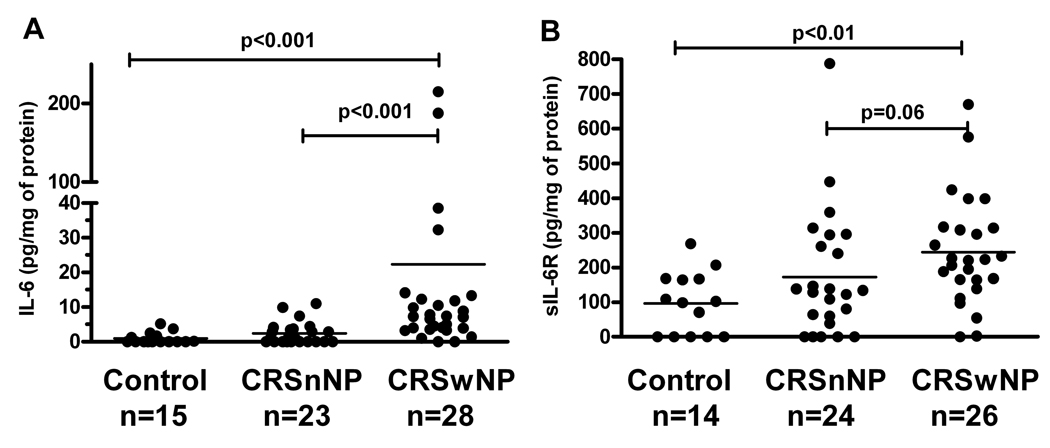
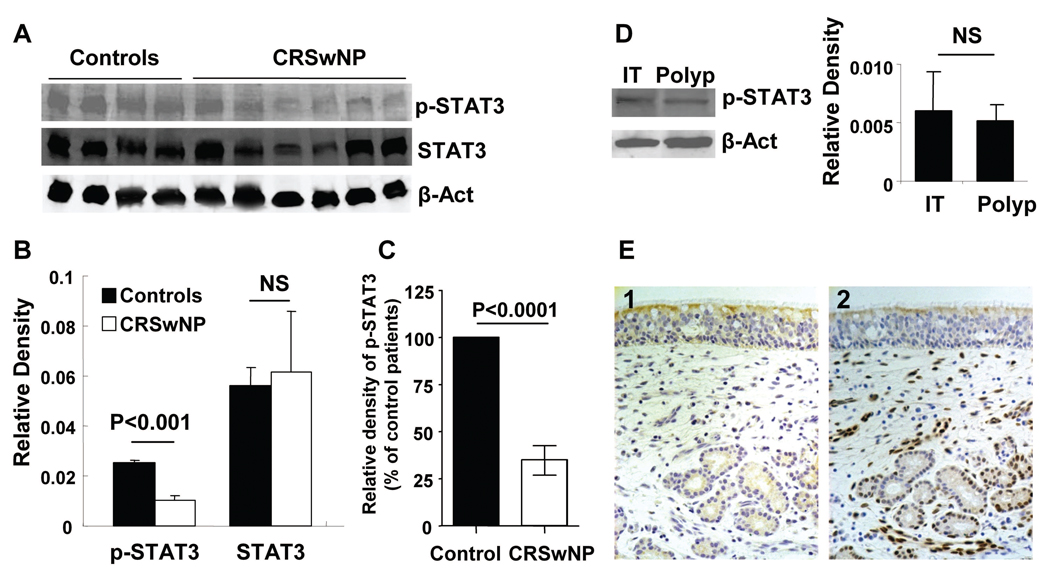
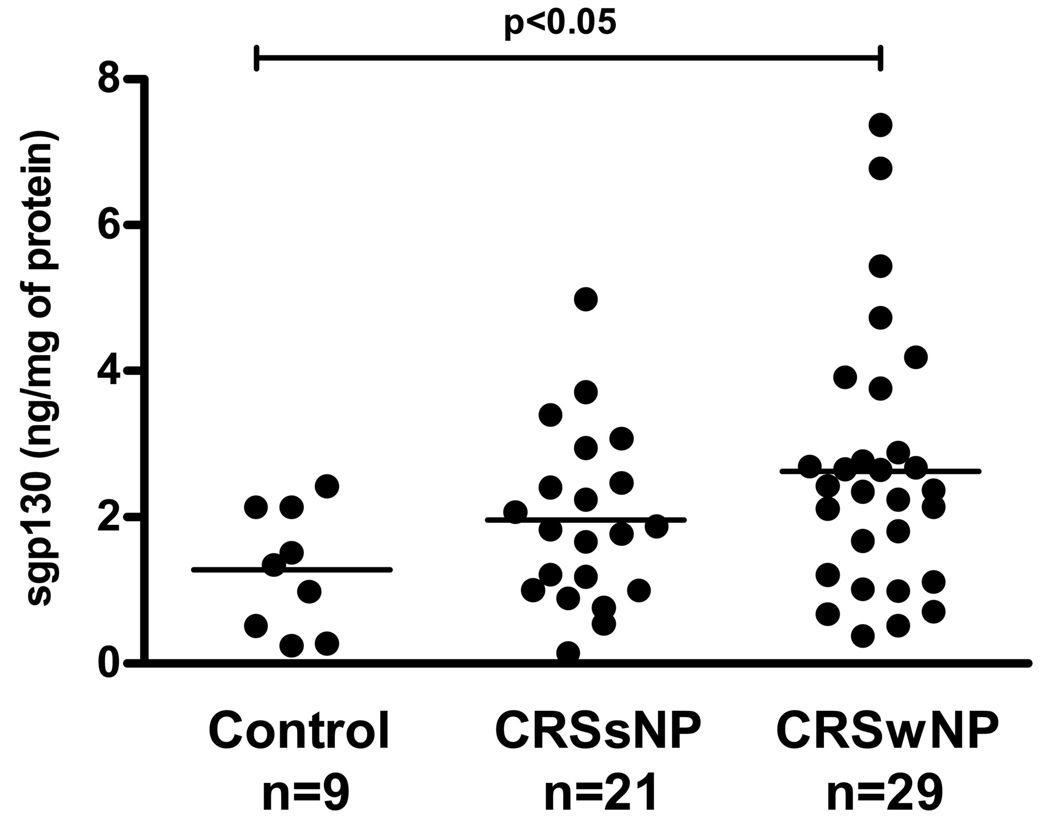
Results: IL-6 protein was significantly (P < .001) increased in CRSwNP compared with CRSsNP and controls. Soluble IL-6R was also increased in nasal polyp compared with control tissue (P < .01). Despite elevated IL-6 and sIL-6R, IL-17A, E, and F were undetectable in the sinus tissue from most of the patients with CRS and controls. p-STAT3 levels were reduced in the polyp tissue, possibly indicating reduced activity of IL-6 in the tissue. sgp130 was elevated in CRSwNP compared with CRSsNP and controls.
Conclusion: p-STAT3 levels are decreased in CRSwNP despite increased levels of IL-6 and sIL-6R and are associated with the absence of an IL-17 response. This may be a response to elevated levels of sgp130, a known inhibitor of IL-6 signaling. These results indicate that IL-6 and its signaling pathway may be altered in CRSwNP.
Copyright 2010 American Academy of Allergy, Asthma & Immunology. Published by Mosby, Inc. All rights reserved.
Figures
Comment in
-
Plasticity of airway epithelial cells.J Allergy Clin Immunol. 2011 Dec;128(6):1225-6. doi: 10.1016/j.jaci.2011.10.006. J Allergy Clin Immunol. 2011. PMID: 22133319 Free PMC article. No abstract available.
References
-
- Van Zele T, Claeys S, Gevaert P, Van Maele G, Holtappels G, Van Cauwenberge, et al. Differentiation of chronic sinus diseases by measurement of inflammatory mediators. Allergy. 2006;61:1280–1289. - PubMed
-
- Bachert C, Gevert P, van Cauwenberge P. Staphylococcus aureus superantigens and airway disease. Curr Allergy Asthma Rep. 2002;2:252–258. - PubMed
-
- Shin SH, Ponikau JU, Sherris DA, Congdon D, Frigas E, Homburger HA, et al. Chronic rhinosinusitis: an enhanced immune response to ubiquitous airborne fungi. J Allergy Clin Immunol. 2004;114:1369–1375. - PubMed
-
- Kramer MF, Ostertag P, Pfrogner E, Rasp G. Nasal interleukin-5, immunoglobulin E, eosinophilic cationic protein, and soluble intercellular adhesion molecule-1 in chronic sinusitis, allergic rhinitis, and nasal polyposis. Laryngoscope. 2000;110:1056–1062. - PubMed
Publication types
MeSH terms
Substances
Grants and funding
LinkOut - more resources
Full Text Sources
Other Literature Sources
Medical
Research Materials
Miscellaneous
