Review
. 2010 Feb;7(1):29-39.
doi: 10.1513/pats.200909-102JS.

Chaperone-mediated autophagy

Affiliations
Review

Chaperone-mediated autophagy

Eloy Bejarano et al. Proc Am Thorac Soc. 2010 Feb.

Abstract

Continuous renewal of intracellular components is required to preserve cellular functionality. In fact, failure to timely turnover proteins and organelles leads often to cell death and disease. Different pathways contribute to the degradation of intracellular components in lysosomes or autophagy. In this review, we focus on chaperone-mediated autophagy (CMA), a selective form of autophagy that modulates the turnover of a specific pool of soluble cytosolic proteins. Selectivity in CMA is conferred by the presence of a targeting motif in the cytosolic substrates that, upon recognition by a cytosolic chaperone, determines delivery to the lysosomal surface. Substrate proteins undergo unfolding and translocation across the lysosomal membrane before reaching the lumen, where they are rapidly degraded. Better molecular characterization of the different components of this pathway in recent years, along with the development of transgenic models with modified CMA activity and the identification of CMA dysfunction in different severe human pathologies and in aging, are all behind the recent regained interest in this catabolic pathway.


Figures
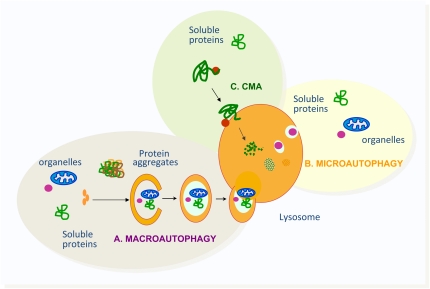
Figure 1.
Figure 1.
Schematic model of the three main types of autophagy described in mammalian cells. (A) Macroautophagy degrades soluble proteins, organelles, and protein aggregates upon their sequestration in a double membrane vesicle that fuses with the lysosome to acquire the hydrolases required for proteolysis. (B) Microautophagy also degrades soluble proteins and organelles incorporated into lysosomes in small vesicles that form from invaginations of the lysosomal membrane. (C) Chaperone-mediated autophagy (CMA) only contributes to the degradation of a specific subset of soluble proteins, and does not require any type of membrane deformity for substrate delivery to lysosomes.
Figure 2.
Figure 2.
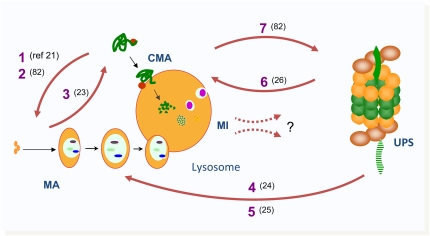
Interactions among different proteolytic systems. Growing evidence supports multiple levels of interactions among autophagic pathways and between the autophagic system and the ubiquitin–proteasome system (UPS). Chronic blockage of CMA promotes up-regulation of macroautophagy (MA) [1] (21), whereas acute blockage leads to macroautophagic dysregulation [2] (79). Cells respond to blockage of MA by increasing CMA [3] (23). Acute blockage of the proteasome up-regulates MA [4] (24), whereas chronic blockage leads to macroautophagic dysregulation [5] (25). Some subunits of the proteasome are degraded by CMA [6] (26), which may explain why blockage of CMA is associated with proteasome dysregulation [7] (79). Interactions of microautophagy (MI) with other proteolytic systems remain undiscovered (?).
Figure 3.
Figure 3.
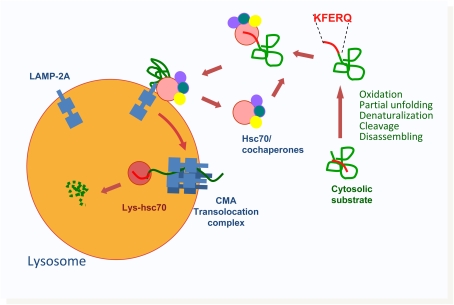
Schematic model of chaperone-mediated autophagy (CMA). Cytosolic proteins substrate for CMA can undergo different modifications that lead to the exposure of the CMA-targeting motif and its subsequent recognition by cytosolic heat shock protein of 70 kD (Hsc70). The complex between the substrate protein, hsc70, and its cochaperones is delivered to the surface of the lysosomal membrane, where it interacts with lysosome-associated membrane protein (LAMP)-2A, the receptor for CMA. Once bound to LAMP-2A, substrate proteins undergo complete unfolding, and, assisted by a luminal form of hsc70 (Lys-hsc70), they cross the lysosomal membrane for rapid degradation in the lumen.
Figure 4.
Figure 4.
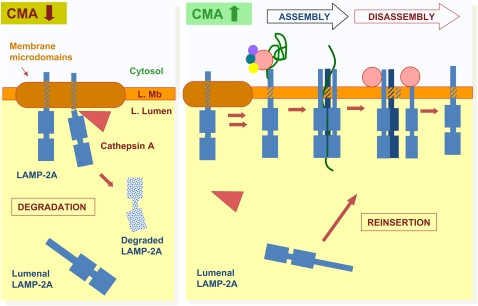
Local regulation of chaperone-mediated autophagy (CMA) activity in lysosomes. Under conditions of low CMA activity (left), lysosome-associated membrane protein (LAMP)-2A is recruited to lysosomal membrane (L. Mb) microdomains, where it undergoes partial cleavage by cathepsin A, followed by rapid degradation of this truncated product in the lysosomal lumen (L. Lumen). There is a fraction of lysosomal LAMP-2A that resides in the lumen and is not accessible for substrate binding or translocation. When CMA is activated (right), association of LAMP-2A with the membrane microdomains decreases, favoring, instead, binding of substrate proteins to the cytosolic tail of this receptor. Substrate binding promotes multimerization of LAMP-2A to form a translocation complex. Once the substrate is released into the lysosomal lumen, hsc70 present at the lysosomal membrane promotes disassembly of LAMP-2A from the translocation complex. When maximal activation of CMA is required, the pool of LAMP-2A resident in the lysosomal lumen can be mobilized toward the membrane to contribute to substrate binding/uptake.
Figure 5.
Figure 5.
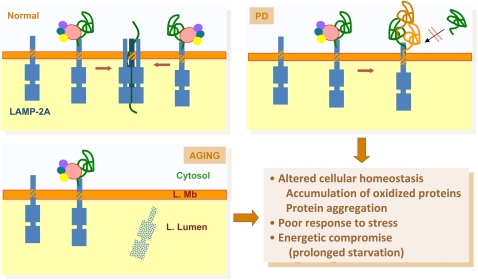
Pathology of chaperone-mediated autophagy (CMA). This model depicts normal CMA and two different conditions in which the activity of this process is compromised. In Parkinson's disease (PD), abnormal association of pathogenic proteins to lysosome-associated membrane protein (LAMP)-2A at the lysosomal membrane (L. Mb) promotes formation of irreversible protein oligomers that compromise uptake and degradation of other proteins through CMA. In aging, compromised stability of LAMP-2A at the lysosomal membrane results in reduced levels of this receptor protein, and the consequent decrease in substrate binding and uptake. Some of the consequences of CMA failure in pathologic conditions and in aging are listed. L. Lumen = lysosomal lumen.

References

    1. Mizushima N, Levine B, Cuervo A, Klionsky D. Autophagy fights disease through cellular self-digestion. Nature 2008;451:1069–1075. - PMC - PubMed
    1. Morimoto RI, Cuervo AM. Protein homeostasis and aging: taking care of proteins from the cradle to the grave. J Gerontol A Biol Sci Med Sci 2009;64:167–170. - PMC - PubMed
    1. Rubinsztein DC, DiFiglia M, Heintz N, Nixon RA, Qin Z-H, Ravikumar B, Stefanis L, Tolkovsky AM. Autophagy and its possible roles in nervous system diseases, damage and repair. Autophagy 2005;1:11–22. - PubMed
    1. Levine B, Deretic V. Unveiling the roles of autophagy in innate and adaptive immunity. Nat Rev Immunol 2007;7:767–777. - PMC - PubMed
    1. Cuervo AM. Autophagy: in sickness and in health. Trends Cell Biol 2004;14:70–77. - PubMed

Publication types

Substances

LinkOut - more resources