Coherence and completeness of population-based family cancer reports
- PMID: 20160272
- PMCID: PMC3102427
- DOI: 10.1158/1055-9965.EPI-09-1138
Coherence and completeness of population-based family cancer reports
Abstract
Background: Although family history of cancer is widely ascertained in research and clinical care, little is known about assessment methods, accuracy, or other quality measures. Given its widespread use in cancer screening and surveillance, better information is needed about the clarity and accuracy of family history information reported in the general population.
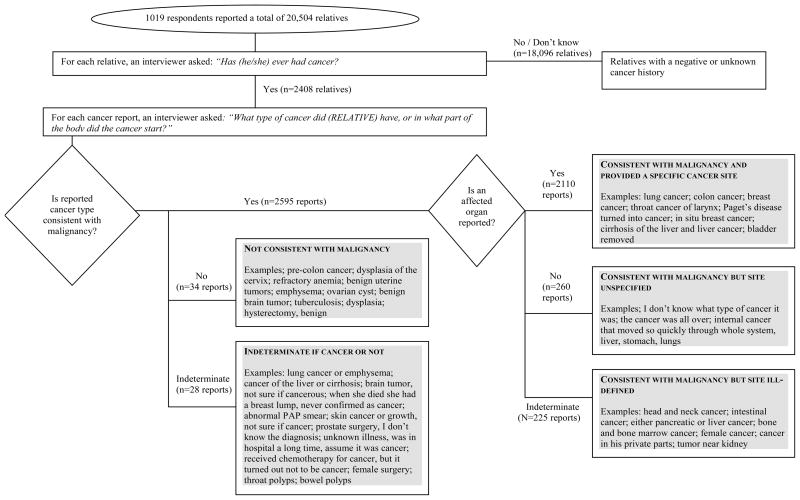
Methods: This telephone survey in Connecticut examined coherence and completeness of reports from 1,019 respondents about 20,504 biological relatives.
Results: Of 2,657 cancer reports, 97.7% were judged consistent with malignancy (versus benign or indeterminate conditions); 79% were site specific, 10.1% had unspecified cancer sites, and 8.6% had "ill-defined" sites. Only 6.1% of relatives had unknown histories. Unknown histories and ambiguous sites were significantly higher for second-degree relatives. The adjusted percentage of first-degree relative reports with ambiguous sites increased with decreasing education and African-American race of survey respondents, and with deceased vital status of relatives. Ambiguous second-degree relative reports were also associated with deceased vital status and with male gender of respondents.
Conclusions: These findings suggest that family history of cancer reports from the general population are generally complete and coherent.
Impact: Strategies are needed to improve site specificity and thus maximize the utility of such information in primary care settings.
Figures
References
-
- Lindor NM, McMaster ML, Lindor CJ, Greene MH National Cancer Institute, Division of Cancer Prevention, Community Oncology and Prevention Trials Research Group. Concise handbook of familial cancer susceptibility syndromes – second edition. J Natl Cancer Inst Monogr. 2008;38:1–93. - PubMed
-
- Noe M, Schroy P, Demierre M, Babayan R, Geller AC. Increased cancer risk for individuals with a family history of prostate cancer, colorectal cancer, and melanoma and their associated screening recommendations and practices. Cancer Causes Control. 2008;19:1–12. - PubMed
-
- US Preventive Services Task Force. Guide to Clinical Preventive Services [Internet] Rockville (MD): Agency for Healthcare Research and Quality; [cited 2008 Jan 23]. Available from: http://www.ahrq.gov/clinic/cps3dix.htm#cancer.
-
- Smith RA, Cokkinides V, Eyre HJ. American Cancer Society guidelines for the early detection of cancer. CA Cancer J Clin. 2006;56:11–25. - PubMed
-
- American Society of Clinical Oncology. American Society of Clinical Oncology policy statement update: genetic testing for cancer susceptibility. J Clin Oncol. 2003;21:2397–2406. - PubMed
Publication types
MeSH terms
Grants and funding
LinkOut - more resources
Full Text Sources
Medical