


Amyloid-beta-derived diffusible ligands cause impaired axonal transport of mitochondria in neurons
- PMID: 20160460
- PMCID: PMC2859232
- DOI: 10.1159/000283484
Amyloid-beta-derived diffusible ligands cause impaired axonal transport of mitochondria in neurons
Abstract
Background: Alzheimer's disease (AD) is the most prevalent form of dementia predominantly affecting the elderly. It is believed that soluble amyloid-beta (Abeta) oligomers are involved in the pathogenesis of AD, yet the underlying mechanisms remain elusive.
Objectives: Emerging evidence suggests that mitochondrial dysfunction likely plays a critical role in Abeta-induced neuronal degeneration. Previously, we demonstrated that Abeta-derived diffusible ligands (ADDLs) induce reduced mitochondrial density in neurites, and we suspect that an impaired mitochondrial trafficking might be involved, which is tested in this study.
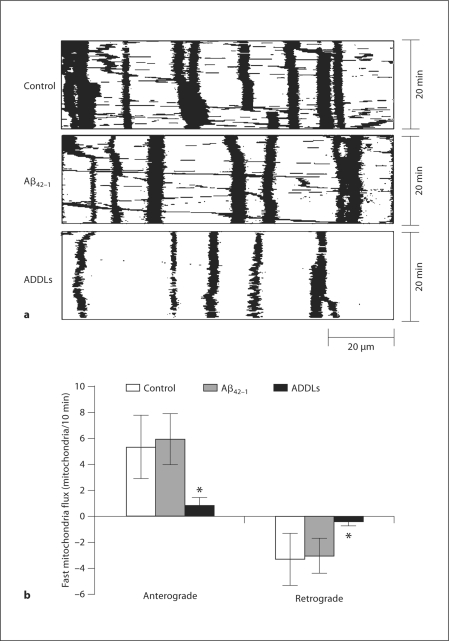
Methods: Using live cell imaging, anterograde and retrograde transport of mitochondria in primary hippocampal neurons treated with sub-lethal doses of ADDLs was measured.
Results: We found that ADDLs induced significant impairment in both anterograde and retrograde transport of mitochondria along axons.
Conclusion: These results suggest that an impaired mitochondrial transport likely contributes to ADDL-induced abnormal mitochondrial distribution and dysfunction and also reinforce the idea that axonal transport is likely involved in AD pathogenesis.
Copyright 2010 S. Karger AG, Basel.
Figures
References
-
- Smith MA. Alzheimer disease. Int Rev Neurobiol. 1998;42:1–54. - PubMed
Publication types
MeSH terms
Substances
Grants and funding
LinkOut - more resources
Full Text Sources
Other Literature Sources
